
TNFRSF4表达的预后意义及预测肝细胞癌中表达的病理组学模型的建立
Prognostic significance of TNFRSF4 expression and development of a pathomics model to predict expression in hepatocellular carcinoma.
作者信息
Yan Zhaoyong, Li Xiang, Li Zeyu, Liu Sinan, Chang Hulin
机构信息
Department of Interventional Radiology, Shaanxi Provincial People's Hospital, Xi'an, 710068, China.
Department of Immunology, School of Basic Medicine, Tongji Medical College, Huazhong University of Science & Technology, Wuhan, 430000, China.
出版信息
Heliyon. 2024 May 24;10(11):e31882. doi: 10.1016/j.heliyon.2024.e31882. eCollection 2024 Jun 15.
BACKGROUND
TNFRSF4 plays a significant role in cancer progression, especially in hepatocellular carcinoma (HCC). This study aims to investigate the prognostic value of TNFRSF4 expression in patients with HCC and to develop a predictive pathomics model for its expression.
METHODS
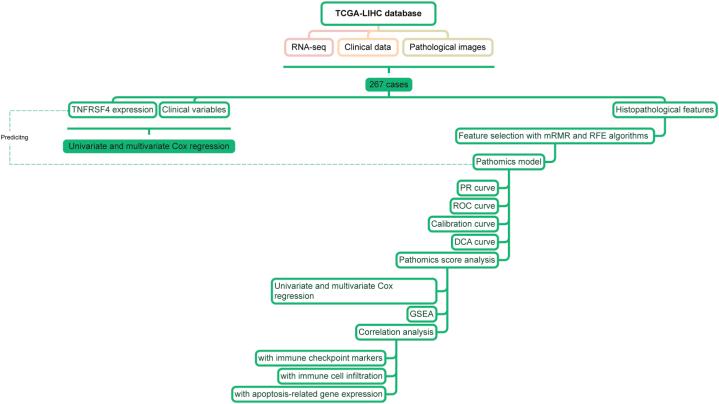
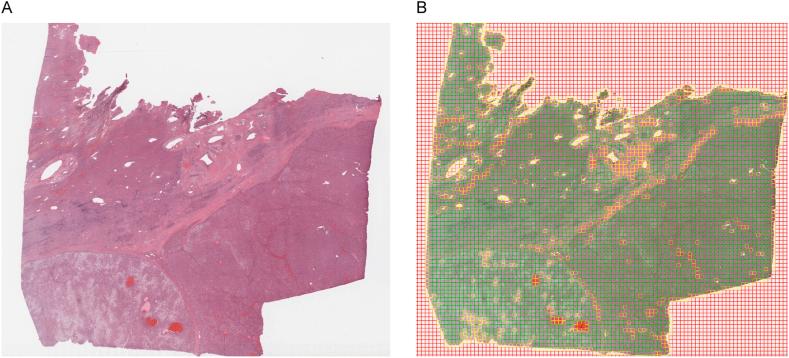
A cohort of patients with HCC retrieved from the TCGA database was analyzed using RNA-seq analysis to determine TNFRSF4 expression and its impact on overall survival (OS). Additionally, hematoxylin-eosin staining analysis was performed to construct a pathomics model for predicting TNFRSF4 expression. Then, pathway enrichment analysis was conducted, immune checkpoint markers were investigated, and immune cell infiltration was examined to explore the underlying biological mechanism of the pathomics score.
RESULTS
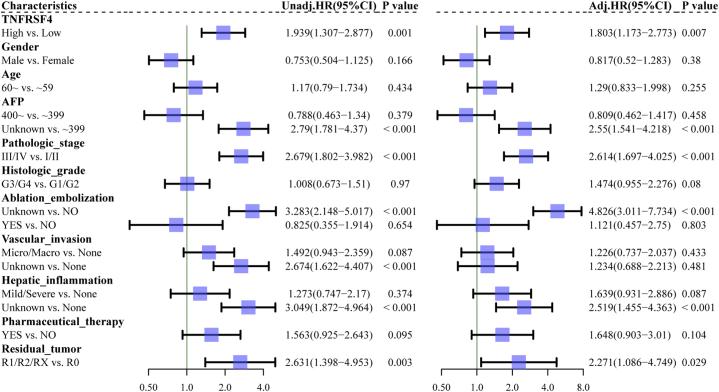
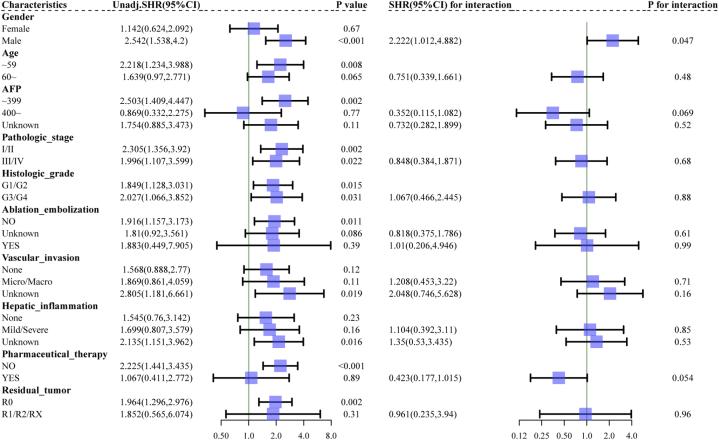
TNFRSF4 expression was significantly higher in tumor tissues than in normal tissues. TNFRSF4 expression also exhibited significant correlations with various clinical variables, including pathologic stage III/IV and R1/R2/RX residual tumor. Furthermore, elevated TNFRSF4 expression was associated with unfavorable OS. Interestingly, in the subgroup analysis, elevated TNFRSF4 expression was identified as a significant risk factor for OS in male patients. The newly developed pathomics model successfully predicted TNFRSF4 expression with good performance and revealed a significant association between high pathomics scores and worse OS. In male patients, high pathomics scores were also associated with a higher risk of mortality. Moreover, pathomics scores were also involved in specific hallmarks, immune-related characteristics, and apoptosis-related genes in HCC, such as epithelial-mesenchymal transition, Tregs, and BAX expression.
CONCLUSIONS
Our findings suggest that TNFRSF4 expression and the newly devised pathomics scores hold potential as prognostic markers for OS in patients with HCC. Additionally, gender influenced the association between these markers and patient outcomes.
背景
肿瘤坏死因子受体超家族成员4(TNFRSF4)在癌症进展中发挥重要作用,尤其是在肝细胞癌(HCC)中。本研究旨在探讨TNFRSF4表达在HCC患者中的预后价值,并建立其表达的预测病理组学模型。
方法
使用RNA测序分析对从TCGA数据库中检索出的一组HCC患者进行分析,以确定TNFRSF4表达及其对总生存期(OS)的影响。此外,进行苏木精-伊红染色分析以构建预测TNFRSF4表达的病理组学模型。然后,进行通路富集分析,研究免疫检查点标志物,并检测免疫细胞浸润,以探索病理组学评分的潜在生物学机制。
结果
肿瘤组织中TNFRSF4表达明显高于正常组织。TNFRSF4表达还与各种临床变量显著相关,包括病理分期III/IV期和R1/R2/RX残留肿瘤。此外,TNFRSF4表达升高与不良的OS相关。有趣的是,在亚组分析中,TNFRSF4表达升高被确定为男性患者OS的显著危险因素。新开发的病理组学模型成功地以良好的性能预测了TNFRSF4表达,并揭示了高病理组学评分与较差的OS之间的显著关联。在男性患者中,高病理组学评分也与更高的死亡风险相关。此外,病理组学评分还涉及HCC中的特定特征、免疫相关特征和凋亡相关基因,如上皮-间质转化、调节性T细胞和BAX表达。
结论
我们的研究结果表明,TNFRSF4表达和新设计的病理组学评分有望作为HCC患者OS的预后标志物。此外,性别影响了这些标志物与患者预后之间的关联。




 Zotero 插件