
中心血管代谢指数与非酒精性脂肪肝和纤维化的关系。
Association between the cardiometabolic index and NAFLD and fibrosis.
机构信息
Department of Cardio Surgery Intensive Care Unit, Ningbo Medical Centre Li Huili Hospital, Ningbo, China.
出版信息
Sci Rep. 2024 Jun 8;14(1):13194. doi: 10.1038/s41598-024-64034-3.
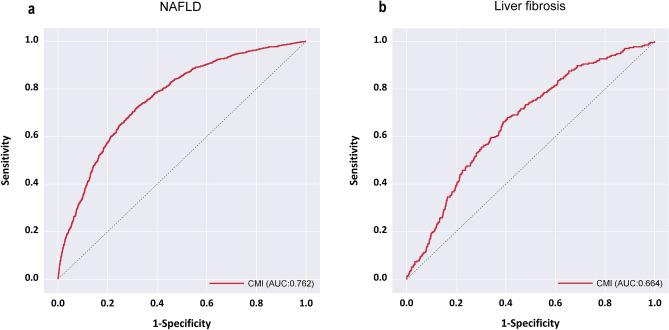
Composed of obesity and lipid parameters, the cardiometabolic index (CMI) has emerged as a novel diagnostic tool. Originally developed for diabetes diagnosis, its application has expanded to identifying patients with cardiovascular diseases, such as atherosclerosis and hypertension. However, the relationship between CMI and non-alcoholic fatty liver disease (NAFLD) and liver fibrosis in the US population remains unclear. This cross-sectional study analyzed data from the National Health and Nutrition Examination Survey (NHANES) spanning 2017-2020, involving 2996 participants aged 20 years or older. Vibration controlled transient elastography using a FibroScan® system (model 502, V2 Touch) with controlled attenuation parameter measurements identified NAFLD at a threshold of ≥ 274 dB/m, while liver stiffness measurement (LSM) results (median, ≥ 8.2 kPa) indicated fibrosis. A multifactorial logistic regression model explored the relationship between CMI and NAFLD and fibrosis. The effectiveness of CMI in detecting NAFLD and liver fibrosis was assessed through receiver operating characteristic curve analysis. Controlling for potential confounders, CMI showed a significant positive association with NAFLD (adjusted OR = 1.44, 95% CI 1.44-1.45) and liver fibrosis (adjusted OR = 1.84, 95% CI 1.84-1.85). The Areas Under the Curve for predicting NAFLD and fibrosis were 0.762 (95% CI 0.745 ~ 0.779) and 0.664(95% CI 0.633 ~ 0.696), respectively, with optimal cut-off values of 0.462 and 0.527. There is a positive correlation between CMI and NAFLD and fibrosis, which is a suitable and simple predictor of NAFLD and fibrosis.
由肥胖和脂质参数组成的代谢指标 (CMI) 已成为一种新的诊断工具。它最初是为糖尿病诊断而开发的,但其应用已扩展到识别心血管疾病患者,如动脉粥样硬化和高血压。然而,CMI 与美国人群中非酒精性脂肪性肝病 (NAFLD) 和肝纤维化之间的关系尚不清楚。本横断面研究分析了 2017-2020 年国家健康和营养检查调查 (NHANES) 的数据,涉及 2996 名 20 岁或以上的参与者。使用 FibroScan®系统(型号 502,V2 Touch)进行振动控制瞬态弹性成像,采用控制衰减参数测量,在阈值≥274dB/m 时确定 NAFLD,而肝硬度测量(LSM)结果(中位数,≥8.2kPa)表示纤维化。多因素逻辑回归模型探讨了 CMI 与 NAFLD 和纤维化之间的关系。通过接收者操作特征曲线分析评估 CMI 检测 NAFLD 和肝纤维化的效果。在控制潜在混杂因素后,CMI 与 NAFLD(调整后的 OR=1.44,95%CI 1.44-1.45)和纤维化(调整后的 OR=1.84,95%CI 1.84-1.85)呈显著正相关。预测 NAFLD 和纤维化的曲线下面积分别为 0.762(95%CI 0.7450.779)和 0.664(95%CI 0.6330.696),最佳截断值分别为 0.462 和 0.527。CMI 与 NAFLD 和纤维化呈正相关,是 NAFLD 和纤维化的合适且简单的预测指标。

 Zotero 插件