
基于狄克逊MRI的眼外肌、眶内脂肪和泪腺定量参数用于甲状腺相关性眼病的分期
Dixon MRI-based quantitative parameters of extraocular muscles, intraorbital fat, and lacrimal glands for staging thyroid-associated ophthalmopathy.
作者信息
Pu Xiong-Ying, Chen Lu, Hu Hao, Wu Qian, Jiang Wen-Hao, Lu Jin-Ling, Chen Huan-Huan, Xu Xiao-Quan, Wu Fei-Yun
机构信息
Department of Radiology, The First Affiliated Hospital of Nanjing Medical University, Nanjing, China.
Department of Endocrinology, The First Affiliated Hospital of Nanjing Medical University, Nanjing, China.
出版信息
Insights Imaging. 2024 Jun 9;15(1):136. doi: 10.1186/s13244-024-01693-w.
OBJECTIVE
To investigate the value of Dixon magnetic resonance imaging (MRI)-based quantitative parameters of extraocular muscles (EOMs), intraorbital fat (IF), and lacrimal glands (LGs) in staging patients with thyroid-associated ophthalmopathy (TAO).
METHODS
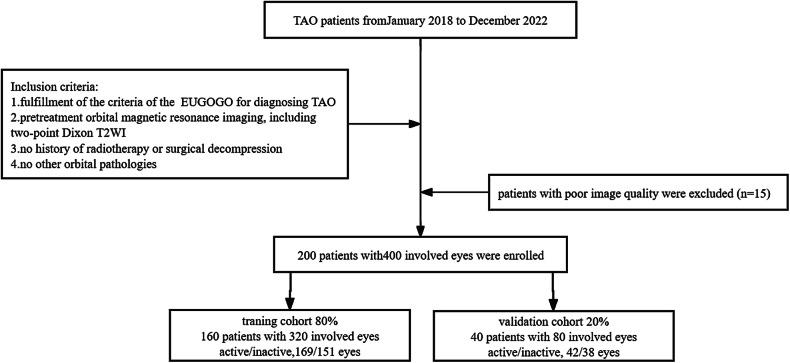
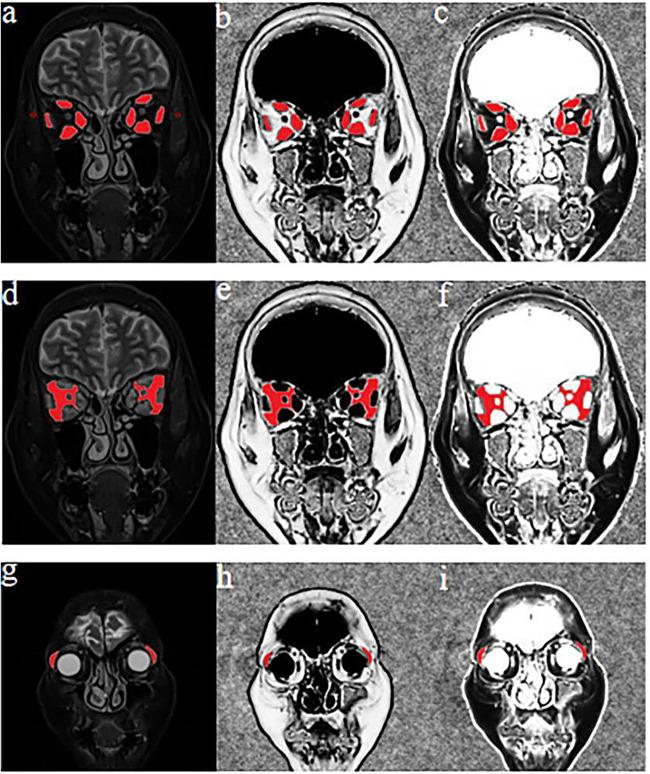
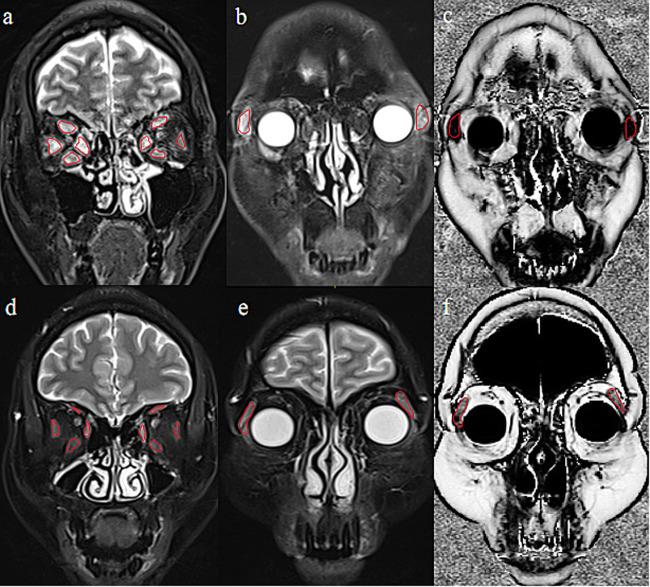
Two hundred patients with TAO (211 active and 189 inactive eyes) who underwent Dixon MRI for pretreatment evaluation were retrospectively enrolled and divided into training (169 active and 151 inactive eyes) and validation (42 active and 38 inactive eyes) cohorts. The maximum, mean, and minimum values of the signal intensity ratio (SIR), fat fraction (FF), and water fraction (WF) of EOMs, IF, and LGs were measured and compared between the active and inactive groups in the training cohort. Binary logistic regression analysis, receiver operating characteristic curve analysis, and the Delong test were used for further statistical analyses, as appropriate.
RESULTS
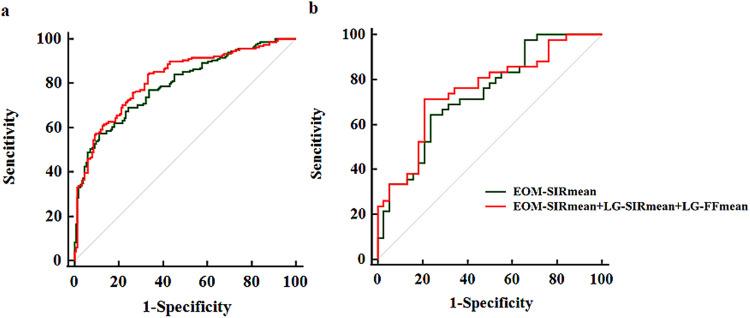
Compared with inactive TAOs, active TAOs demonstrated significantly greater EOM-SIR, EOM-SIR, EOM-SIR, IF-SIR, IF-SIR, LG-SIR, LG-SIR, EOM-WF, EOM-WF, IF-WF, IF-WF, and LG-WF and lower EOM-FF, EOM-FF, IF-FF, IF-FF, and LG-FF values (all p < 0.05). The EOM-SIR, LG-SIR, and LG-FF values were independently associated with active TAO (all p < 0.05). The combination of the EOM-SIR, LG-SIR, and LG-FF values showed better performance than the EOM-SIR value alone in staging TAO in both the training (AUC, 0.820 vs 0.793; p = 0.016) and validation (AUC, 0.751 vs 0.733, p = 0.341) cohorts.
CONCLUSION
Dixon MRI-based parameters of EOMs, LGs, and IF are useful for differentiating active from inactive TAO. The integration of multiple parameters can further improve staging performance.
CRITICAL RELEVANCE STATEMENT
In this study, the authors explored the combined value of quantitative parameters of EOMs, IF, and LGs derived from Dixon MRI in staging TAO patients, which can support the establishment of a proper therapeutic plan.
KEY POINTS
The quantitative parameters of EOMs, LGs, and IF are useful for staging TAO. The EOM-SIR, LG-SIR, and LG-FF values were found to independently correlate with active TAO. Joint evaluation of orbital tissue improved the ability to assess TAO activity.
目的
探讨基于狄克逊磁共振成像(MRI)的眼外肌(EOM)、眶内脂肪(IF)和泪腺(LG)定量参数在甲状腺相关眼病(TAO)患者分期中的价值。
方法
回顾性纳入200例接受狄克逊MRI进行预处理评估的TAO患者(211只活动期眼和189只非活动期眼),并分为训练组(169只活动期眼和151只非活动期眼)和验证组(42只活动期眼和38只非活动期眼)。测量训练组活动期和非活动期组EOM、IF和LG的信号强度比(SIR)、脂肪分数(FF)和水分数(WF)的最大值、平均值和最小值,并进行比较。酌情使用二元逻辑回归分析、受试者工作特征曲线分析和德龙检验进行进一步统计分析。
结果
与非活动期TAO相比,活动期TAO的EOM-SIR、EOM-SIR、EOM-SIR、IF-SIR、IF-SIR、LG-SIR、LG-SIR、EOM-WF、EOM-WF、IF-WF、IF-WF和LG-WF显著更高,而EOM-FF、EOM-FF、IF-FF、IF-FF和LG-FF值更低(均p<0.05)。EOM-SIR、LG-SIR和LG-FF值与活动期TAO独立相关(均p<0.05)。在训练组(AUC,0.820对0.793;p=0.016)和验证组(AUC,0.751对0.733,p=0.341)中,EOM-SIR、LG-SIR和LG-FF值的组合在TAO分期中的表现均优于单独的EOM-SIR值。
结论
基于狄克逊MRI的EOM、LG和IF参数有助于区分活动期和非活动期TAO。多个参数的整合可进一步提高分期性能。
关键相关性声明
在本研究中,作者探讨了狄克逊MRI得出的EOM、IF和LG定量参数在TAO患者分期中的综合价值,这有助于制定合适的治疗方案。
要点
EOM、LG和IF的定量参数对TAO分期有用。发现EOM-SIR、LG-SIR和LG-FF值与活动期TAO独立相关。对眼眶组织进行联合评估可提高评估TAO活动的能力。
 Zotero 插件