
黄酮类化合物槲皮素可降低培养的人肺细胞中ACE2和TMPRSS2的表达,但不影响SARS-CoV-2感染。
The flavonoid quercetin decreases ACE2 and TMPRSS2 expression but not SARS-CoV-2 infection in cultured human lung cells.
作者信息
Houghton Michael James, Balland Eglantine, Gartner Matthew James, Thomas Belinda Jane, Subbarao Kanta, Williamson Gary
机构信息
Department of Nutrition, Dietetics and Food, Monash University, BASE Facility, Notting Hill, VIC, Australia.
Victorian Heart Institute, Monash University, Victorian Heart Hospital, Clayton, VIC, Australia.
出版信息
Biofactors. 2024 Nov-Dec;50(6):1268-1286. doi: 10.1002/biof.2084. Epub 2024 Jun 17.
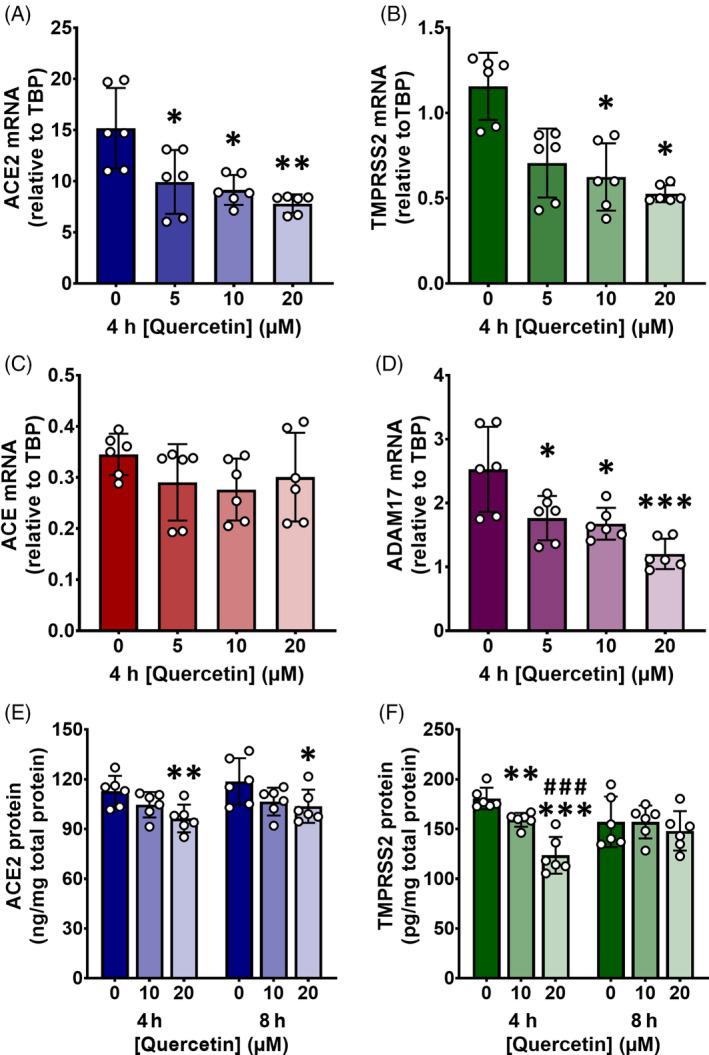
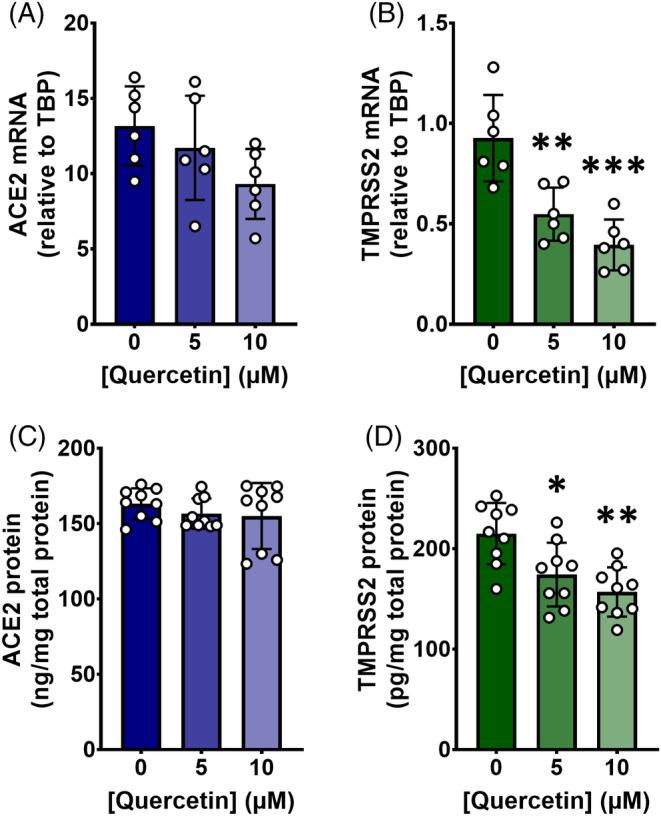
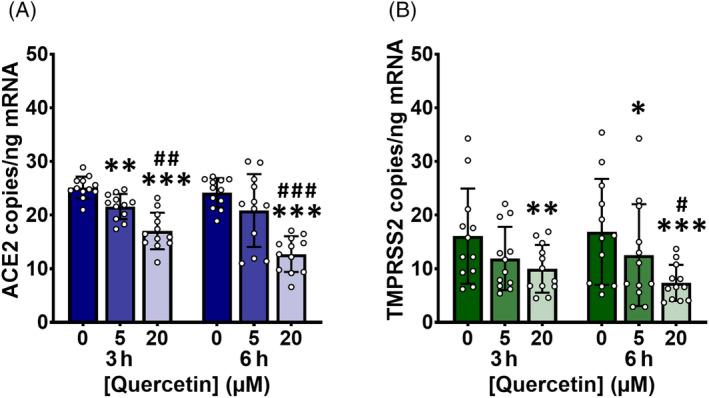
Severe acute respiratory syndrome coronavirus 2 (SARS-CoV-2) binds to angiotensin-converting enzyme 2 (ACE2) on host cells, via its spike protein, and transmembrane protease, serine 2 (TMPRSS2) cleaves the spike-ACE2 complex to facilitate virus entry. As rate-limiting steps for virus entry, modulation of ACE2 and/or TMPRSS2 may decrease SARS-CoV-2 infectivity and COVID-19 severity. In silico modeling suggested the natural bioactive flavonoid quercetin can bind to ACE2 and a recent randomized clinical trial demonstrated that oral supplementation with quercetin increased COVID-19 recovery. A range of cultured human cells were assessed for co-expression of ACE2 and TMPRSS2. Immortalized Calu-3 lung cells, cultured and matured at an air-liquid interface (Calu-3-ALIs), were established as the most appropriate. Primary bronchial epithelial cells (PBECs) were obtained from healthy adult males (N = 6) and cultured under submerged conditions to corroborate the outcomes. Upon maturation or reaching 80% confluence, respectively, the Calu-3-ALIs and PBECs were treated with quercetin, and mRNA and protein expression were assessed by droplet digital PCR and ELISA, respectively. SARS-CoV-2 infectivity, and the effects of pre- and co-treatment with quercetin, was assessed by median tissue culture infectious dose assay. Quercetin dose-dependently decreased ACE2 and TMPRSS2 mRNA and protein in both Calu-3-ALIs and PBECs after 4 h, while TMPRSS2 remained suppressed in response to prolonged treatment with lower doses (twice daily for 3 days). Quercetin also acutely decreased ADAM17 mRNA, but not ACE, in Calu-3-ALIs, and this warrants further investigation. Calu-3-ALIs, but not PBECs, were successfully infected with SARS-CoV-2; however, quercetin had no antiviral effect, neither directly nor indirectly through downregulation of ACE2 and TMPRSS2. Calu-3-ALIs were reaffirmed to be an optimal cell model for research into the regulation of ACE2 and TMPRSS2, without the need for prior genetic modification, and will prove valuable in future coronavirus and respiratory infectious disease work. However, our data demonstrate that a significant decrease in the expression of ACE2 and TMPRSS2 by a promising prophylactic candidate may not translate to infection prevention.
严重急性呼吸综合征冠状病毒2(SARS-CoV-2)通过其刺突蛋白与宿主细胞上的血管紧张素转换酶2(ACE2)结合,跨膜蛋白酶丝氨酸2(TMPRSS2)切割刺突-ACE2复合物以促进病毒进入。作为病毒进入的限速步骤,调节ACE2和/或TMPRSS2可能会降低SARS-CoV-2的感染性和新冠肺炎的严重程度。计算机模拟表明,天然生物活性类黄酮槲皮素可以与ACE2结合,最近一项随机临床试验表明,口服补充槲皮素可提高新冠肺炎的康复率。对一系列培养的人类细胞进行了ACE2和TMPRSS2共表达的评估。永生化的Calu-3肺细胞在气液界面培养和成熟(Calu-3-ALIs),被确定为最合适的细胞。从健康成年男性(N = 6)获取原代支气管上皮细胞(PBECs),并在浸没条件下培养以证实结果。分别在成熟或达到80%汇合度时,用槲皮素处理Calu-3-ALIs和PBECs,分别通过液滴数字PCR和ELISA评估mRNA和蛋白质表达。通过半数组织培养感染剂量测定评估SARS-CoV-2的感染性以及槲皮素预处理和共处理的效果。4小时后,槲皮素在Calu-3-ALIs和PBECs中均呈剂量依赖性降低ACE2和TMPRSS2的mRNA和蛋白质水平,而较低剂量(每日两次,共3天)的长期处理使TMPRSS2仍受到抑制。槲皮素还可急性降低Calu-3-ALIs中ADAM17的mRNA水平,但不影响ACE的水平,这值得进一步研究。Calu-3-ALIs成功感染了SARS-CoV-2,而PBECs未感染;然而,槲皮素无论是直接还是通过下调ACE2和TMPRSS2均无抗病毒作用。Calu-3-ALIs被再次确认为研究ACE2和TMPRSS2调节的最佳细胞模型,无需事先进行基因改造,在未来的冠状病毒和呼吸道传染病研究中将具有重要价值。然而,我们的数据表明,一种有前景的预防性候选药物使ACE2和TMPRSS2表达显著降低可能无法转化为感染预防效果。

 Zotero 插件