
双(频哪醇合)二硼促进的镍催化的烷基亲电试剂的还原芳基化/乙烯基化反应
Bis(pinacolato)diboron-Enabled Ni-Catalyzed Reductive Arylation/Vinylation of Alkyl Electrophiles.
作者信息
Sun Deli, Gong Yuxin, Wu Yu, Chen Yunrong, Gong Hegui
机构信息
School of Resources and Environmental Engineering, Shanghai Polytechnic University, No. 2360 Jinhai Road, Shanghai, 201209, China.
Center for Supramolecular Chemistry and Catalysis, Department of Chemistry, Shanghai University, Shanghai, 200444, China.
出版信息
Adv Sci (Weinh). 2024 Aug;11(31):e2404301. doi: 10.1002/advs.202404301. Epub 2024 Jun 17.
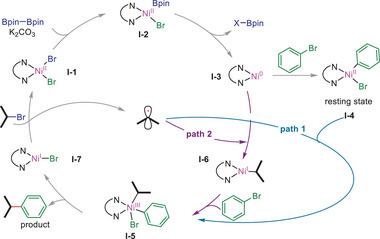
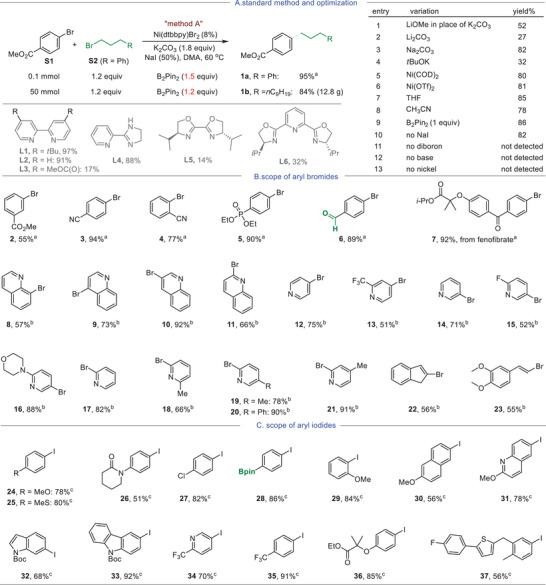
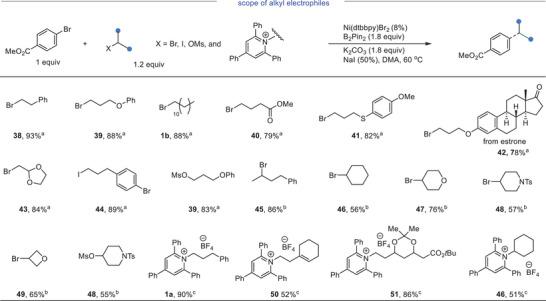
Herein, the use of economically and environmentally friendly bis(pinacolato)diboron (BPin) is described as a non-metallic reductant in mediating Ni-catalyzed C(sp)-C(sp) reductive cross-coupling of alkyl electrophiles with aryl/vinyl halides. This method exhibits excellent suitability for heteroaryl halides and alkyl halides/Katritzky salts. The present study is compatible with an in situ halogenation of alcohol method, allowing for selective mono-functionalization of diols and bio-relevant alcohols (e.g., carbohydrates). The use of BPin shows potential for easy scalability without introducing additional metal impurities into the products. It is observed for the first time in the realm of cross-electrophile coupling chemistry that BPin can sever as a reductant to reduce Ni to Ni. This mechanistic insight may inspire the development of new reductive bond-forming methodologies that can otherwise be difficult to achieve with a metal reductant.
在此,描述了使用经济且环境友好的双(频哪醇合)二硼(BPin)作为非金属还原剂,介导镍催化的烷基亲电试剂与芳基/乙烯基卤化物的C(sp)-C(sp)还原交叉偶联反应。该方法对杂芳基卤化物以及烷基卤化物/卡特里茨基盐表现出优异的适用性。本研究与醇的原位卤化方法兼容,可实现二醇和与生物相关的醇(如碳水化合物)的选择性单官能化。使用BPin显示出易于扩大规模的潜力,且不会在产物中引入额外的金属杂质。在交叉亲电试剂偶联化学领域首次观察到,BPin可作为还原剂将Ni还原为Ni。这一机理见解可能会激发新型还原成键方法的开发,而这些方法用金属还原剂难以实现。



 Zotero 插件