
一项评估 Fianlimab(一种人淋巴细胞激活基因-3[LAG-3]单克隆抗体)联合 Cemiplimab 治疗晚期黑色素瘤的 I 期研究。
Phase I Study of Fianlimab, a Human Lymphocyte Activation Gene-3 (LAG-3) Monoclonal Antibody, in Combination With Cemiplimab in Advanced Melanoma.
机构信息
The Angeles Clinical and Research Institute, a Cedars-Sinai Affiliate, Los Angeles, CA.
University of Colorado Denver Cancer Center, Aurora, CO.
出版信息
J Clin Oncol. 2024 Aug 20;42(24):2928-2938. doi: 10.1200/JCO.23.02172. Epub 2024 Jun 20.
PURPOSE
Coblockade of lymphocyte activation gene-3 (LAG-3) and PD-1 receptors could provide significant clinical benefit for patients with advanced melanoma. Fianlimab and cemiplimab are high-affinity, human, hinge-stabilized IgG4 monoclonal antibodies, targeting LAG-3 and PD-1, respectively. We report results from a first-in-human phase-I study of fianlimab and cemiplimab safety and efficacy in various malignancies including advanced melanoma.
METHODS
Patients with advanced melanoma were eligible for enrollment into four cohorts: three for patients without and one for patients with previous anti-PD-1 therapy in the advanced disease setting. Patients were treated with fianlimab 1,600 mg and cemiplimab 350 mg intravenously once every 3 weeks for up to 51 weeks, with an optional additional 51 weeks if clinically indicated. The primary end point was objective response rate (ORR) per RECIST 1.1 criteria.
RESULTS
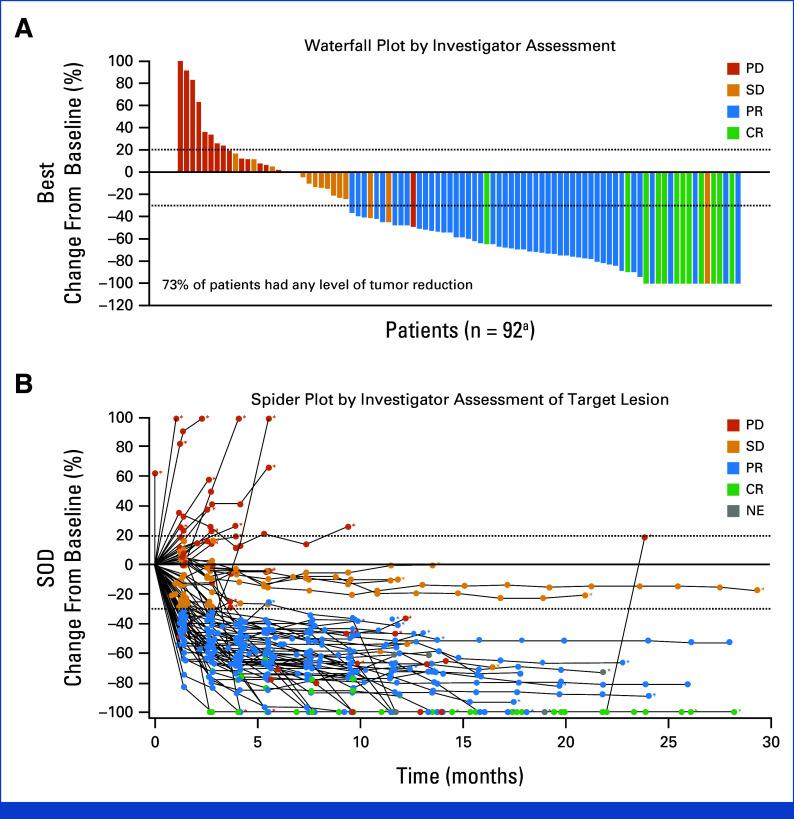
ORRs were 63% for patients with anti-PD-1-naïve melanoma (cohort-6; n = 40; median follow-up 20.8 months), 63% for patients with systemic treatment-naïve melanoma (cohort-15; n = 40; 11.5 months), and 56% for patients with previous neo/adjuvant treatment melanoma (cohort-16; n = 18, 9.7 months). At a median follow-up of 12.6 months for the combined cohorts (6 + 15 + 16), the ORR was 61.2% and the median progression-free survival (mPFS) 13.3 months (95% CI, 7.5 to not estimated [NE]). In patients (n = 13) with previous anti-PD-1 adjuvant therapy, ORR was 61.5% and mPFS 12 months (95% CI, 1.4 to NE). ORR in patients with previous anti-PD-1 therapy for advanced disease (n = 15) was 13.3% and mPFS 1.5 months (95% CI, 1.3 to 7.7). Treatment-emergent and treatment-related adverse events ≥grade 3 (G3) were observed in 44% and 22% of patients, respectively. Except for increased incidence of adrenal insufficiency (12%-G1-4, 4%-G3-4), no new safety signals were recorded.
CONCLUSION
The current results show a promising benefit-risk profile of fianlimab/cemiplimab combination for patients with advanced melanoma, including those with previous anti-PD-1 therapy in the adjuvant, but not advanced, setting.
目的
淋巴细胞激活基因-3(LAG-3)和 PD-1 受体的共封锁可能为晚期黑色素瘤患者提供显著的临床获益。Fianlimab 和 cemiplimab 是高亲和力的、人源的、铰链稳定的 IgG4 单克隆抗体,分别靶向 LAG-3 和 PD-1。我们报告了一项 fianlimab 和 cemiplimab 在各种恶性肿瘤中(包括晚期黑色素瘤)的安全性和疗效的首次人体 I 期研究结果。
方法
晚期黑色素瘤患者有资格入组四个队列:三个队列为晚期疾病中无抗 PD-1 治疗史的患者,一个队列为有抗 PD-1 治疗史的患者。患者接受 fianlimab 1600mg 和 cemiplimab 350mg 静脉输注,每 3 周一次,最多 51 周,如有临床需要,可额外延长 51 周。主要终点为根据 RECIST 1.1 标准评估的客观缓解率(ORR)。
结果
抗 PD-1 初治黑色素瘤患者(队列 6;n=40;中位随访 20.8 个月)的 ORR 为 63%,系统治疗初治黑色素瘤患者(队列 15;n=40;11.5 个月)的 ORR 为 63%,先前新辅助/辅助治疗黑色素瘤患者(队列 16;n=18;9.7 个月)的 ORR 为 56%。在联合队列(6+15+16)的中位随访 12.6 个月时,ORR 为 61.2%,中位无进展生存期(mPFS)为 13.3 个月(95%CI,7.5-NE)。在先前接受抗 PD-1 辅助治疗的 13 名患者(n=13)中,ORR 为 61.5%,mPFS 为 12 个月(95%CI,1.4-NE)。先前接受抗 PD-1 治疗晚期疾病的患者(n=15)的 ORR 为 13.3%,mPFS 为 1.5 个月(95%CI,1.3-7.7)。≥3 级(G3)的治疗出现和治疗相关不良事件分别在 44%和 22%的患者中观察到。除肾上腺功能不全发生率增加(12%-G1-4,4%-G3-4)外,未记录到新的安全性信号。
结论
目前的结果显示,Fianlimab/cemiplimab 联合治疗晚期黑色素瘤患者具有良好的获益风险比,包括先前在辅助治疗中(但不在晚期)接受过抗 PD-1 治疗的患者。

 Zotero 插件