
解析肿瘤微环境中的T细胞耗竭:为创新实体瘤疗法铺平道路。
Deciphering T-cell exhaustion in the tumor microenvironment: paving the way for innovative solid tumor therapies.
作者信息
Nair Reshmi, Somasundaram Veena, Kuriakose Anshu, Krishn Shiv Ram, Raben David, Salazar Rachel, Nair Pradip
机构信息
Syngene International Limited, Bengaluru, India.
Bicara Therapeutics, Boston, MA, United States.
出版信息
Front Immunol. 2025 Apr 1;16:1548234. doi: 10.3389/fimmu.2025.1548234. eCollection 2025.
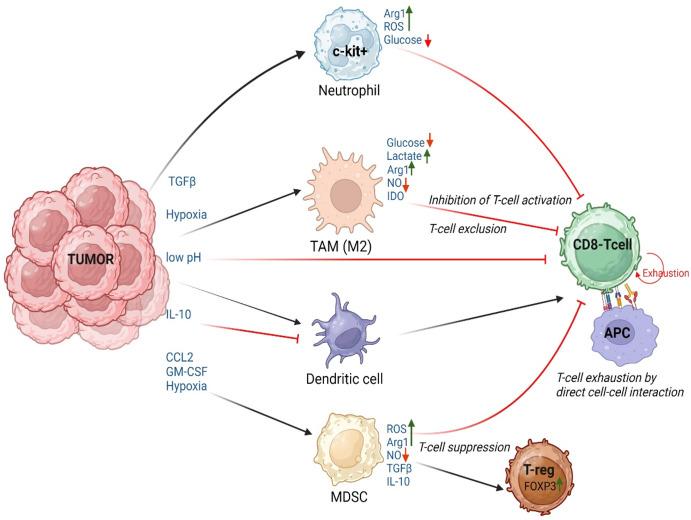
In solid tumors, the tumor microenvironment (TME) is a complex mix of tumor, immune, stromal cells, fibroblasts, and the extracellular matrix. Cytotoxic T lymphocytes (CTLs) constitute a fraction of immune cells that may infiltrate into the TME. The primary function of these T-cells is to detect and eliminate tumor cells. However, due to the immunosuppressive factors present in the TME primarily mediated by Myeloid-Derived Suppressor Cells (MDSCs), Tumor associated macrophages (TAMs), Cancer Associated Fibroblasts (CAFs) as well as the tumor cells themselves, T-cells fail to differentiate into effector cells or become dysfunctional and are unable to eliminate the tumor. In addition, chronic antigen stimulation within the TME also leads to a phenomenon, first identified in chronic lymphocytic choriomeningitis virus (LCMV) infection in mice, where the T-cells become exhausted and lose their effector functions. Exhausted T-cells (Tex) are characterized by the presence of remarkably conserved inhibitory receptors, transcription and signaling factors and the downregulation of key effector molecules. Tex cells have been identified in various malignancies, including melanoma, colorectal and hepatocellular cancers. Recent studies have indicated novel strategies to reverse T-cell exhaustion. These include checkpoint inhibitor blockade targeting programmed cell death protein 1 (PD-1), T-cell immunoglobulin and mucin-domain containing-3 (Tim-3), cytotoxic T-lymphocyte associated protein 4 (CTLA-4), or combinations of different immune checkpoint therapies (ICTs) or combination of ICTs with cytokine co-stimulation. In this review, we discuss aspects of T-cell dysfunction within the TME with a focus on T-cell exhaustion. We believe that gaining insight into the mechanisms of T-cell exhaustion within the TME of human solid tumors will pave the way for developing therapeutic strategies to target and potentially re-invigorate exhausted T-cells in cancer.
在实体瘤中,肿瘤微环境(TME)是肿瘤细胞、免疫细胞、基质细胞、成纤维细胞和细胞外基质的复杂混合物。细胞毒性T淋巴细胞(CTL)是可能浸润到TME中的一部分免疫细胞。这些T细胞的主要功能是检测和消除肿瘤细胞。然而,由于TME中存在主要由髓系来源的抑制细胞(MDSC)、肿瘤相关巨噬细胞(TAM)、癌症相关成纤维细胞(CAF)以及肿瘤细胞本身介导的免疫抑制因子,T细胞无法分化为效应细胞或功能失调,从而无法消除肿瘤。此外,TME内的慢性抗原刺激还会导致一种现象,这种现象最早在小鼠慢性淋巴细胞性脉络丛脑膜炎病毒(LCMV)感染中被发现,即T细胞会耗竭并失去其效应功能。耗竭性T细胞(Tex)的特征是存在高度保守的抑制性受体、转录和信号因子以及关键效应分子的下调。Tex细胞已在多种恶性肿瘤中被鉴定出来,包括黑色素瘤、结直肠癌和肝细胞癌。最近的研究表明了逆转T细胞耗竭的新策略。这些策略包括针对程序性细胞死亡蛋白1(PD-1)、含T细胞免疫球蛋白和粘蛋白结构域3(Tim-3)、细胞毒性T淋巴细胞相关蛋白4(CTLA-4)的检查点抑制剂阻断,或不同免疫检查点疗法(ICT)的联合使用,或ICT与细胞因子共刺激的联合使用。在这篇综述中,我们讨论了TME内T细胞功能障碍的各个方面,重点是T细胞耗竭。我们相信,深入了解人类实体瘤TME中T细胞耗竭的机制将为开发靶向并可能使癌症中耗竭的T细胞恢复活力的治疗策略铺平道路。


 Zotero 插件