
免疫疗法在肾癌中对胸腺嘧啶二聚体和WT1抗原的应用:一项比较统计分析。
Immunotherapy Applications for Thymine Dimers and WT1 Antigen in Renal Cancers: A Comparative Statistical Analysis.
作者信息
Latcu Silviu Constantin, Bardan Razvan, Cumpanas Alin Adrian, Barbos Vlad, Baderca Flavia, Gaje Pusa Nela, Ceausu Raluca Amalia, Comsa Serban, Dumitru Cristina-Stefania, Dumache Raluca, Cut Talida Georgiana, Lazureanu Voichita Elena, Petrica Ligia
机构信息
Doctoral School, Victor Babes University of Medicine and Pharmacy Timisoara, E. Murgu Square, No. 2, 300041 Timisoara, Romania.
Department XV, Discipline of Urology, Victor Babes University of Medicine and Pharmacy Timisoara, E. Murgu Square, No. 2, 300041 Timisoara, Romania.
出版信息
J Pers Med. 2024 May 23;14(6):557. doi: 10.3390/jpm14060557.
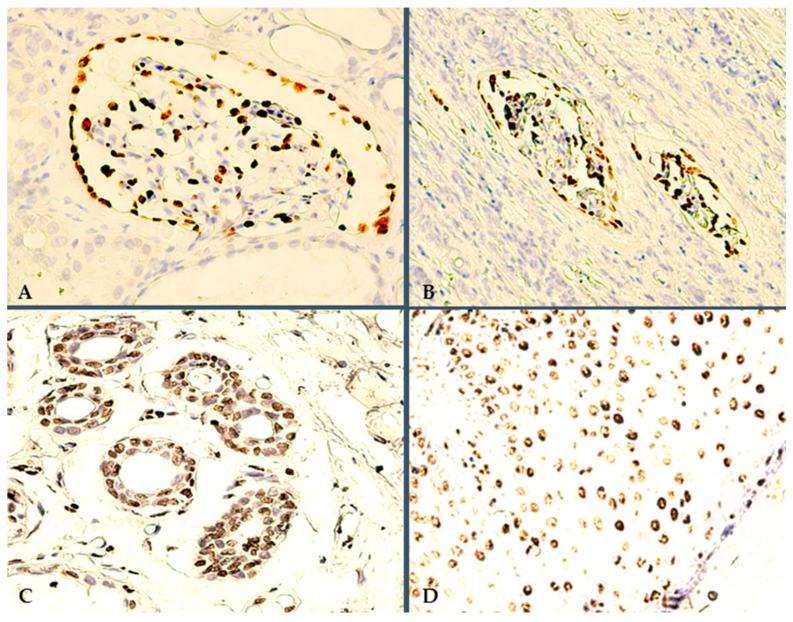
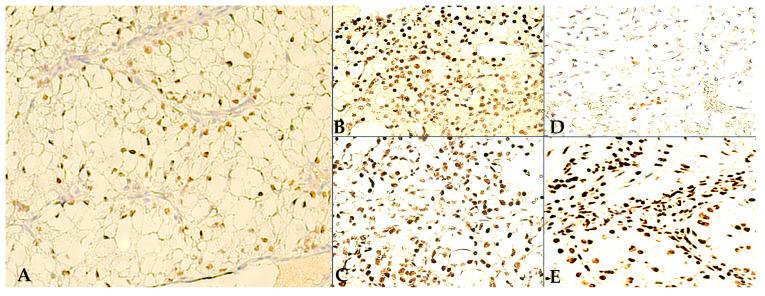
Renal cell carcinoma (RCC) remains incurable in advanced stages. Biomarkers have proven to be quite useful in cancer therapeutics. Herein, we provide a comparative/integrative statistical analysis of seminal immunohistochemistry (IHC) findings for Wilms' Tumor 1 antigen (WT1) and thymine dimers (TDs), emerging as atypical, yet promising, potential biomarkers for RCCs. We assessed WT1/TD reactivity in adult RCC tumor cells, tumor microenvironment (TME), and tumor-adjacent healthy renal tissue (HRT). WT1 positivity was scarce and strictly nuclear in tumor cells, whereas TD-reactive tumor tissues were prevalent. We report statistically significant positive correlations between the density of reactive RCC cellularity and the intensity of nuclear staining for both biomarkers (WT1 - rho = 0.341, -value = 0.036; TDs - rho = 0.379, -value = 0.002). RCC stromal TME TD-positivity was much more frequent than WT1 reactivity, apparently proportional to that of the proper RCC cellularity and facilitated by extensive RCC inflammatory infiltration. TDs exhibited nuclear reactivity for most TME cell lines, while RCC TME WT1 expression was rare and inconsistent. In HRTs, TDs were entirely restricted to renal tubular cells, the likely cellular progenitor of most conventional RCC subtypes. In lieu of proper validation, these early findings have significant implications regarding the origins/biology of RCCs and may inform RCC therapeutics, both accounting for the high frequency of immunotherapy-permissive frameshift indels in RCCs, but also hinting at novel predictive clinical tools for WT1-targeted immunotherapy. Overall, the current study represents a meek yet hopefully significant step towards understanding the molecular biology and potential therapeutic targets of RCCs.
晚期肾细胞癌(RCC)仍然无法治愈。生物标志物已被证明在癌症治疗中非常有用。在此,我们对威尔姆斯瘤1抗原(WT1)和胸腺嘧啶二聚体(TDs)的开创性免疫组织化学(IHC)结果进行了比较/综合统计分析,它们是RCCs非典型但有前景的潜在生物标志物。我们评估了WT1/TD在成人RCC肿瘤细胞、肿瘤微环境(TME)和肿瘤邻近健康肾组织(HRT)中的反应性。WT1在肿瘤细胞中阳性稀少且严格局限于细胞核,而TD反应性肿瘤组织普遍存在。我们报告了两种生物标志物(WT1 - 相关系数 = 0.341,P值 = 0.036;TDs - 相关系数 = 0.379,P值 = 0.002)的反应性RCC细胞密度与核染色强度之间存在统计学显著正相关。RCC基质TME中TD阳性比WT1反应性更频繁,显然与适当的RCC细胞数量成正比,并由广泛的RCC炎症浸润促进。TDs对大多数TME细胞系表现出核反应性,而RCC TME中WT1表达罕见且不一致。在HRTs中,TDs完全局限于肾小管细胞,这可能是大多数传统RCC亚型的细胞祖源。在没有适当验证的情况下,这些早期发现对RCCs的起源/生物学具有重要意义,并可能为RCC治疗提供信息,既解释了RCCs中免疫治疗允许的移码插入缺失的高频率,也暗示了针对WT1的免疫治疗的新型预测性临床工具。总体而言,当前研究是朝着理解RCCs的分子生物学和潜在治疗靶点迈出的虽小但有望意义重大的一步。



 Zotero 插件