
急性住院老年人运动时长与功能及认知增强之间的剂量反应关系:一项随机临床试验的二次分析
Dose-Response Relationship Between Exercise Duration and Enhanced Function and Cognition in Acutely Hospitalized Older Adults: A Secondary Analysis of a Randomized Clinical Trial.
作者信息
Sáez de Asteasu Mikel L, Martínez-Velilla Nicolás, Zambom-Ferraresi Fabricio, Galbete Arkaitz, Ramírez-Vélez Robinson, Cadore Eduardo L, Abizanda Pedro, Gómez-Pavón Javier, Izquierdo Mikel
机构信息
Navarrabiomed, Hospital Universitario de Navarra (HUN)-Universidad Pública de Navarra (UPNA), IdiSNA, Pamplona, Spain.
CIBER of Frailty and Healthy Aging (CIBERFES), Instituto de Salud Carlos III, Madrid, Spain.
出版信息
Innov Aging. 2024 Jun 1;8(6):igae053. doi: 10.1093/geroni/igae053. eCollection 2024.
BACKGROUND AND OBJECTIVES
Exercise may reverse functional decline in hospitalized older adults, but the optimal duration is unclear. This study examined the potential relationship between in-hospital multicomponent exercise program duration and changes in physical function, cognition, and muscle function to maximize exercise-related health benefits in acutely hospitalized older patients.
RESEARCH DESIGN AND METHODS
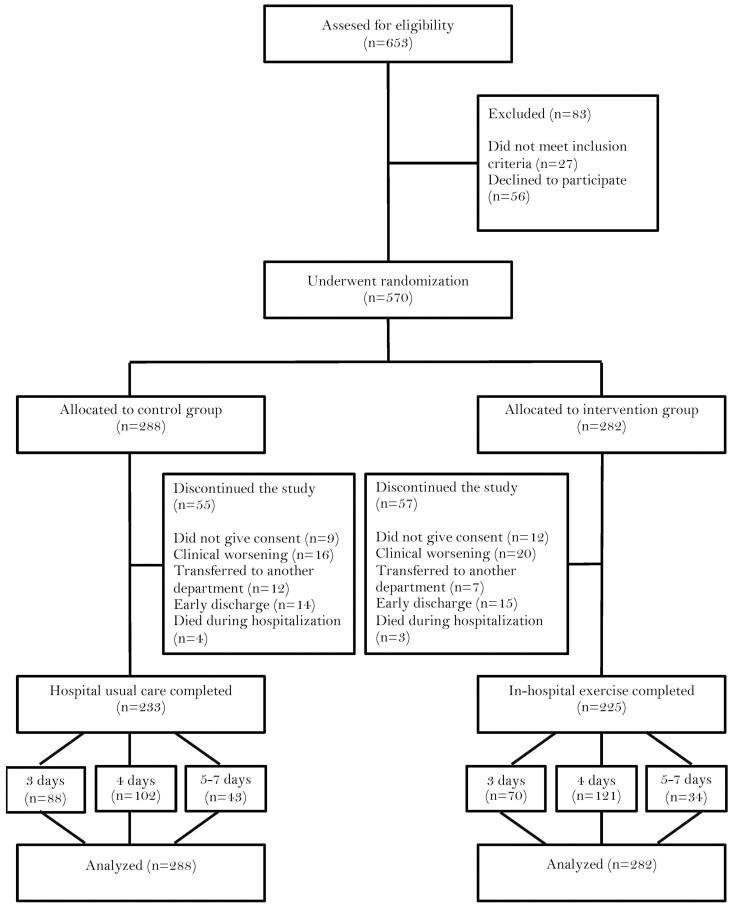
This secondary analysis of a multicenter randomized controlled trial examined the relationship between the duration of an in-hospital multicomponent exercise program and changes in physical function, cognition, and muscle strength in 570 acutely hospitalized older adults. Participants completed 3, 4, or 5-7 consecutive days of exercise based on the progression of their acute medical illness. The acute clinical condition of the older patients was similar across the study groups (i.e., 3/4/5-7 days) at admission. Outcomes included the Short Physical Performance Battery (SPPB) for functional capacity, Gait Velocity Test for gait speed, handgrip for muscle strength, and cognitive tests.
RESULTS
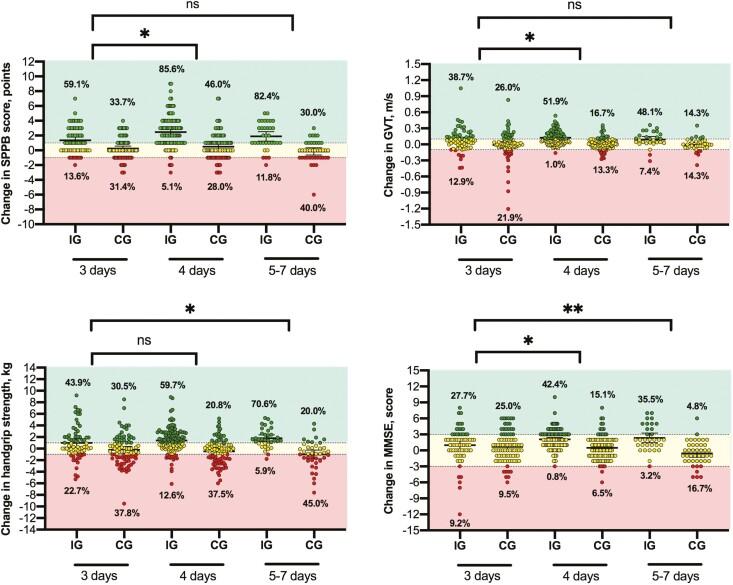
Of the 570 patients included in the analysis, 298 were women (52.3%), and the mean () age was 87.3 (4.8) years. Exercise groups increased SPPB scores compared with controls, with gains of 1.09 points after three days, 1.97 points after four days, and 2.02 points after 5-7 days ( < .001). The 4-day program showed the most significant benefit for functional capacity. Gait velocity increased by 0.11 m/s after 4 and 5-7 days ( = .032). Similar dose-response relationships were seen for handgrip strength and cognition, with 5-7 days showing more significant gains than three days ( < .05).
DISCUSSION AND IMPLICATIONS
Multicomponent exercise programs enhance physical and cognitive function in hospitalized older adults, regardless of exercise dosage. A 4-day program significantly boosts functional capacity, although 5-7 days improves handgrip strength and cognition, highlighting the importance of exercise dosage in countering functional decline. Implementing evidence-based inpatient exercise prescriptions can help reverse muscle weakness and improve cognitive and physical function.Clinical Trial Registration: NCT04600453.
背景与目的
运动可能会逆转住院老年患者的功能衰退,但最佳时长尚不清楚。本研究探讨了住院多组分运动计划时长与身体功能、认知及肌肉功能变化之间的潜在关系,以在急性住院老年患者中最大化运动相关的健康益处。
研究设计与方法
这项对多中心随机对照试验的二次分析,研究了570例急性住院老年患者的住院多组分运动计划时长与身体功能、认知及肌肉力量变化之间的关系。参与者根据其急性疾病的进展情况连续进行3、4或5 - 7天的运动。各研究组(即3/4/5 - 7天组)的老年患者入院时急性临床状况相似。结局指标包括用于评估功能能力的简短体能状况量表(SPPB)、用于评估步速的步态速度测试、用于评估肌肉力量的握力测试以及认知测试。
结果
纳入分析的570例患者中,298例为女性(52.3%),平均(±标准差)年龄为87.3(4.8)岁。与对照组相比,运动组的SPPB评分有所提高,3天后提高1.09分,4天后提高1.97分,5 - 7天后提高2.02分(P <.001)。4天的运动计划对功能能力显示出最显著的益处。4天和5 - 7天后步态速度提高了0.11 m/s(P = 0.032)。握力和认知方面也观察到类似的剂量反应关系,5 - 7天组比3天组显示出更显著的改善(P < 0.05)。
讨论与启示
多组分运动计划可增强住院老年患者的身体和认知功能,无论运动剂量如何。4天的运动计划能显著提高功能能力,尽管5 - 7天的运动计划能改善握力和认知,这凸显了运动剂量在对抗功能衰退中的重要性。实施基于证据的住院运动处方有助于逆转肌肉无力并改善认知和身体功能。临床试验注册编号:NCT04600453。

 Zotero 插件