
自体移植与 CAR-T 疗法在完全缓解期治疗的弥漫性大 B 细胞淋巴瘤患者中的应用比较。
Autologous transplant vs. CAR-T therapy in patients with DLBCL treated while in complete remission.
机构信息
Clinical Research Division, Fred Hutchinson Cancer Center, Seattle, WA, USA.
Division of Hematology and Medical Oncology, University of Washington, Seattle, WA, USA.
出版信息
Blood Cancer J. 2024 Jul 8;14(1):108. doi: 10.1038/s41408-024-01084-w.
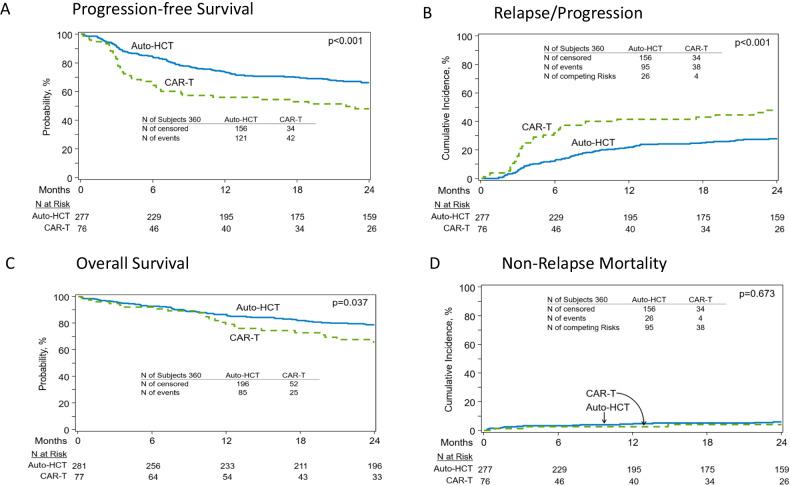
In patients with relapsed DLBCL in complete remission (CR), autologous hematopoietic cell transplantation (auto-HCT) and CAR-T therapy are both effective, but it is unknown which modality provides superior outcomes. We compared the efficacy of auto-HCT vs. CAR-T in patients with DLBCL in a CR. A retrospective observational study comparing auto-HCT (2015-2021) vs. CAR-T (2018-2021) using the Center for International Blood & Marrow Transplant Research registry. Median follow-up was 49.7 months for the auto-HCT and 24.7 months for the CAR-T cohort. Patients ages 18 and 75 with a diagnosis of DLBCL were included if they received auto-HCT (n = 281) or commercial CAR-T (n = 79) while in a CR. Patients undergoing auto-HCT with only one prior therapy line and CAR-T patients with a previous history of auto-HCT treatment were excluded. Endpoints included Progression-free survival (PFS), relapse rate, non-relapse mortality (NRM) and overall survival (OS). In univariate analysis, treatment with auto-HCT was associated with a higher rate of 2-year PFS (66.2% vs. 47.8%; p < 0.001), a lower 2-year cumulative incidence of relapse (27.8% vs. 48% ; p < 0.001), and a superior 2-year OS (78.9% vs. 65.6%; p = 0.037). In patients with early (within 12 months) treatment failure, auto-HCT was associated with a superior 2-year PFS (70.9% vs. 48.3% ; p < 0.001), lower 2-year cumulative incidence of relapse (22.8% vs. 45.9% ; p < 0.001) and trend for higher 2-year OS (82.4% vs. 66.1% ; p = 0.076). In the multivariable analysis, treatment with auto-HCT was associated with a superior PFS (hazard ratio 1.83; p = 0.0011) and lower incidence of relapse (hazard ratio 2.18; p < 0.0001) compared to CAR-T. In patients with relapsed LBCL who achieve a CR, treatment with auto-HCT is associated with improved clinical outcomes compared to CAR-T. These data support the consideration of auto-HCT in select patients with LBCL achieving a CR in the relapsed setting.
在完全缓解(CR)的复发性弥漫性大 B 细胞淋巴瘤(DLBCL)患者中,自体造血细胞移植(auto-HCT)和 CAR-T 治疗均有效,但尚不清楚哪种方法的疗效更好。我们比较了 CR 中接受 auto-HCT 和 CAR-T 治疗的 DLBCL 患者的疗效。这是一项使用国际血液和骨髓移植研究中心(Center for International Blood & Marrow Transplant Research registry)进行的回顾性观察性研究,比较了 2015 年至 2021 年接受 auto-HCT(n=281)和 2018 年至 2021 年接受 CAR-T(n=79)的患者。纳入年龄在 18 岁至 75 岁之间、诊断为 DLBCL 且在 CR 中接受 auto-HCT(n=281)或商业 CAR-T(n=79)的患者。排除仅接受一线治疗的 auto-HCT 患者和既往接受过 auto-HCT 治疗的 CAR-T 患者。主要终点包括无进展生存期(PFS)、复发率、非复发死亡率(NRM)和总生存期(OS)。单因素分析显示,接受 auto-HCT 治疗的患者 2 年 PFS 率更高(66.2% vs. 47.8%;p<0.001),2 年累积复发率更低(27.8% vs. 48%;p<0.001),2 年 OS 更高(78.9% vs. 65.6%;p=0.037)。在早期(12 个月内)治疗失败的患者中,auto-HCT 治疗的患者 2 年 PFS 更高(70.9% vs. 48.3%;p<0.001),2 年累积复发率更低(22.8% vs. 45.9%;p<0.001),2 年 OS 更高(82.4% vs. 66.1%;p=0.076)。多因素分析显示,与 CAR-T 相比,auto-HCT 治疗与更好的 PFS(风险比 1.83;p=0.0011)和更低的复发率(风险比 2.18;p<0.0001)相关。在达到 CR 的复发性弥漫性大 B 细胞淋巴瘤患者中,与 CAR-T 相比,接受 auto-HCT 治疗可获得更好的临床结局。这些数据支持在复发环境中达到 CR 的选择患者中考虑使用 auto-HCT。
 Zotero 插件