
在细胞内寄生虫感染过程中,选择性宿主自噬被诱导以控制氨基酸水平。
Selective host autophagy is induced during the intracellular parasite infection controlling amino acid levels.
机构信息
Department of Pathology, Microbiology, and Immunology, University of Nebraska Medical Center, Omaha, Nebraska, USA.
Program in Health Science, University of Santo Amaro (UNISA), São Paulo, Brazil.
出版信息
mSphere. 2024 Jul 30;9(7):e0036924. doi: 10.1128/msphere.00369-24. Epub 2024 Jul 9.
UNLABELLED
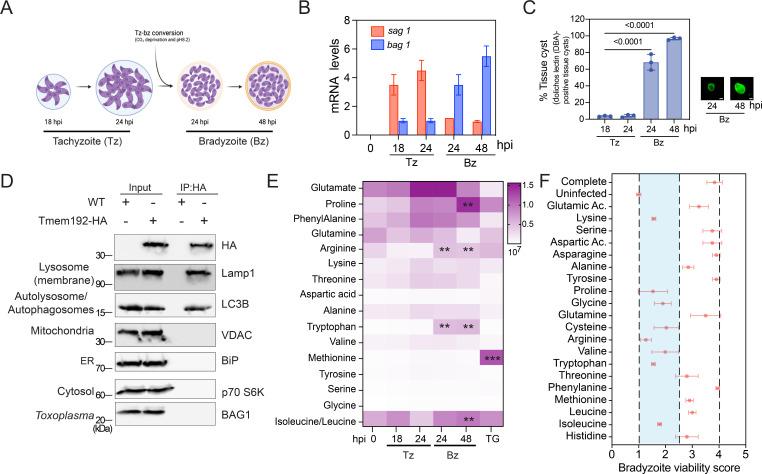
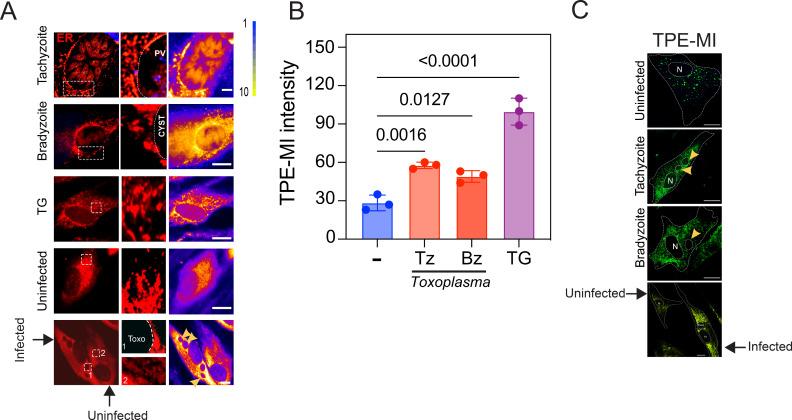
a widespread parasite, has the ability to infect nearly any nucleated cell in warm-blooded vertebrates. It is estimated that around 2 billion people globally have been infected by this pathogen. Although most healthy individuals can effectively control parasite replication, certain parasites may evade the immune response, establishing cysts in the brain that are refractory to the immune system and resistant to available drugs. For its chronic persistence in the brain, the parasite relies on host cells' nutrients, particularly amino acids and lipids. Therefore, understanding how latent parasites persist in the brain is crucial for identifying potential drug targets against chronic forms. While shielded within parasitophorous vacuoles (PVs) or cysts, exploits the host endoplasmic reticulum (ER) metabolism to sustain its persistence in the brain, resulting in host neurological alterations. In this study, we demonstrate that disrupts the host ER homeostasis, resulting in the accumulation of unfolded protein within the host ER. The host counters this stress by initiating an autophagic pathway known as ER-phagy, which breaks down unfolded proteins into amino acids, promoting their recycling. Our findings unveil the underlying mechanisms employed by to exploit host ER and lysosomal pathways, enhancing nutrient levels during infection. These insights provide new strategies for the treatment of toxoplasmosis.
IMPORTANCE
Intracellular parasites employ several mechanisms to manipulate the cellular environment, enabling them to persist in the host. , a single-celled parasite, possesses the ability to infect virtually any nucleated cell of warm-blooded vertebrates, including nearly 2 billion people worldwide. Unfortunately, existing treatments and immune responses are not entirely effective in eliminating the chronic persisting forms of the parasite. This study reveals that induces the host's autophagic pathway to boost amino acid levels in infected cells. The depletion of amino acids, in turn, influences the persistence of the parasite's chronic forms. Significantly, our investigation establishes the crucial role of host endoplasmic reticulum (ER)-phagy in the parasite's persistence within the host during latent infection.
未加标签
一种广泛存在的寄生虫,能够感染温血脊椎动物几乎所有有核细胞。据估计,全球约有 20 亿人感染了这种病原体。尽管大多数健康个体能够有效控制寄生虫的复制,但某些寄生虫可能会逃避免疫反应,在大脑中形成对免疫系统和现有药物具有抗性的囊肿。由于寄生虫在大脑中的慢性持续存在,它依赖于宿主细胞的营养物质,特别是氨基酸和脂质。因此,了解潜伏寄生虫如何在大脑中持续存在对于确定针对慢性形式的潜在药物靶点至关重要。当寄生虫处于寄生泡(PV)或囊肿内时,它会利用宿主内质网(ER)代谢来维持其在大脑中的持续存在,从而导致宿主神经系统的改变。在这项研究中,我们证明 破坏了宿主 ER 的内稳态,导致宿主 ER 中未折叠蛋白的积累。宿主通过启动一种称为 ER 自噬的自噬途径来应对这种应激,该途径将未折叠的蛋白质分解成氨基酸,促进它们的回收利用。我们的研究结果揭示了 利用宿主 ER 和溶酶体途径的潜在机制,在感染过程中提高营养水平。这些发现为治疗弓形体病提供了新的策略。
意义
细胞内寄生虫采用多种机制来操纵细胞环境,使其能够在宿主中持续存在。弓形虫是一种单细胞寄生虫,几乎能够感染温血脊椎动物的任何有核细胞,包括全球近 20 亿人。不幸的是,现有的治疗方法和免疫反应并不能完全有效地消除寄生虫的慢性持续存在形式。这项研究表明,弓形虫诱导宿主的自噬途径来提高感染细胞中的氨基酸水平。反过来,氨基酸的消耗会影响寄生虫慢性形式的持续存在。重要的是,我们的研究确立了宿主内质网(ER)自噬在寄生虫潜伏感染期间在宿主中持续存在的关键作用。


 Zotero 插件