
基于地理信息系统的通过环境组学标记工程对玉米杂交种进行基因×环境建模
GIS-based G × E modeling of maize hybrids through enviromic markers engineering.
作者信息
Resende Rafael T, Xavier Alencar, Silva Pedro Italo T, Resende Marcela P M, Jarquin Diego, Marcatti Gustavo E
机构信息
Plant Breeding Sector, School of Agronomy (EA), Federal University of Goiás (UFG), Av. Esperança, s/n, Samambaia Campus, Goiânia, GO, 74690-900, Brazil.
TheCROP, A Precision Breeding Project, Av. Esperança, n° 1533, FUNAPE, Samambaia Technological Park, Samambaia Campus - UFG, Goiânia, GO, 74690-612, Brazil.
出版信息
New Phytol. 2025 Jan;245(1):102-116. doi: 10.1111/nph.19951. Epub 2024 Jul 16.
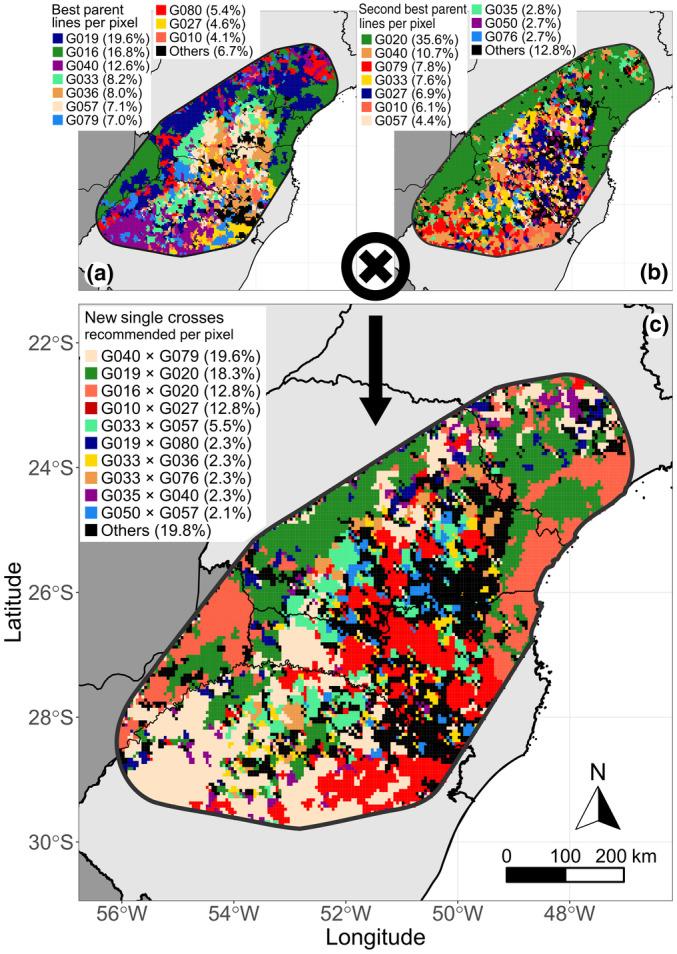
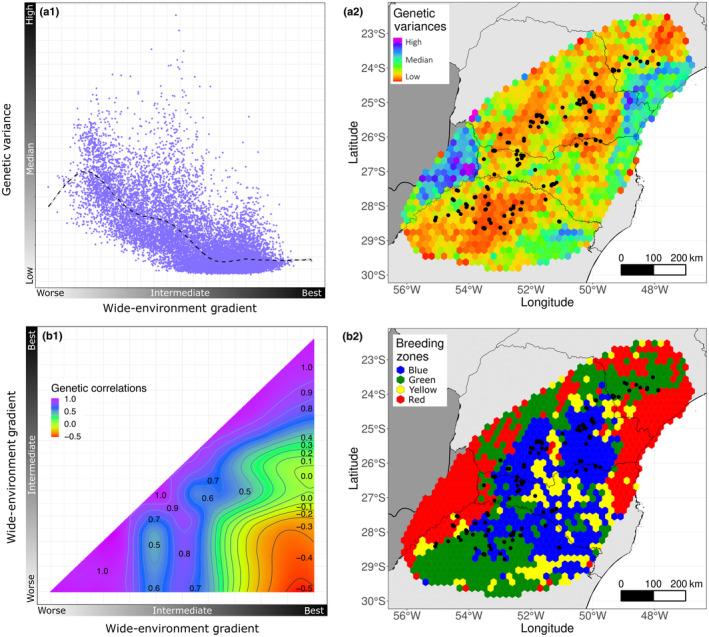
Through enviromics, precision breeding leverages innovative geotechnologies to customize crop varieties to specific environments, potentially improving both crop yield and genetic selection gains. In Brazil's four southernmost states, data from 183 distinct geographic field trials (also accounting for 2017-2021) covered information on 164 genotypes: 79 phenotyped maize hybrid genotypes for grain yield and their 85 nonphenotyped parents. Additionally, 1342 envirotypic covariates from weather, soil, sensor-based, and satellite sources were collected to engineer 10 K synthetic enviromic markers via machine learning. Soil, radiation light, and surface temperature variations remarkably affect differential genotype yield, hinting at ecophysiological adjustments including evapotranspiration and photosynthesis. The enviromic ensemble-based random regression model showcases superior predictive performance and efficiency compared to the baseline and kernel models, matching the best genotypes to specific geographic coordinates. Clustering analysis has identified regions that minimize genotype-environment (G × E) interactions. These findings underscore the potential of enviromics in crafting specific parental combinations to breed new, higher-yielding hybrid crops. The adequate use of envirotypic information can enhance the precision and efficiency of maize breeding by providing important inputs about the environmental factors that affect the average crop performance. Generating enviromic markers associated with grain yield can enable a better selection of hybrids for specific environments.
通过环境组学,精准育种利用创新的地理技术来使作物品种适应特定环境,有可能提高作物产量和遗传选择增益。在巴西最南端的四个州,来自183个不同地理田间试验(涵盖2017 - 2021年)的数据包含了164个基因型的信息:79个已进行表型分析的玉米杂交基因型的籽粒产量及其85个未进行表型分析的亲本。此外,还收集了来自天气、土壤、基于传感器和卫星来源的1342个环境型协变量,通过机器学习设计了10K个合成环境组学标记。土壤、辐射光和地表温度变化显著影响不同基因型的产量,这暗示了包括蒸散和光合作用在内的生态生理调节。与基线模型和核模型相比,基于环境组学集成的随机回归模型展现出卓越的预测性能和效率,将最佳基因型与特定地理坐标相匹配。聚类分析确定了使基因型 - 环境(G×E)相互作用最小化的区域。这些发现强调了环境组学在构建特定亲本组合以培育新的、高产杂交作物方面的潜力。充分利用环境型信息可以通过提供有关影响作物平均表现的环境因素的重要输入,提高玉米育种的精度和效率。生成与籽粒产量相关的环境组学标记能够更好地为特定环境选择杂交种。


 Zotero 插件