
人睑板腺分泌物在盐水上的高分辨率图像。
High Resolution Images of Human Meibum Spread on Saline.
机构信息
College of Optometry, Ohio State University, Columbus, Ohio, United States.
School of Optometry, Indiana University, Bloomington, Indiana, United States.
出版信息
Invest Ophthalmol Vis Sci. 2024 Jul 1;65(8):41. doi: 10.1167/iovs.65.8.41.
PURPOSE
Understanding of the role of the tear film lipid layer (TFLL) in evaporative dry eye requires knowledge of its structure. X-ray studies show 11.1-nm thick lamellae in meibum at tear film temperature (approximately 35°C), whereas below 30°C, 4.88-nm thick lamellae predominate. Here, high resolution microscopy of meibum spread on saline is studied as a function of temperature, to compare with x-ray results.
METHODS
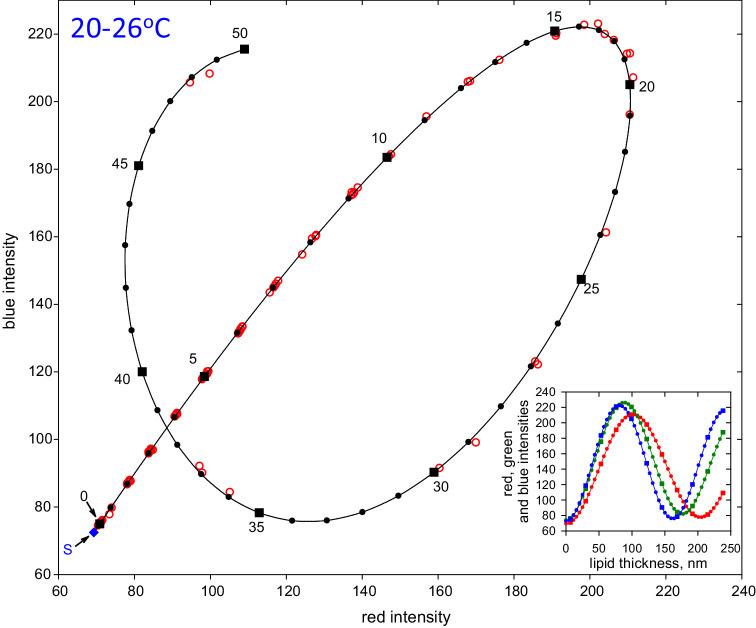
A purpose-built high resolution color microscope, previously used to study the TFLL, was used to study meibum from 10 subjects. It was spread on buffered saline at near 40°C, and allowed to cool to room temperature. Analytical methods from previous studies were applied to measure meibum and lamellar thickness.
RESULTS
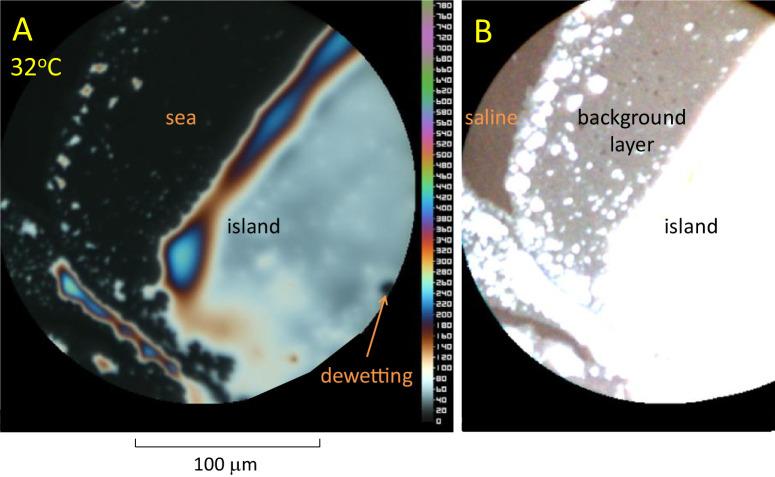
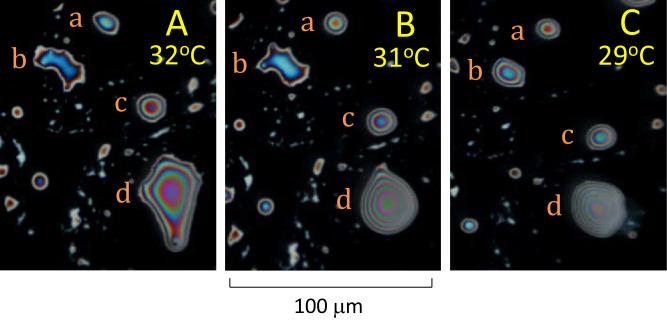
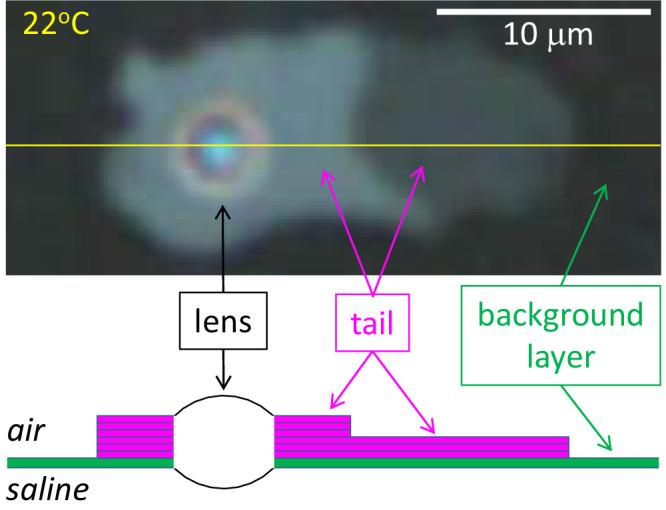
Initially, an irregular "island" was formed, surrounded by a "background layer" of 7.8 ± 0.3 nm thickness. Dewetting of the meibum layer always occurred, leading to the formation of lens-shaped droplets. Below 30°C, the lenses start to emit "tails" having a multilamellar structure containing up to about 49 lamellae superimposed on the background layer, each lamella being 4.82 ± 0.13 nm thick.
CONCLUSIONS
Below 30°C, meibum spread on saline shows a multilamellar structure like the 4.88 nm thickness in x-ray studies, demonstrating the ability to observe and measure tightly stacked lamellae. In contrast, above 30°C, the 11.1 nm lamellae were not observed as in x-ray studies, indicating that these lamellae were not tightly stacked but may be separated by disordered lipid. The role of these findings in evaporative dry eye is discussed.
目的
要了解泪膜脂质层(TFLL)在蒸发性干眼症中的作用,就需要了解其结构。X 射线研究表明,在泪膜温度(约 35°C)下,睑板腺中的脂层呈 11.1nm 厚的薄片,而在 30°C 以下,4.88nm 厚的薄片占主导地位。在这里,研究了在盐水中展开的睑板腺作为温度函数的高分辨率显微镜,以与 X 射线结果进行比较。
方法
先前用于研究 TFLL 的专用高分辨率彩色显微镜用于研究来自 10 位受试者的睑板腺。它在接近 40°C 的缓冲盐水中展开,并允许冷却至室温。应用以前研究中的分析方法来测量睑板腺和脂层的厚度。
结果
最初形成一个不规则的“岛”,周围是 7.8 ± 0.3nm 厚的“背景层”。睑板腺层总是会发生去湿,导致形成透镜状液滴。在 30°C 以下,透镜开始发出具有多层结构的“尾巴”,其中包含多达约 49 个重叠在背景层上的脂层,每个脂层厚 4.82 ± 0.13nm。
结论
在 30°C 以下,在盐水中展开的睑板腺显示出类似于 X 射线研究中 4.88nm 厚度的多层结构,证明能够观察和测量紧密堆叠的脂层。相比之下,在 30°C 以上,没有观察到 X 射线研究中的 11.1nm 脂层,这表明这些脂层没有紧密堆积,而是可能被无序脂质隔开。讨论了这些发现在蒸发性干眼症中的作用。





 Zotero 插件