
理解阳极催化剂电导率和载量对阴离子交换膜水电解中催化剂层利用率及性能的影响。
Understanding the Effects of Anode Catalyst Conductivity and Loading on Catalyst Layer Utilization and Performance for Anion Exchange Membrane Water Electrolysis.
作者信息
Kreider Melissa E, Yu Haoran, Osmieri Luigi, Parimuha Makenzie R, Reeves Kimberly S, Marin Daniela H, Hannagan Ryan T, Volk Emily K, Jaramillo Thomas F, Young James L, Zelenay Piotr, Alia Shaun M
机构信息
Chemistry and Nanoscience Center, National Renewable Energy Laboratory, Golden, Colorado 80401, United States.
Center for Nanophase Materials Sciences, Oak Ridge National Laboratory, Oak Ridge, Tennessee 37830, United States.
出版信息
ACS Catal. 2024 Jul 3;14(14):10806-10819. doi: 10.1021/acscatal.4c02932. eCollection 2024 Jul 19.
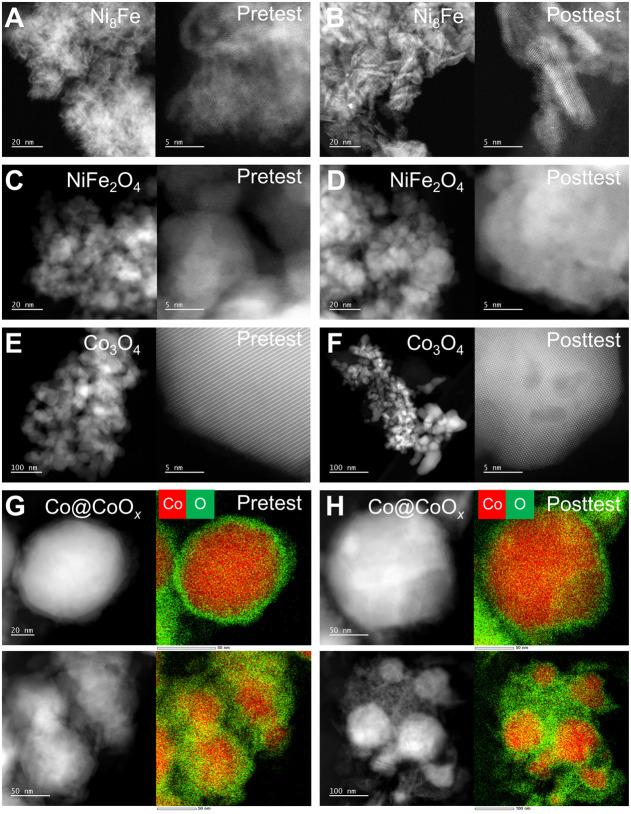
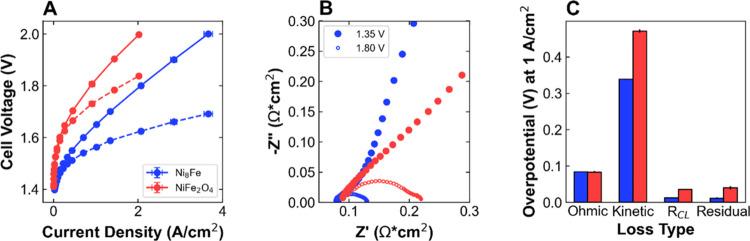
Anion exchange membrane water electrolysis (AEMWE) is a promising technology to produce hydrogen from low-cost, renewable power sources. Recently, the efficiency and durability of AEMWE have improved significantly due to advances in the anion exchange polymers and catalysts. To achieve performances and lifetimes competitive with proton exchange membrane or liquid alkaline electrolyzers, however, improvements in the integration of materials into the membrane electrode assembly (MEA) are needed. In particular, the integration of the oxygen evolution reaction (OER) catalyst, ionomer, and transport layer in the anode catalyst layer has significant impacts on catalyst utilization and voltage losses due to the transport of gases, hydroxide ions, and electrons within the anode. This study investigates the effects of the properties of the OER catalyst and the catalyst layer morphology on performance. Using cross-sectional electron microscopy and in-plane conductivity measurements for four PGM-free catalysts, we determine the catalyst layer thickness, uniformity, and electronic conductivity and further use a transmission line model to relate these properties to the catalyst layer resistance and utilization. We find that increased loading is beneficial for catalysts with high electronic conductivity and uniform catalyst layers, resulting in up to 55% increase in current density at 2 V due to decreased kinetic and catalyst layer resistance losses, while for catalysts with lower conductivity and/or less uniform catalyst layers, there is minimal impact. This work provides important insights into the role of catalyst layer properties beyond intrinsic catalyst activity in AEMWE performance.
阴离子交换膜水电解(AEMWE)是一种利用低成本可再生能源制氢的很有前景的技术。近年来,由于阴离子交换聚合物和催化剂的进展,AEMWE的效率和耐久性有了显著提高。然而,为了实现与质子交换膜或液体碱性电解槽相竞争的性能和寿命,需要改进材料在膜电极组件(MEA)中的集成。特别是,阳极催化剂层中析氧反应(OER)催化剂、离聚物和传输层的集成,对催化剂利用率以及由于阳极内气体、氢氧根离子和电子传输导致的电压损失有重大影响。本研究调查了OER催化剂的性质和催化剂层形态对性能的影响。通过对四种无铂族金属催化剂进行截面电子显微镜和平面电导率测量,我们确定了催化剂层的厚度、均匀性和电子电导率,并进一步使用传输线模型将这些性质与催化剂层电阻和利用率联系起来。我们发现,增加负载量对具有高电子电导率和均匀催化剂层的催化剂有益,由于动力学和催化剂层电阻损失降低,在2V时电流密度可提高多达55%,而对于电导率较低和/或催化剂层不太均匀的催化剂,影响最小。这项工作为催化剂层性质在AEMWE性能中超越固有催化剂活性的作用提供了重要见解。


 Zotero 插件