
不同易感性小鼠系统性微生物诱导实验性牙周病的全基因组甲基化分析
Methylome-wide analysis in systemic microbial-induced experimental periodontal disease in mice with different susceptibility.
作者信息
Hernandez Martinez Cristhiam de Jesus, Glessner Joseph, Finoti Livia Sertori, Silva Pedro Felix, Messora Michel, Coletta Ricardo Della, Hakonarson Hakon, Palioto Daniela Bazan
机构信息
Department of Oral & Maxillofacial Surgery and Periodontology, Ribeirão Preto Dental School, University of São Paulo - USP, Ribeirão Preto, São Paulo, Brazil.
The Center for Applied Genomics, Children's Hospital of Philadelphia, Philadelphia, PA, United States.
出版信息
Front Cell Infect Microbiol. 2024 Jul 16;14:1369226. doi: 10.3389/fcimb.2024.1369226. eCollection 2024.
OBJECTIVE
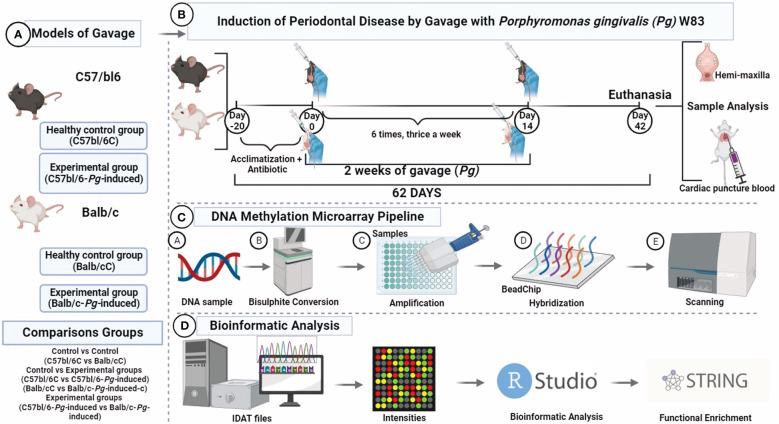
The study delved into the epigenetic factors associated with periodontal disease in two lineages of mice, namely C57bl/6 and Balb/c. Its primary objective was to elucidate alterations in the methylome of mice with distinct genetic backgrounds following systemic microbial challenge, employing high-throughput DNA methylation analysis as the investigative tool.
METHODS
()was orally administered to induce periodontitis in both Balb/c and C57bl/6 lineage. After euthanasia, genomic DNA from both maxilla and blood were subjected to bisulfite conversion, PCR amplification and genome-wide DNA methylation analysis using the Ovation RRBS Methyl-Seq System coupled with the Illumina Infinium Mouse Methylation BeadChip.
RESULTS
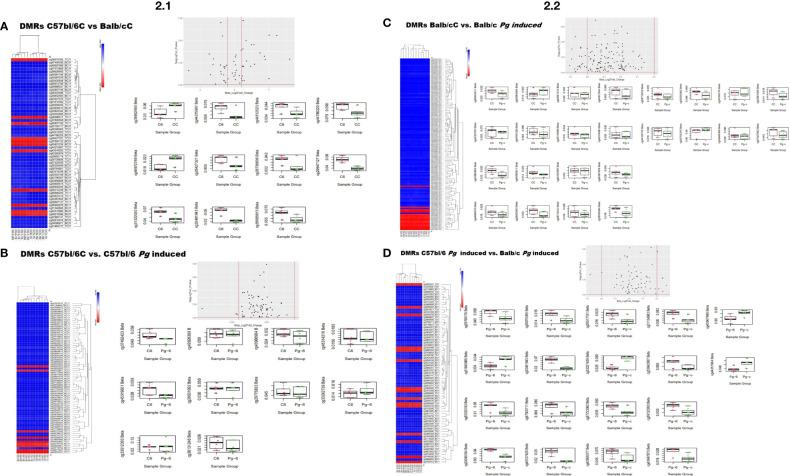
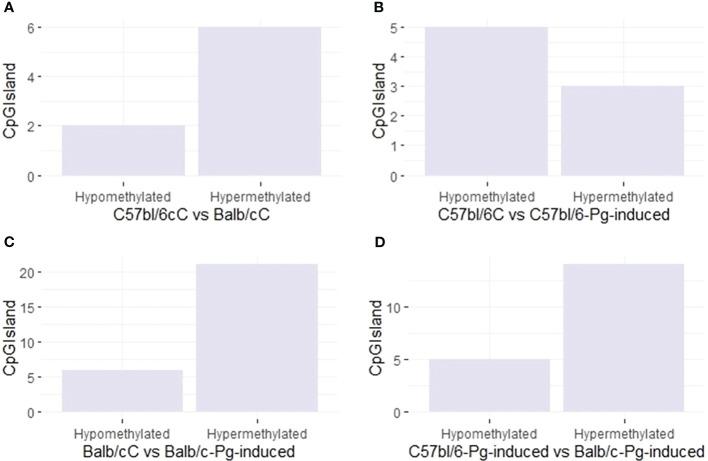
Of particular significance was the distinct methylation profile observed within the -induced group of the Balb/c lineage, contrasting with both the control and -induced groups of the C57bl/6 lineage. Utilizing rigorous filtering criteria, we successfully identified a substantial number of differentially methylated regions (DMRs) across various tissues and comparison groups, shedding light on the prevailing hypermethylation in non-induced cohorts and hypomethylation in induced groups. The comparison between blood and maxilla samples underscored the unique methylation patterns specific to the jaw tissue. Our comprehensive methylome analysis further unveiled statistically significant disparities, particularly within promoter regions, in several comparison groups.
CONCLUSION
The differential DNA methylation patterns observed between C57bl/6 and Balb/c mouse lines suggest that epigenetic factors contribute to the variations in disease susceptibility. The identified differentially methylated regions associated with immune regulation and inflammatory response provide potential targets for further investigation. These findings emphasize the importance of considering epigenetic mechanisms in the development and progression of periodontitis.
目的
本研究深入探究了C57bl/6和Balb/c两个小鼠品系中与牙周病相关的表观遗传因素。其主要目的是通过高通量DNA甲基化分析这一研究工具,阐明在全身性微生物攻击后具有不同遗传背景的小鼠甲基化组的变化。
方法
对Balb/c和C57bl/6品系的小鼠口服()以诱导牙周炎。安乐死后,对上颌骨和血液中的基因组DNA进行亚硫酸氢盐转化、PCR扩增,并使用Ovation RRBS甲基化测序系统结合Illumina Infinium小鼠甲基化芯片进行全基因组DNA甲基化分析。
结果
特别值得注意的是,在Balb/c品系的()诱导组中观察到明显不同的甲基化谱,这与C57bl/6品系的对照组和()诱导组形成对比。利用严格的筛选标准,我们成功地在各种组织和比较组中鉴定出大量差异甲基化区域(DMR),揭示了未诱导组中普遍存在的高甲基化和诱导组中的低甲基化现象。血液和上颌骨样本之间的比较突出了颌组织特有的独特甲基化模式。我们全面的甲基化组分析进一步揭示了几个比较组中具有统计学意义的差异,特别是在启动子区域。
结论
C57bl/6和Balb/c小鼠品系之间观察到的不同DNA甲基化模式表明表观遗传因素导致了疾病易感性的差异。与免疫调节和炎症反应相关的已鉴定差异甲基化区域为进一步研究提供了潜在靶点。这些发现强调了在牙周炎发生和发展过程中考虑表观遗传机制的重要性。


 Zotero 插件