
肿瘤微环境中低水平的肿瘤坏死因子α通过血管生成素介导的糖酵解维持胶质瘤干细胞的自我更新。
A low level of tumor necrosis factor α in tumor microenvironment maintains the self-renewal of glioma stem cells by Vasorin-mediated glycolysis.
作者信息
Zhang Yang, Kang Tianxu, Wang Yuxi, Song Chao, Li Huan, Mi Hailong, Li Yachao, Dong Minhai, Ma Xiaoyu, Zhu Hongtao, Cheng Lidong, Zhang Po, Chen Zhiye, Zhou Lin, Wu Qiulian, Mao Feng, Wang Baofeng, Zhang Suojun, Shu Kai, Wan Feng, Zhou Wenchao, Rich Jeremy N, Shen Jianying, Xiao Qungen, Yu Xingjiang
机构信息
Department of Histology and Embryology, School of Basic Medicine, Tongji Medical College, Huazhong University of Science and Technology, Wuhan, China.
School of Basic Medicine, Tongji Medical College, Huazhong University of Science and Technology, Wuhan, China.
出版信息
Neuro Oncol. 2024 Dec 5;26(12):2256-2271. doi: 10.1093/neuonc/noae147.
BACKGROUND
Self-renewal of glioma stem cells (GSCs) is responsible for glioblastoma (GBM) therapy resistance and recurrence. Tumor necrosis factor α (TNFα) and TNF signaling pathway display an antitumor activity in preclinical models and in tumor patients. However, TNFα exhibits no significance for glioma clinical prognosis based on the Glioma Genome Atlas database. This study aimed to explore whether TNFα of tumor microenvironment maintains self-renewal of GSCs and promotes worse prognosis in glioma patients.
METHODS
Spatial transcriptomics, immunoblotting, sphere formation assay, extreme limiting dilution, and gene expression analysis were used to determine the role of TNFα on GSC's self-renewal. Mass spectrometry, RNA-sequencing detection, bioinformatic analyses, qRT-RNA, immunofluorescence, immunohistochemistry, single-cell RNA sequencing, in vitro and in vivo models were used to uncover the mechanism of TNFα-induced GSC self-renewal.
RESULTS
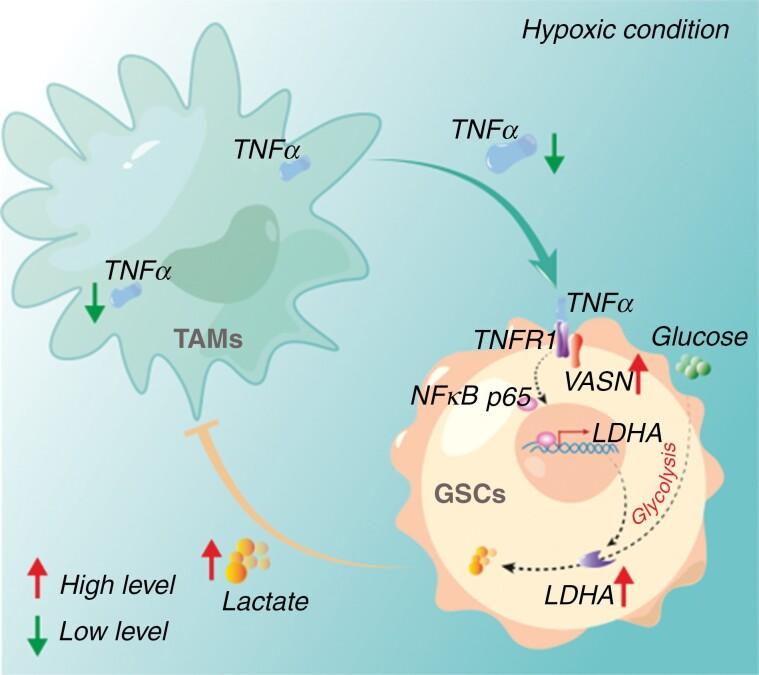
A low level of TNFα displays a promoting effect on GSC self-renewal and worse glioma prognosis. Mechanistically, Vasorin (VASN) mediated TNFα-induced self-renewal by potentiating glycolysis. Lactate produced by glycolysis inhibits the TNFα secretion of tumor-associated macrophages (TAMs) and maintains TNFα at a low level.
CONCLUSIONS
TNFα-induced GSC self-renewal mediated by VASN provides a possible explanation for the failures of endogenous TNFα effect on GBM. A combination of targeting VASN and TNFα antitumor effect may be an effective approach for treating GBM.
背景
胶质瘤干细胞(GSCs)的自我更新是胶质母细胞瘤(GBM)治疗耐药性和复发的原因。肿瘤坏死因子α(TNFα)及TNF信号通路在临床前模型和肿瘤患者中显示出抗肿瘤活性。然而,基于胶质瘤基因组图谱数据库,TNFα对胶质瘤临床预后无显著意义。本研究旨在探讨肿瘤微环境中的TNFα是否维持GSCs的自我更新并促进胶质瘤患者的不良预后。
方法
采用空间转录组学、免疫印迹、成球试验、极限稀释法和基因表达分析来确定TNFα对GSCs自我更新的作用。运用质谱分析、RNA测序检测、生物信息学分析、qRT-RNA、免疫荧光、免疫组化、单细胞RNA测序、体外和体内模型来揭示TNFα诱导GSCs自我更新的机制。
结果
低水平的TNFα对GSCs自我更新具有促进作用,并导致更差的胶质瘤预后。机制上,血管调节蛋白(VASN)通过增强糖酵解介导TNFα诱导的自我更新。糖酵解产生的乳酸抑制肿瘤相关巨噬细胞(TAMs)的TNFα分泌,并使TNFα维持在低水平。
结论
VASN介导的TNFα诱导的GSCs自我更新为内源性TNFα对GBM治疗无效提供了一种可能的解释。联合靶向VASN和TNFα的抗肿瘤作用可能是治疗GBM的有效方法。
 Zotero 插件