
系统转化疗法治疗初诊不可切除的肝细胞癌:系统评价和荟萃分析。
Systemic conversion therapies for initially unresectable hepatocellular carcinoma: a systematic review and meta-analysis.
机构信息
Division of Liver Surgery, Department of General Surgery, West China Hospital, Sichuan University, 37 Guo Xue Road, Wu hou District, Chengdu, 610041, China.
出版信息
BMC Cancer. 2024 Aug 14;24(1):1008. doi: 10.1186/s12885-024-12772-y.
BACKGROUND
Systemic conversion therapy provides patients with initially unresectable hepatocellular carcinoma (HCC) the chance to salvage radical liver resection and superior survival outcomes, but the optimal conversion strategy is unclear.
METHODS
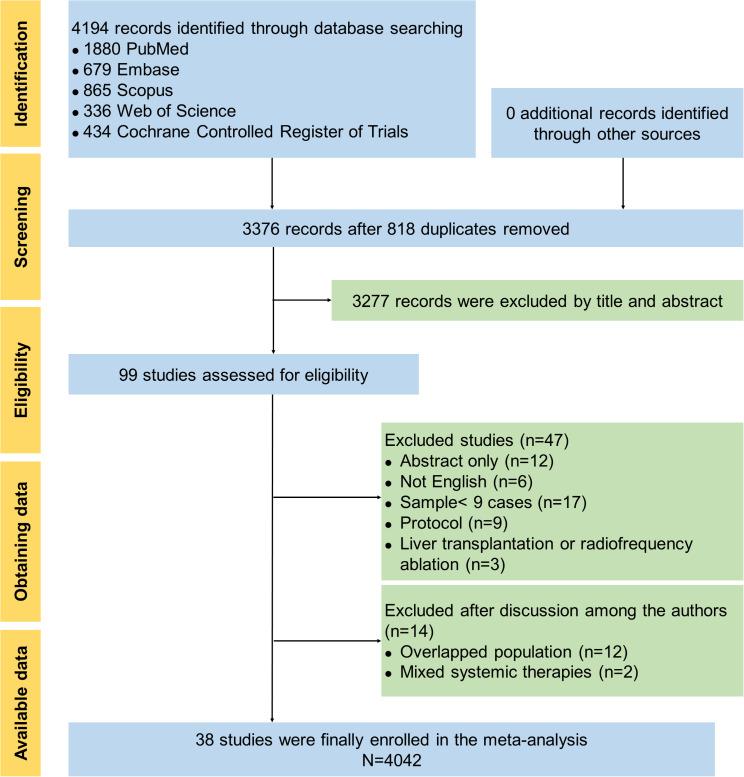
A systematic literature search was conducted on PubMed, EMBASE, Web of Science, Scopus, and the Cochrane Library between 2007 and 2024 focusing on studies reporting conversion therapy for HCC. The treatment groups were divided into Tyrosine kinase inhibitors (TKI), TKI plus loco-regional therapy (LRT), TKI plus anti-PD-1 therapy (TKI + PD-1), TKI + PD-1 + LRT, immune checkpoint inhibitors (ICI) plus LRT, and Atezolizumab plus bevacizumab (A + T) groups. The conversion to surgery rate (CSR), objective response rate (ORR), grade ≥ 3 treatment-related adverse events (AEs), overall survival (OS) and progression-free survival (PFS) were analyzed.
RESULTS
38 studies and 4,042 patients were included. The pooled CSR were 8% (95% CI, 5-12%) in TKI group, 13% (95% CI, 8-19%) in TKI + LRT group, 28% (95% CI, 19-37%) in TKI + PD-1 group, 33% (95% CI, 25-41%) in TKI + PD-1 + LRT group, 23% (95% CI, 1-46%) in ICI + LRT group, and 5% (95% CI, 3-8%) in A + T group, respectively. The pooled HR for OS (0.45, 95% CI, 0.35-0.60) and PFS (0.49, 95% CI, 0.35-0.70) favored survival benefit of conversion surgery. Subgroup analysis revealed that lenvatinib + PD-1 + LRT conferred higher CSR of 35% (95% CI, 26-44%) and increased ORR of 70% (95% CI, 56-83%).
CONCLUSIONS
The current study indicates that TKI + PD-1 + LRT, especially lenvatinib + PD-1 + LRT, may be the superior conversion therapy with a manageable safety profile for patients with initially unresectable HCC. The successful conversion therapy favors the superior OS and PFS compared with systemic treatment alone.
TRIAL REGISTRATION
International prospective register of systematic reviews (PROSPERO) (registration code: CRD 42024495289).
背景
系统转化疗法为最初无法切除的肝细胞癌(HCC)患者提供了接受根治性肝切除术和更好生存结果的机会,但最佳转化策略仍不清楚。
方法
对 2007 年至 2024 年间在 PubMed、EMBASE、Web of Science、Scopus 和 Cochrane 图书馆上进行的系统文献检索进行了研究,重点是报告 HCC 转化治疗的研究。治疗组分为酪氨酸激酶抑制剂(TKI)、TKI 加局部区域治疗(LRT)、TKI 加抗 PD-1 治疗(TKI + PD-1)、TKI + PD-1 + LRT、免疫检查点抑制剂(ICI)加 LRT 和阿替利珠单抗加贝伐珠单抗(A + T)组。分析转化率(CSR)、客观缓解率(ORR)、≥3 级治疗相关不良事件(AE)、总生存期(OS)和无进展生存期(PFS)。
结果
纳入 38 项研究和 4042 例患者。TKI 组的 CSR 为 8%(95%CI,5-12%),TKI + LRT 组为 13%(95%CI,8-19%),TKI + PD-1 组为 28%(95%CI,19-37%),TKI + PD-1 + LRT 组为 33%(95%CI,25-41%),ICI + LRT 组为 23%(95%CI,1-46%),A + T 组为 5%(95%CI,3-8%)。OS(0.45,95%CI,0.35-0.60)和 PFS(0.49,95%CI,0.35-0.70)的 HR 均有利于转化手术的生存获益。亚组分析显示,仑伐替尼+PD-1+LRT 的 CSR 更高,为 35%(95%CI,26-44%),ORR 更高,为 70%(95%CI,56-83%)。
结论
本研究表明,TKI + PD-1 + LRT,特别是仑伐替尼+PD-1 + LRT,可能是最初无法切除的 HCC 患者的较好转化治疗方法,具有可管理的安全性。与单纯全身治疗相比,成功的转化治疗有利于更好的 OS 和 PFS。
试验注册
国际前瞻性系统评价注册库(PROSPERO)(注册号:CRD42024495289)。



 Zotero 插件