
评价美国拉丁裔人群中人乳头瘤病毒(HPV)自我采样:系统评价。
Evaluating human papillomavirus (HPV) self-sampling among Latinas in the United States: A systematic review.
机构信息
Cancer Prevention and Control Program, Fox Chase Cancer Center, Philadelphia, Pennsylvania, USA.
College of Medicine, University of Central Florida, Orlando, Florida, USA.
出版信息
Cancer Med. 2024 Aug;13(16):e70098. doi: 10.1002/cam4.70098.
BACKGROUND
Latinas experience the greatest cervical cancer incidence compared with other ethnic/racial groups in the United States (US) due in part to significant disparities in screening uptake. Social and structural conditions that impede access to and participation in screening include language barriers, concerns about documentation status, logistical issues (e.g., transportation, limited clinic hours), and cultural beliefs regarding modesty and promiscuity. To overcome these challenges, self-sampling for human papillomavirus (HPV) DNA testing has emerged as a potentially promising method for promoting cervical cancer screening among this population. Thus, this systematic review aimed to assess the acceptability of HPV self-sampling among US Latinas.
METHODS
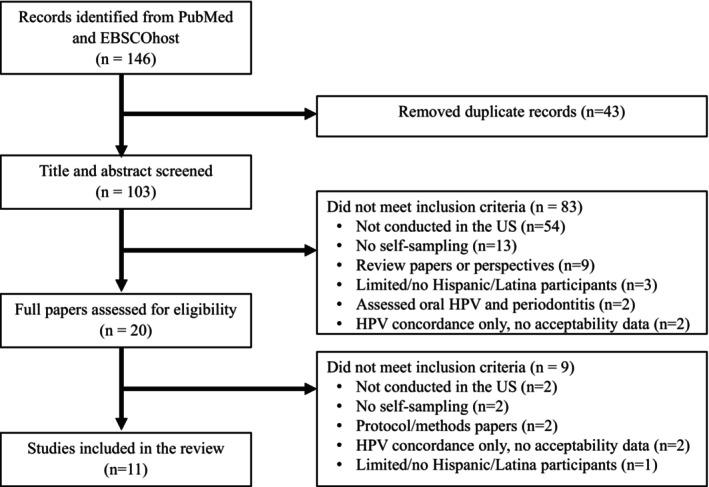
Using EBSCOhost and PubMed databases, we searched for studies published in the past two decades (2003-2023) that described participation in HPV self-sampling among Latinas. Eleven articles met inclusion criteria.
RESULTS
The majority of studies were conducted in Florida, California, and Puerto Rico, were single-arm designs, and involved the use of community health workers and Spanish-language materials (e.g., brochures). Across studies, the majority of participants reported that self-sampling was acceptable with respect to ease of use, comfort (lack of pain), privacy, and convenience; however, some women were concerned about the accuracy of self-sampling or whether they had performed sample collection correctly.
CONCLUSION
Given the high acceptability, self-collection of cervicovaginal samples for HPV testing may offer a feasible option for enhancing participation in cervical cancer screening in this population that encounters significant barriers to screening.
背景
由于在筛查参与度方面存在显著差异,拉丁裔女性在美国(美国)的宫颈癌发病率最高,与其他族裔/种族群体相比。妨碍获得和参与筛查的社会和结构性条件包括语言障碍、对文件状况的担忧、后勤问题(例如,交通、诊所时间有限)以及对谦虚和淫乱的文化信仰。为了克服这些挑战,自我采样用于 HPV DNA 检测已成为促进该人群宫颈癌筛查的一种有前途的方法。因此,本系统评价旨在评估 HPV 自我采样在美国拉丁裔女性中的可接受性。
方法
我们使用 EBSCOhost 和 PubMed 数据库,搜索了过去二十年(2003-2023 年)发表的描述拉丁裔女性参与 HPV 自我采样的研究。有 11 篇文章符合纳入标准。
结果
大多数研究在佛罗里达州、加利福尼亚州和波多黎各进行,设计为单臂设计,涉及使用社区卫生工作者和西班牙语材料(例如,小册子)。在各项研究中,大多数参与者报告说,自我采样在易用性、舒适度(无疼痛)、隐私和便利性方面是可以接受的;然而,一些女性担心自我采样的准确性或他们是否正确采集了样本。
结论
鉴于高度可接受性,自行采集宫颈阴道样本进行 HPV 检测可能是增强该人群参与宫颈癌筛查的可行选择,该人群在筛查方面存在重大障碍。
 Zotero 插件