
基于美国食品药品监督管理局不良事件报告系统(FAERS)数据库的奥利司他不良事件的药物警戒分析。
Pharmacovigilance analysis of orlistat adverse events based on the FDA adverse event reporting system (FAERS) database.
作者信息
Zhu Jinfeng, Hu Mianda, Liang Yingshi, Zhong Mingjun, Chen Zilin, Wang Zhenjie, Yang Yujia, Luo Ziyi, Zeng Wenqi, Li Jiahui, Du Yikuan, Liu Yi, Yang Chun
机构信息
Dongguan Key Laboratory of Stem Cell and Regenerative Tissue Engineering, The First Dongguan Affiliated Hospital, School of Basic Medical Sciences, Guangdong Medical University, Dongguan, 523808, China.
Central Laboratory, The Tenth Affiliated Hospital of Southern Medical University, Dongguan, 523059, China.
出版信息
Heliyon. 2024 Jul 18;10(14):e34837. doi: 10.1016/j.heliyon.2024.e34837. eCollection 2024 Jul 30.
OBJECTIVE
Based on the U.S. Food and Drug Administration Adverse Event Reporting System (FAERS) database, we analyzed the signals of potential adverse events (AEs) of orlistat in the real world to provide a reference for its safe clinical use.
METHODS
The FAERS database and OpenVigil 2.1 were used to obtain data on adverse events of orlistat from the first quarter of 2004 to the first quarter of 2023, and to analyze the population in which the adverse events occurred. And the signals of their potential adverse events were mined using reporting odds ratio (ROR), proportional reporting ratio (PRR), Bayesian confidence propagation neural network (BCPNN) and empirical Bayesian geometric mean (EBGM).
RESULT
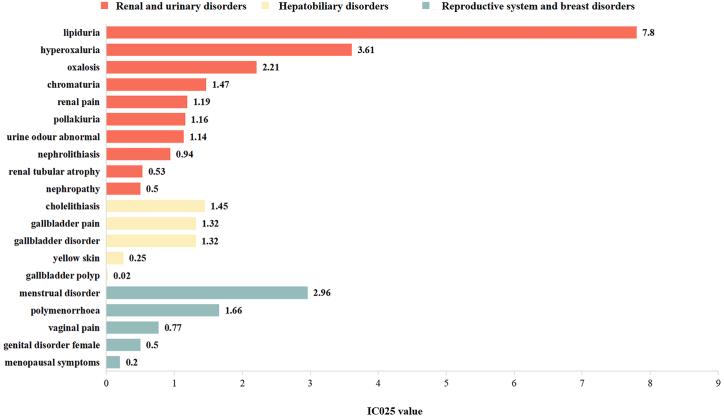
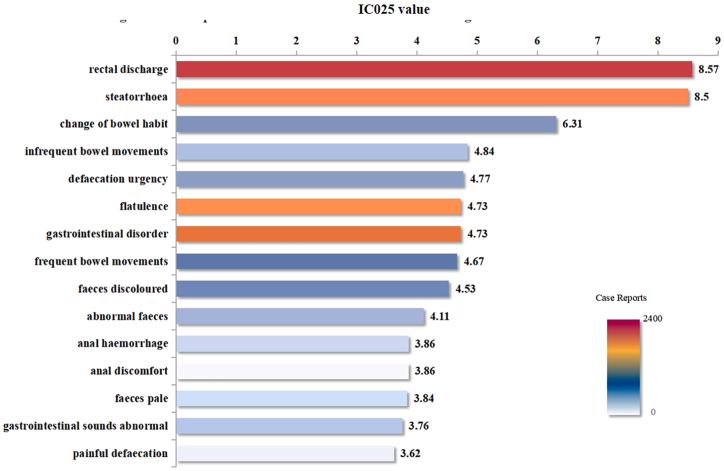
A total of 21,079 reports of adverse events with orlistat as the primary suspected drug were collected in this study. Using four disproportionate analyses, we screened 117 preferred terms (PTs) involving 18 system organ classes (SOCs). We found that the most common adverse events at SOC level for orlistat remained "gastrointestinal disorders", while "metabolism and nutrition disorders", "renal and urinary disorders", "musculoskeletal and connective tissue disorders" and "hepatobiliary disorders" also ranked high in the number of case reports. In addition, at the PT level, we identified several new signals of adverse events not mentioned in the specification, including "lipiduria", "anal haemorrhage", "rectal haemorrhage", "haematochezia", "sigmoiditis", "diverticulitis" and "muscle spasms".
CONCLUSION
Most of the adverse events found in this study are consistent with the results described in the drug label. At the same time, we also found some new adverse events, which require more prospective studies to verify and elucidate their relationship with orlistat.
目的
基于美国食品药品监督管理局不良事件报告系统(FAERS)数据库,分析奥利司他在现实世界中潜在不良事件(AE)的信号,为其临床安全使用提供参考。
方法
利用FAERS数据库和OpenVigil 2.1获取2004年第一季度至2023年第一季度奥利司他不良事件的数据,并分析不良事件发生的人群。采用报告比值比(ROR)、比例报告比值(PRR)、贝叶斯置信传播神经网络(BCPNN)和经验贝叶斯几何均值(EBGM)挖掘其潜在不良事件的信号。
结果
本研究共收集到以奥利司他为主要可疑药物的不良事件报告21,079份。通过四种不成比例分析,筛选出涉及18个系统器官分类(SOC)的117个首选术语(PT)。我们发现,奥利司他在SOC层面最常见的不良事件仍是“胃肠道疾病”,而“代谢和营养紊乱”“肾脏和泌尿系统疾病”“肌肉骨骼和结缔组织疾病”以及“肝胆疾病”的病例报告数量也较多。此外,在PT层面,我们识别出了一些说明书中未提及的不良事件新信号,包括“脂尿”“肛门出血”“直肠出血”“便血”“乙状结肠炎”“憩室炎”和“肌肉痉挛”。
结论
本研究发现的大多数不良事件与药品标签中描述的结果一致。同时,我们也发现了一些新的不良事件,需要更多前瞻性研究来验证并阐明它们与奥利司他的关系。

 Zotero 插件