
比较 COVID-19 快速抗原检测与成人病毒基因检测的诊断准确性:系统评价和荟萃分析。
Comparison of diagnostic accuracy of rapid antigen tests for COVID-19 compared to the viral genetic test in adults: a systematic review and meta-analysis.
机构信息
Touro University Nevada, College of Osteopathic Medicine, Department of Basic Sciences, Henderson, NV, USA.
Touro University Nevada, Jay Sexter Library, Henderson, NV, USA.
出版信息
JBI Evid Synth. 2024 Oct 1;22(10):1939-2002. doi: 10.11124/JBIES-23-00291.
OBJECTIVE
The objective of this review was to determine the diagnostic accuracy of the currently available and upcoming point-of-care rapid antigen tests (RATs) used in primary care settings relative to the viral genetic real-time reverse transcriptase polymerase chain reaction (RT-PCR) test as a reference for diagnosing COVID-19/SARS-CoV-2 in adults.
INTRODUCTION
Accurate COVID-19 point-of-care diagnostic tests are required for real-time identification of SARS-CoV-2 infection in individuals. Real-time RT-PCR is the accepted gold standard for diagnostic testing, requiring technical expertise and expensive equipment that are unavailable in most primary care locations. RATs are immunoassays that detect the presence of a specific viral protein, which implies a current infection with SARS-CoV-2. RATs are qualitative or semi-quantitative diagnostics that lack thresholds that provide a result within a short time frame, typically within the hour following sample collection. In this systematic review, we synthesized the current evidence regarding the accuracy of RATs for detecting SARS-CoV-2 compared with RT-PCR.
INCLUSION CRITERIA
Studies that included nonpregnant adults (18 years or older) with suspected SARS-CoV-2 infection, regardless of symptomology or disease severity, were included. The index test was any available SARS-CoV-2 point-of-care RAT. The reference test was any commercially distributed RT-PCR-based test that detects the RNA genome of SARS-CoV-2 and has been validated by an independent third party. Custom or in-house RT-PCR tests were also considered, with appropriate validation documentation. The diagnosis of interest was COVID-19 disease and SARS-CoV-2 infection. This review considered cross-sectional and cohort studies that examined the diagnostic accuracy of COVID-19/SARS-CoV-2 infection where the participants had both index and reference tests performed.
METHODS
The keywords and index terms contained in relevant articles were used to develop a full search strategy for PubMed and adapted for Embase, Scopus, Qinsight, and the WHO COVID-19 databases. Studies published from November 2019 to July 12, 2022, were included, as SARS-CoV-2 emerged in late 2019 and is the cause of a continuing pandemic. Studies that met the inclusion criteria were critically appraised using QUADAS-2. Using a customized tool, data were extracted from included studies and were verified prior to analysis. The pooled sensitivity, specificity, positive predictive, and negative predictive values were calculated and presented with 95% CIs. When heterogeneity was observed, outlier analysis was conducted, and the results were generated by removing outliers.
RESULTS
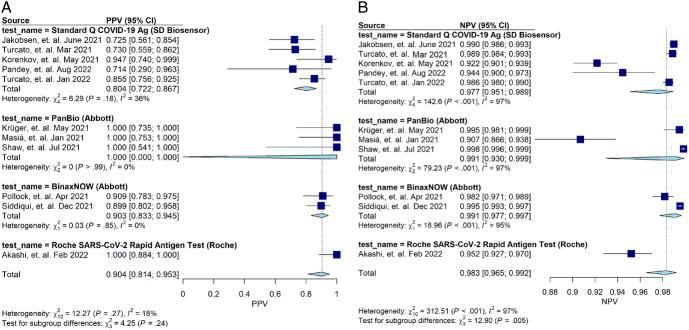
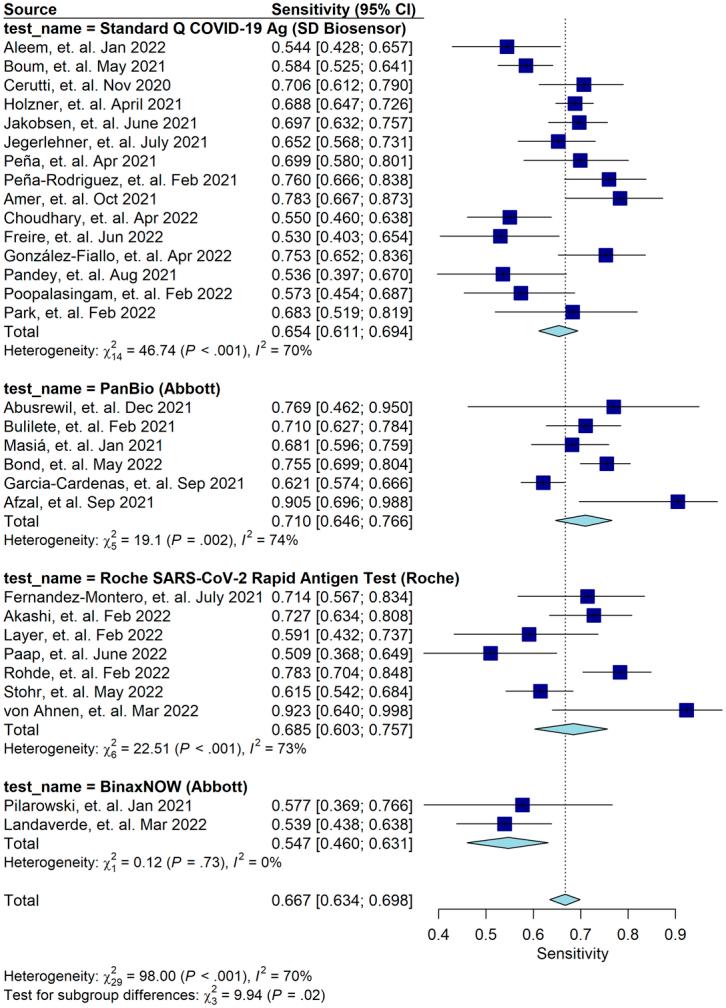
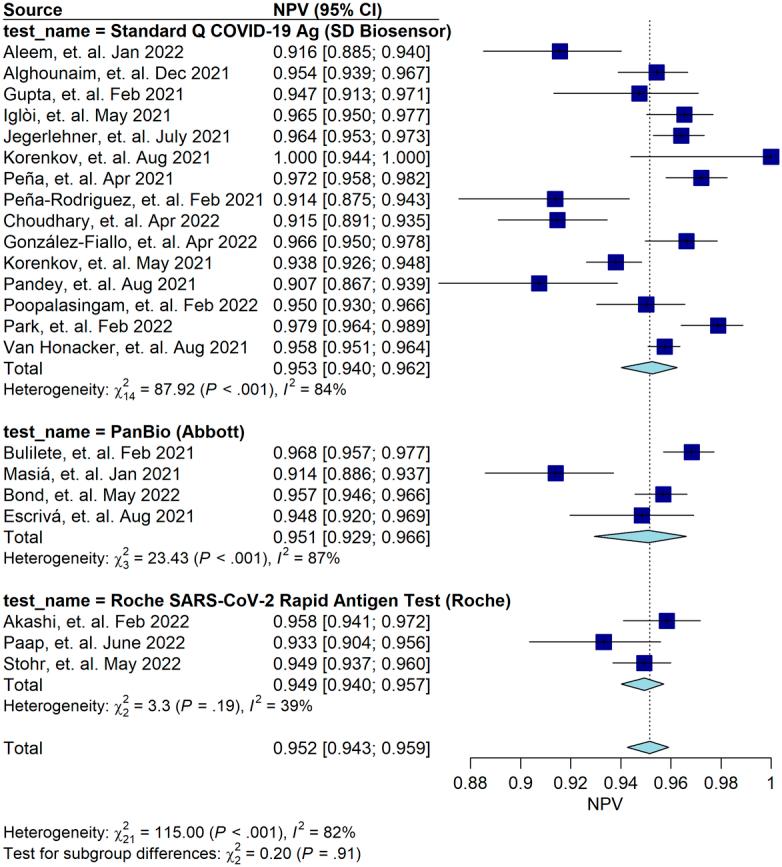
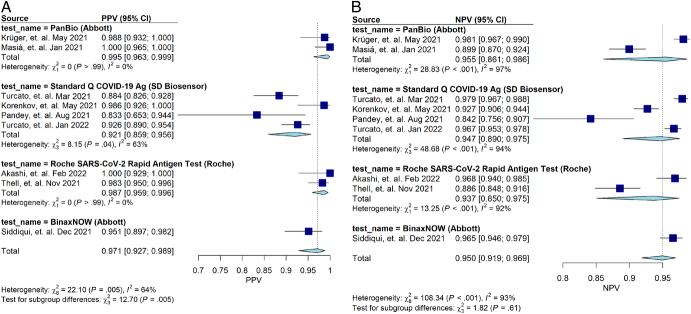
Meta-analysis was performed on 91 studies of 581 full-text articles retrieved that provided true-positive, true-negative, false-positive, and false-negative values. RATs can identify individuals who have COVID-19 with high reliability (positive predictive value 97.7%; negative predictive value 95.2%) when considering overall performance. However, the lower level of sensitivity (67.1%) suggests that negative test results likely need to be retested through an additional method.
CONCLUSIONS
Most reported RAT brands had only a few studies comparing their performance with RT-PCR. Overall, a positive RAT result is an excellent predictor of a positive diagnosis of COVID-19. We recommend that Roche's SARS-CoV-2 Rapid Antigen Test and Abbott's BinaxNOW tests be used in primary care settings, with the understanding that negative results need to be confirmed through RT-PCR. We recommend adherence to the STARD guidelines when reporting on diagnostic data.
REVIEW REGISTRATION
PROSPERO CRD42020224250.
目的
本综述旨在确定目前可用于初级保健环境中的即时快速抗原检测(RAT)与病毒基因实时逆转录聚合酶链反应(RT-PCR)检测相比,用于诊断成人 COVID-19/SARS-CoV-2 的诊断准确性。
简介
准确的 COVID-19 即时点诊断测试对于实时识别个体中 SARS-CoV-2 感染至关重要。实时 RT-PCR 是诊断检测的公认金标准,需要专业技术和昂贵的设备,而这些设备在大多数初级保健场所都无法获得。RAT 是检测特定病毒蛋白存在的免疫测定法,这意味着当前存在 SARS-CoV-2 感染。RAT 是定性或半定量诊断,缺乏提供在短时间内(通常在样本采集后 1 小时内)结果的阈值。在本系统评价中,我们综合了目前关于 RAT 检测 SARS-CoV-2 与 RT-PCR 相比的准确性的证据。
纳入标准
包括疑似 SARS-CoV-2 感染的非孕妇(18 岁或以上)的研究,无论症状或疾病严重程度如何。索引测试是任何可用的 SARS-CoV-2 即时点 RAT。参考测试是任何商业化的基于 RT-PCR 的测试,可检测 SARS-CoV-2 的 RNA 基因组,并已由独立第三方验证。也考虑了定制或内部 RT-PCR 测试,并附有适当的验证文件。感兴趣的诊断是 COVID-19 疾病和 SARS-CoV-2 感染。本综述考虑了横断面和队列研究,这些研究检查了 COVID-19/SARS-CoV-2 感染的诊断准确性,其中参与者都进行了索引和参考测试。
方法
使用相关文章中的关键词和索引术语制定了 PubMed 的全面搜索策略,并对 Embase、Scopus、Qinsight 和世界卫生组织 COVID-19 数据库进行了改编。纳入了 2019 年 11 月至 2022 年 7 月 12 日发表的研究,因为 SARS-CoV-2 是在 2019 年底出现的,是持续大流行的原因。符合纳入标准的研究使用 QUADAS-2 进行批判性评价。使用定制工具,从纳入的研究中提取数据,并在分析前进行验证。计算并呈现了合并的敏感性、特异性、阳性预测值和阴性预测值,并带有 95%CI。当观察到异质性时,进行了离群值分析,并通过去除离群值生成结果。
结果
对从 581 篇全文文章中检索到的 91 项研究进行了荟萃分析,提供了真阳性、真阴性、假阳性和假阴性值。当考虑整体性能时,RAT 可以可靠地识别出患有 COVID-19 的个体(阳性预测值 97.7%;阴性预测值 95.2%)。然而,较低的敏感性(67.1%)表明,阴性检测结果可能需要通过另一种方法进行重新检测。
结论
大多数报告的 RAT 品牌只有少数研究将其性能与 RT-PCR 进行比较。总体而言,阳性 RAT 结果是 COVID-19 阳性诊断的极佳预测指标。我们建议在初级保健环境中使用罗氏 SARS-CoV-2 快速抗原检测和雅培 BinaxNOW 检测,同时了解到阴性结果需要通过 RT-PCR 确认。我们建议在报告诊断数据时遵守 STARD 指南。
审查注册
PROSPERO CRD42020224250。







 Zotero 插件