
用于培养肉的牛脐带干细胞的优化脂肪生成分化与递送
Optimized Adipogenic Differentiation and Delivery of Bovine Umbilical Cord Stem Cells for Cultivated Meat.
作者信息
Ozhava Derya, Lee Kathleen, Bektas Cemile, Jackson Anisha, Patel Krishi, Mao Yong
机构信息
Laboratory for Biomaterials Research, Department of Chemistry and Chemical Biology, Rutgers University, 145 Bevier Rd., Piscataway, NJ 08854, USA.
出版信息
Gels. 2024 Jul 24;10(8):488. doi: 10.3390/gels10080488.
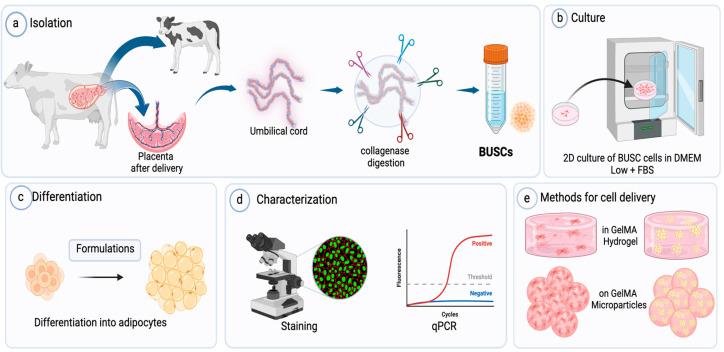
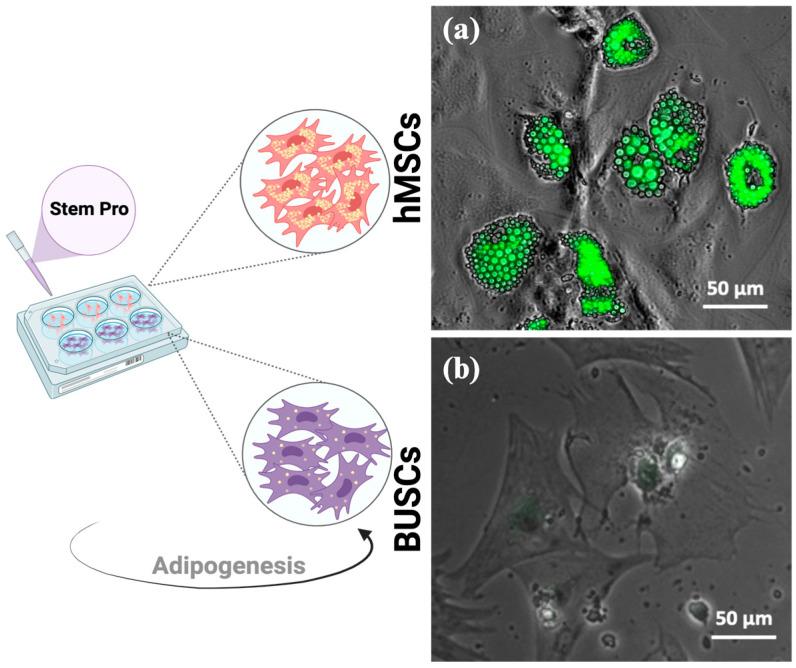
Cultivated meat, also known as cell-based or clean meat, utilizes mesenchymal stem cells to cultivate mature cell types like adipocytes, which are pivotal for imparting the desired taste and texture. The delivery of differentiated cells, crucial in cultivated meat production, is facilitated through extensive exploration of 3D culturing techniques mimicking physiological environments. In this study, we investigated the adipogenic differentiation potential of bovine umbilical cord stem cells (BUSCs), sourced from discarded birth tissue, and assessed the feasibility of delivering differentiated cells for cultivated meat using gelatin methacrylate (GelMA) as a carrier for adipose tissue. Various adipogenic inducers, previously reported to be effective for human mesenchymal stem cells (hMSCs), were evaluated individually or in combination for their efficacy in promoting the adipogenesis of BUSCs. Surprisingly, while the traditional adipogenic inducers, including insulin, dexamethasone, isobutylmethylxantine (IBMX), indomethacin, and rosiglitazone, showed no significant effect on the adipogenic differentiation of BUSCs, efficient differentiation was achieved in the presence of a fatty acid cocktail. Furthermore, we explored methods for the delivery of BUSCs. Differentiated cells were delivered either encapsulated in GelMA hydrogel or populated on the surface of GelMA microparticles (MPs) as the adipose component of cultivated meat. Our findings reveal that after adipogenic induction, the lipid production per cell was comparable when cultured either within hydrogel or on MPs. However, GelMA-MPs supported better cell growth compared to hydrogel encapsulation. Consequently, the overall lipid production is higher when BUSCs are delivered via GelMA-MPs rather than encapsulation. This study not only systematically evaluated the impact of common adipogenic inducers on BUSCs, but also identified GelMA-MPs as a promising carrier for delivering bovine adipocytes for cultivated meat production.
养殖肉,也被称为细胞培育肉或清洁肉,利用间充质干细胞培育成熟的细胞类型,如脂肪细胞,这些细胞对于赋予所需的味道和质地至关重要。在养殖肉生产中,通过广泛探索模拟生理环境的3D培养技术,促进了分化细胞的递送。在本研究中,我们研究了源自废弃出生组织的牛脐带干细胞(BUSCs)的成脂分化潜力,并评估了使用甲基丙烯酸明胶(GelMA)作为脂肪组织载体递送分化细胞用于养殖肉的可行性。对先前报道对人间充质干细胞(hMSCs)有效的各种成脂诱导剂进行了单独或组合评估,以确定它们促进BUSCs成脂的功效。令人惊讶的是,虽然传统的成脂诱导剂,包括胰岛素、地塞米松、异丁基甲基黄嘌呤(IBMX)、吲哚美辛和罗格列酮,对BUSCs的成脂分化没有显著影响,但在脂肪酸混合物存在的情况下实现了有效分化。此外,我们探索了BUSCs的递送方法。分化细胞以封装在GelMA水凝胶中或接种在GelMA微粒(MPs)表面的形式作为养殖肉的脂肪成分进行递送。我们的研究结果表明,成脂诱导后,当在水凝胶中或MPs上培养时,每个细胞的脂质产量相当。然而,与水凝胶封装相比,GelMA-MPs支持更好的细胞生长。因此,当通过GelMA-MPs而不是封装递送BUSCs时,总脂质产量更高。本研究不仅系统地评估了常见成脂诱导剂对BUSCs的影响,还确定GelMA-MPs是一种有前景的载体,可用于递送牛脂肪细胞用于养殖肉生产。



 Zotero 插件