
术前早期肺癌患者与局部脑区变化:一项横断面观察性描述性研究。
Preoperative early-stage lung cancer patients and local brain area changes: a cross-sectional observational descriptive study.
作者信息
Yuan Pei-Pei, Hua Xu-Yun
机构信息
Department of Nursing, Shuguang Hospital, Shanghai University of Traditional Chinese Medicine, Shanghai, China.
Department of Orthopedics, Shuguang Hospital, Shanghai University of Traditional Chinese Medicine, Shanghai, China.
出版信息
Front Psychol. 2024 Aug 14;15:1417668. doi: 10.3389/fpsyg.2024.1417668. eCollection 2024.
INTRODUCTION
Lung cancer is a major global health concern. Patients undergo a substantial process of emotional transformation following a lung cancer diagnosis, during which subtle changes in brain function and/or structure may occur. As such, the present study aimed to investigate the neuroplastic changes induced by negative emotions in patients with early-stage lung cancer.
METHODS
This cross-sectional study recruited 35 patients with early-stage lung cancer and 33 age- and sex-matched healthy control patients. All participants completed the Hamilton Anxiety Rating Scale (HAMA), Hamilton Depression Rating Scale (HAMD), and functional magnetic resonance imaging (fMRI). Amplitude of low-frequency fluctuations (ALFF) and regional homogeneity (ReHo) were used as the fMRI indices. Correlations between the clinical assessments and ALFF and ReHo values were calculated.
RESULTS
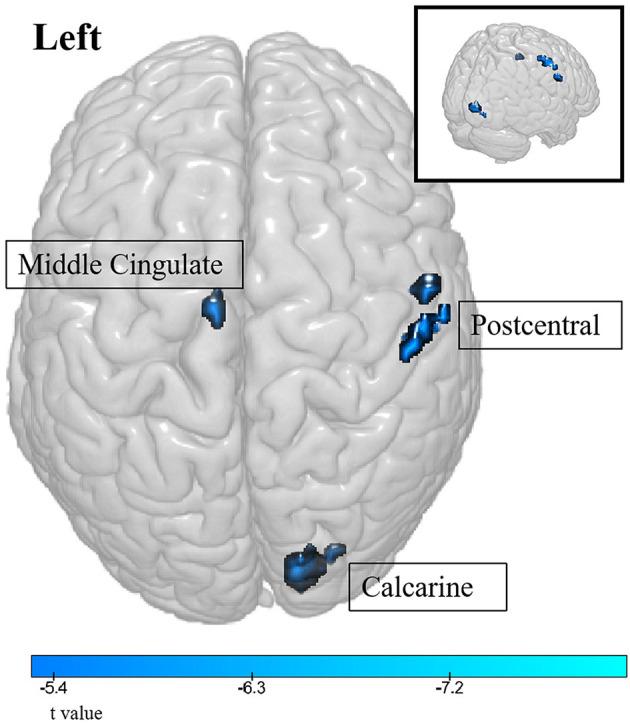
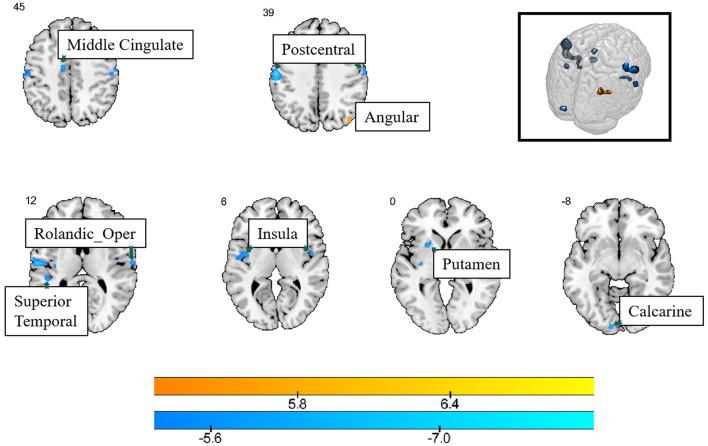
Our analysis revealed no significant differences in HAMD and HAMA scores between patients and control patients ( > 0.05). However, significant alterations in ALFF and ReHo were observed in multiple brain regions in patients with early-stage lung cancer compared to healthy controls ( < 0.05). Specifically, ALFF values were decreased in the right postcentral gyrus, calcarine, and left middle cingulate, while ReHo values increased in the right angular gyrus and decreased in the bilateral postcentral gyrus, insula, left calcarine, putamen, superior temporal gyrus, middle cingulate, and right Rolandic gyrus. The HAMD score was significantly correlated with the ALFF value in the right postcentral gyrus ( = 0.007).
CONCLUSION
This study provides valuable insights into the adaptive responses of the brain following the early diagnosis of lung cancer, revealing potential disturbances in negative emotional processing. Harnessing neuroplasticity may open new avenues for the establishment of personalized treatment strategies and targeted interventions to support the emotional and mental health of patients with lung cancer.
引言
肺癌是全球主要的健康问题。肺癌确诊后,患者会经历一个重大的情绪转变过程,在此期间大脑功能和/或结构可能会发生细微变化。因此,本研究旨在探讨早期肺癌患者负面情绪引起的神经可塑性变化。
方法
本横断面研究招募了35例早期肺癌患者和33例年龄及性别匹配的健康对照者。所有参与者均完成汉密尔顿焦虑量表(HAMA)、汉密尔顿抑郁量表(HAMD)以及功能磁共振成像(fMRI)检查。低频振幅(ALFF)和局部一致性(ReHo)被用作fMRI指标。计算临床评估与ALFF和ReHo值之间的相关性。
结果
我们的分析显示,患者与对照者之间的HAMD和HAMA评分无显著差异(>0.05)。然而,与健康对照者相比,早期肺癌患者多个脑区的ALFF和ReHo出现了显著改变(<0.05)。具体而言,右侧中央后回、距状裂以及左侧中央扣带回的ALFF值降低,而右侧角回的ReHo值升高,双侧中央后回、岛叶、左侧距状裂、壳核、颞上回、中央扣带回以及右侧中央前回的ReHo值降低。HAMD评分与右侧中央后回的ALFF值显著相关(=0.007)。
结论
本研究为肺癌早期诊断后大脑的适应性反应提供了有价值的见解,揭示了负面情绪处理过程中的潜在干扰。利用神经可塑性可能为制定个性化治疗策略和针对性干预措施开辟新途径,以支持肺癌患者的情绪和心理健康。

 Zotero 插件