
塑料化学回收与升级再造中的界面反应
Interfacial Reactions in Chemical Recycling and Upcycling of Plastics.
作者信息
Ong Albert, Teo Jerald Y Q, Lim Jason Y C
机构信息
Institute of Materials Research and Engineering (IMRE), Agency for Science, Technology and Research (A*STAR), 2 Fusionopolis Way, Innovis #08-03, Singapore 138634, Republic of Singapore.
Department of Materials Science and Engineering, National University of Singapore (NUS), 9 Engineering Drive 1, Singapore 117576, Singapore.
出版信息
ACS Appl Mater Interfaces. 2024 Sep 11;16(36):46975-46987. doi: 10.1021/acsami.4c09315. Epub 2024 Aug 30.
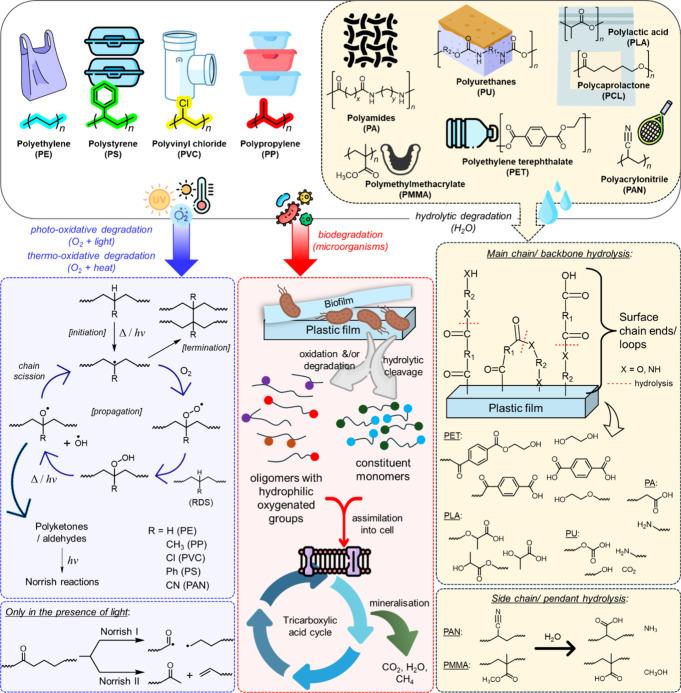
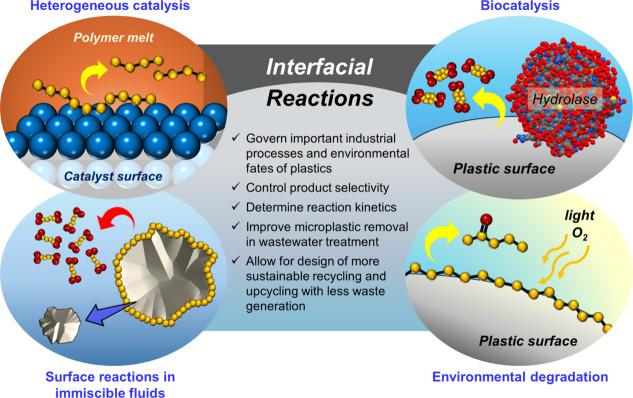
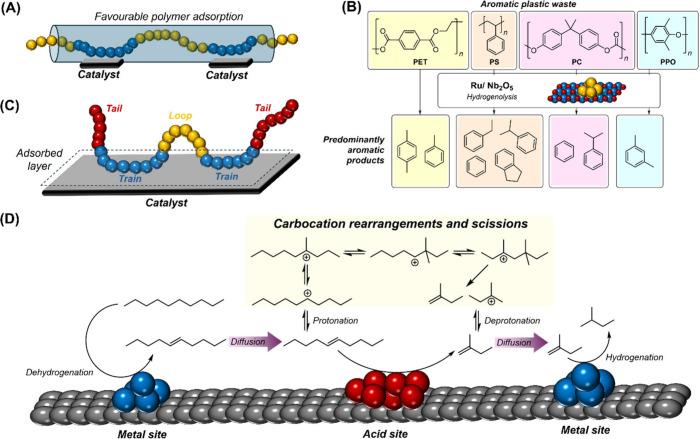
Depolymerization of plastics is a leading strategy to combat the escalating global plastic waste crisis through chemical recycling, upcycling, and remediation of micro-/nanoplastics. However, critical processes necessary for polymer chain scission, occurring at the polymer-catalyst or polymer-fluid interfaces, remain largely overlooked. Herein, we spotlight the importance of understanding these interfacial chemical processes as a critical necessity for optimizing kinetics and reactivity in plastics recycling and upcycling, controlling reaction outcomes, product distributions, as well as improving the environmental sustainability of these processes. Several examples are highlighted in heterogeneous processes such as hydrogenation over solid catalysts, reaction of plastics in immiscible media, and biocatalysis. Ultimately, judicious exploitation of interfacial reactivity has practical implications in developing practical, robust, and cost-effective processes to reduce plastic waste and enable a viable post-use circular plastics economy.
塑料解聚是通过化学回收、升级再造以及微/纳米塑料修复来应对全球塑料垃圾危机不断升级的一项主要策略。然而,聚合物链断裂所需的关键过程发生在聚合物-催化剂或聚合物-流体界面,这一点在很大程度上仍被忽视。在此,我们强调理解这些界面化学过程的重要性,这是优化塑料回收和升级再造中的动力学和反应性、控制反应结果、产物分布以及提高这些过程的环境可持续性的关键必要条件。在多相过程中突出了几个例子,如在固体催化剂上的氢化、塑料在不混溶介质中的反应以及生物催化。最终,明智地利用界面反应性对于开发实用、稳健且具有成本效益的减少塑料垃圾的过程以及实现可行的使用后循环塑料经济具有实际意义。

 Zotero 插件