
新冠疫情对韩国儿童血清维生素D浓度的影响。
Effects of the COVID-19 pandemic on serum vitamin D concentration in Korean children.
作者信息
Choi Jinjoo, Choe Yunsoo, Lee Kyeongmi, Kim Nayoung, Yang Seung
机构信息
Department of Pediatrics, Hanyang University Seoul Hospital, Korea.
Department of Pediatrics, Hanyang University Guri Hospital, Korea.
出版信息
Ann Pediatr Endocrinol Metab. 2024 Aug;29(4):220-226. doi: 10.6065/apem.2346196.098. Epub 2024 Aug 31.
PURPOSE
Social distancing policies and school closures in South Korea induced by coronavirus disease 2019 have raised concerns about a lower chance of exposure to sunlight in children and adolescents. This study investigates changes in the vitamin D status of children and adolescents following the pandemic.
METHODS
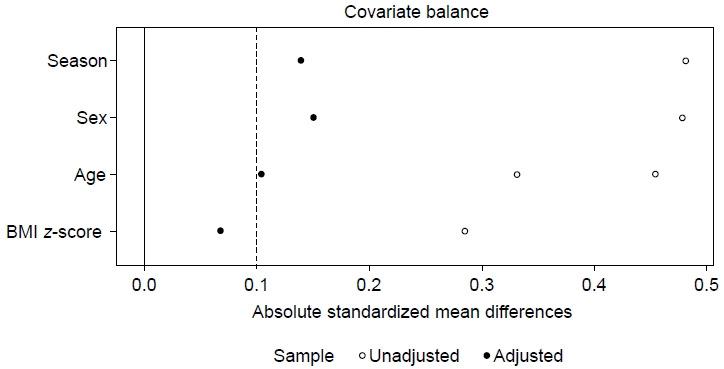
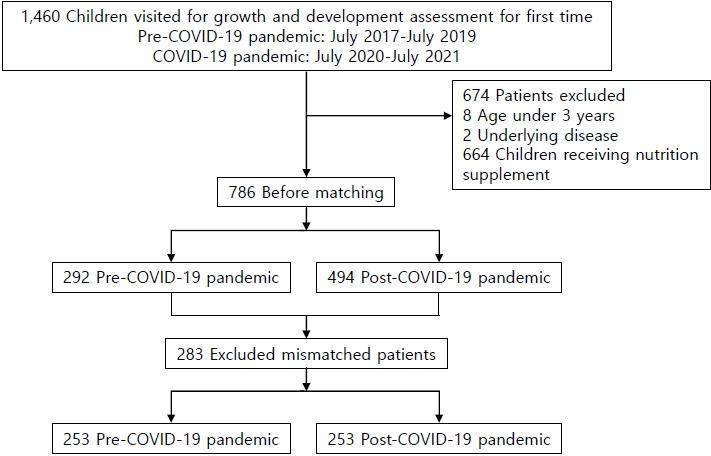
This retrospective study includes healthy children aged 3-18 years who visited Hanyang University Hospitals in Seoul or Guri during pre-coronavirus disease 2019 (COVID-19) and post-COVID-19 pandemic periods. August 2017 to July 2019 is defined as the pre-COVID-19 pandemic period, while the period from July 2020 to July 2021 is defined as post-COVID-19 or "during the pandemic." Propensity scores were used to match the prepandemic and pandemic groups 1:1 based on age, sex, season of blood collection, and body mass index z-score to compare vitamin D status among subjects.
RESULTS
Among 786 eligible children, 506 were matched using propensity scores. There were no significant differences in mean serum 25-hydroxyvitamin D (25(OH) D) levels (20.1±6.5 ng/mL vs. 19.9±6.3 ng/mL, P>0.05) or vitamin D deficiency rates (53.0% vs. 54.9%, P>0.05) between the prepandemic and pandemic groups. Seasonal analysis revealed lower mean serum 25(OH)D levels during the pandemic in winter/spring seasons in comparison to these levels in subjects in prepandemic winter/spring seasons (19.1±3.8 ng/mL vs. 17.2±3.7 ng/mL, P=0.006).
CONCLUSION
During the COVID-19 pandemic, Korean children and adolescents showed similar serum 25(OH)D levels and vitamin D status to the prepandemic period, with a significant decrease in these measures observed in winter/spring seasons only. Prolonged confinement, such as in pandemic circumstances, underscores the need for vigilant monitoring of vitamin D status and supplementation, particularly in high-risk seasons.
目的
2019年冠状病毒病引发的韩国社交距离政策和学校关闭引发了人们对儿童和青少年日照机会减少的担忧。本研究调查了疫情期间儿童和青少年维生素D状况的变化。
方法
这项回顾性研究纳入了2019年冠状病毒病(COVID-19)之前和之后在首尔或九里的汉阳大学医院就诊的3至18岁健康儿童。2017年8月至2019年7月被定义为COVID-19大流行前时期,而2020年7月至2021年7月期间被定义为COVID-19后或“大流行期间”。倾向得分用于根据年龄、性别、采血季节和体重指数z评分将大流行前和大流行组进行1:1匹配,以比较受试者之间的维生素D状况。
结果
在786名符合条件的儿童中,使用倾向得分匹配了506名。大流行前和大流行组之间的平均血清25-羟基维生素D(25(OH)D)水平(20.1±6.5 ng/mL对19.9±6.3 ng/mL,P>0.05)或维生素D缺乏率(53.0%对54.9%,P>0.05)没有显著差异。季节性分析显示,与大流行前冬季/春季的受试者相比,大流行期间冬季/春季的平均血清25(OH)D水平较低(19.1±3.8 ng/mL对17.2±3.7 ng/mL,P=0.006)。
结论
在COVID-19大流行期间,韩国儿童和青少年的血清25(OH)D水平和维生素D状况与大流行前时期相似,仅在冬季/春季观察到这些指标显著下降。长时间的隔离,如在大流行情况下,凸显了对维生素D状况进行密切监测和补充的必要性,特别是在高危季节。
 Zotero 插件