
高浓度氢气吸入通过改善线粒体动力学减轻脓毒症相关性脑病小鼠的损伤。
High-concentration hydrogen inhalation mitigates sepsis-associated encephalopathy in mice by improving mitochondrial dynamics.
机构信息
Department of Pathogen Biology, School of Basic Medical Sciences, Tianjin Medical University, Tianjin, China.
Department of Critical Care Medicine, Tianjin Medical University General Hospital, Tianjin, China.
出版信息
CNS Neurosci Ther. 2024 Sep;30(9):e70021. doi: 10.1111/cns.70021.
BACKGROUND
Sepsis-associated encephalopathy (SAE) is a neuronal injury with poor prognosis. Mitochondrial dysfunction is critical in SAE development, and hydrogen gas (H) has a protective effect on septic mice. This study aimed to investigate the effect of high concentration (67%) of H on SAE and whether it is related to mitochondrial biogenesis and mitochondrial dynamics.
METHODS
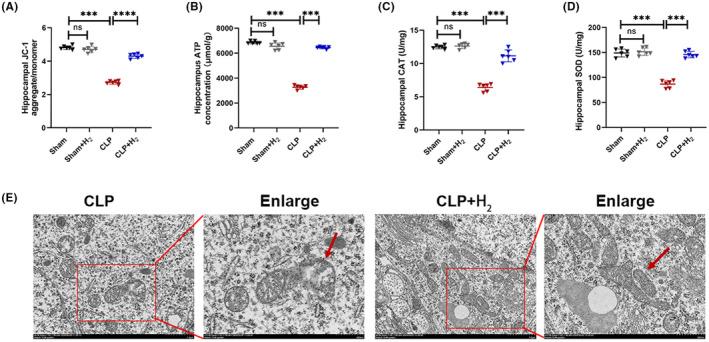
A mouse sepsis model was induced by cecal ligation and puncture. The mice inhalated 67% H for 1 h at 1 and 6 h post-surgery, respectively. The 7-day survival rate was recorded. Cognitive function was assessed using the Y-maze test and Morris water maze test. Serum inflammatory factors, antioxidant enzymes, as well as mitochondrial function indexes including mitochondrial membrane potential (MMP) and ATP in the hippocampal tissue were evaluated 24 h after surgery. Mitochondrial dynamic proteins (DRP1 and MFN2) and biosynthetic proteins (PGC-1α, NRF2, and TFAM) in the hippocampal tissue were detected. Moreover, the morphology of mitochondria was observed by transmission electron microscopy.
RESULTS
Inhalation of 67% H improved the 7-day survival rates and recognition memory function of septic mice, alleviated brain antioxidant enzyme activity (SOD and CAT), and reduced serum proinflammatory cytokine levels. H inhalation also enhanced the expression of MFN2 and mitochondrial biogenesis-related factors (PGC-1α, NRF2, and TFAM) and decreased the expression of fission protein (DRP1), leading to improvement in mitochondrial function, as evidenced by MMP and ATP levels.
CONCLUSIONS
Inhalation of high concentration (67%) of H in septic mice improved the survival rate and reduced neuronal injury. Its mechanism might be mediated by enhancing mitochondrial biogenesis and mitochondrial dynamics.
背景
脓毒症相关性脑病(SAE)是一种预后不良的神经元损伤。线粒体功能障碍在 SAE 的发展中至关重要,氢气(H)对脓毒症小鼠具有保护作用。本研究旨在探讨高浓度(67%)H 对 SAE 的影响,以及其是否与线粒体生物发生和线粒体动力学有关。
方法
采用盲肠结扎穿孔术建立小鼠脓毒症模型。术后 1 小时和 6 小时,分别让小鼠吸入 67%H 1 小时。记录 7 天生存率。术后 24 小时,采用 Y 迷宫测试和 Morris 水迷宫测试评估认知功能。评估血清炎症因子、抗氧化酶以及海马组织中线粒体功能指标,包括线粒体膜电位(MMP)和 ATP。检测海马组织中线粒体动态蛋白(DRP1 和 MFN2)和生物合成蛋白(PGC-1α、NRF2 和 TFAM)。此外,通过透射电子显微镜观察线粒体的形态。
结果
吸入 67%H 可提高脓毒症小鼠的 7 天生存率和识别记忆功能,减轻大脑抗氧化酶活性(SOD 和 CAT),降低血清促炎细胞因子水平。H 吸入还增强了 MFN2 和线粒体生物发生相关因子(PGC-1α、NRF2 和 TFAM)的表达,降低了分裂蛋白(DRP1)的表达,从而改善了线粒体功能,表现为 MMP 和 ATP 水平的提高。
结论
在脓毒症小鼠中吸入高浓度(67%)H 可提高生存率并减轻神经元损伤。其机制可能是通过增强线粒体生物发生和线粒体动力学来介导的。



 Zotero 插件