
1990 - 2021年全球、区域和国家层面上呼吸道感染和中耳炎的负担:全球疾病负担研究2021的系统分析
Global, regional, and national burden of upper respiratory infections and otitis media, 1990-2021: a systematic analysis from the Global Burden of Disease Study 2021.
出版信息
Lancet Infect Dis. 2025 Jan;25(1):36-51. doi: 10.1016/S1473-3099(24)00430-4. Epub 2024 Sep 9.
BACKGROUND
Upper respiratory infections (URIs) are the leading cause of acute disease incidence worldwide and contribute to a substantial health-care burden. Although acute otitis media is a common complication of URIs, the combined global burden of URIs and otitis media has not been studied comprehensively. We used results from the Global Burden of Diseases, Injuries, and Risk Factors Study 2021 to explore the fatal and non-fatal burden of the two diseases across all age groups, including a granular analysis of children younger than 5 years, in 204 countries and territories from 1990 to 2021.
METHODS
Mortality due to URIs and otitis media was estimated with use of vital registration and sample-based vital registration data, which are used as inputs to the Cause of Death Ensemble model to separately model URIs and otitis media mortality by age and sex. Morbidity was modelled with a Bayesian meta-regression tool using data from published studies identified via systematic reviews, population-based survey data, and cause-specific URI and otitis media mortality estimates. Additionally, we assessed and compared the burden of otitis media as it relates to URIs and examined the collective burden and contributing risk factors of both diseases.
FINDINGS
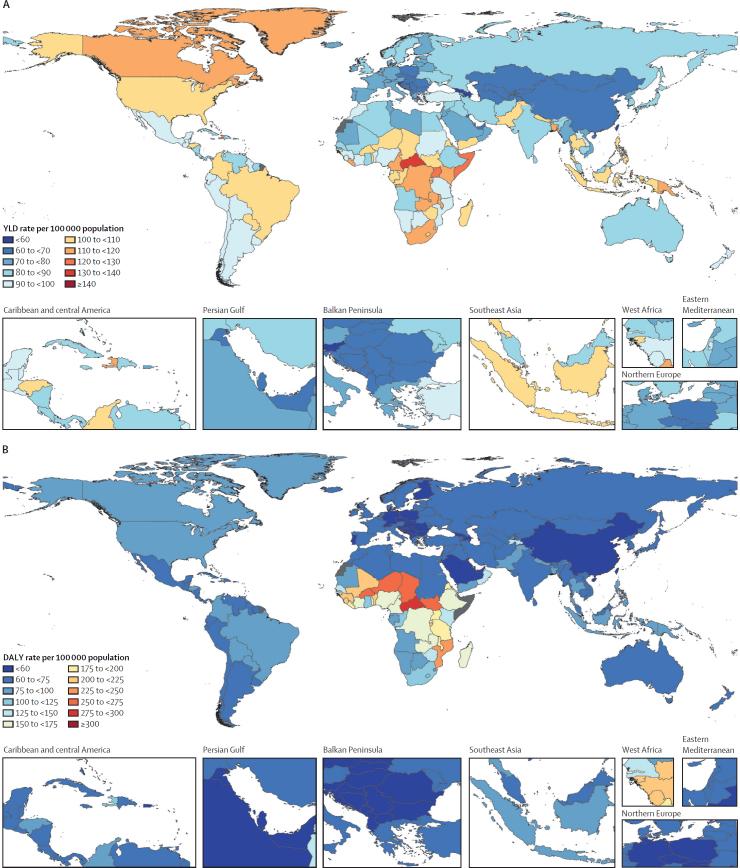
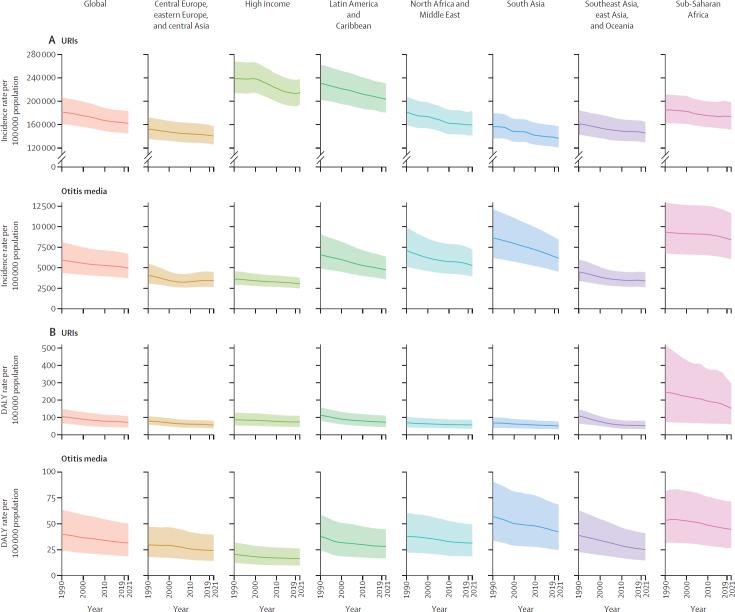
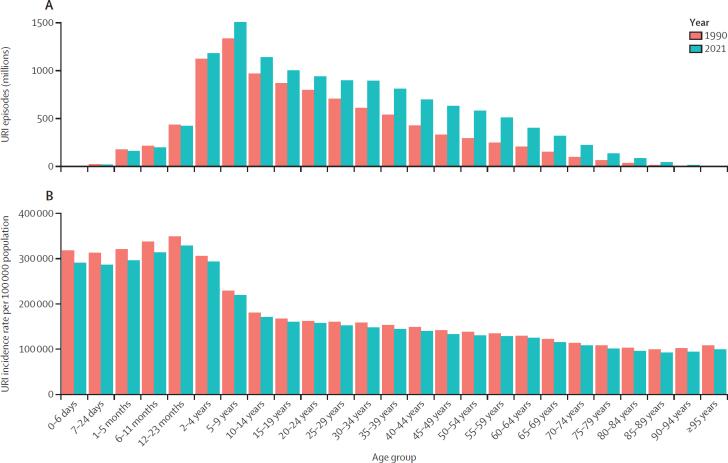
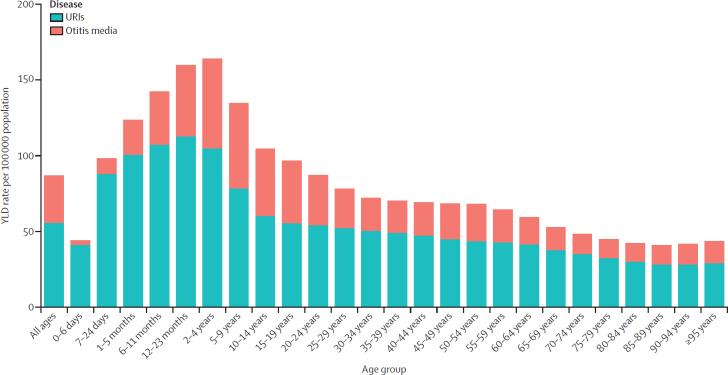
The global number of new episodes of URIs was 12·8 billion (95% uncertainty interval 11·4 to 14·5) for all ages across males and females in 2021. The global all-age incidence rate of URIs decreased by 10·1% (-12·0 to -8·1) from 1990 to 2019. From 2019 to 2021, the global all-age incidence rate fell by 0·5% (-0·8 to -0·1). Globally, the incidence rate of URIs was 162 484·8 per 100 000 population (144 834·0 to 183 289·4) in 2021, a decrease of 10·5% (-12·4 to -8·4) from 1990, when the incidence rate was 181 552·5 per 100 000 population (160 827·4 to 206 214·7). The highest incidence rates of URIs were seen in children younger than 2 years in 2021, and the largest number of episodes was in children aged 5-9 years. The number of new episodes of otitis media globally for all ages was 391 million (292 to 525) in 2021. The global incidence rate of otitis media was 4958·9 per 100 000 (3705·4 to 6658·6) in 2021, a decrease of 16·3% (-18·1 to -14·0) from 1990, when the incidence rate was 5925·5 per 100 000 (4371·8 to 8097·9). The incidence rate of otitis media in 2021 was highest in children younger than 2 years, and the largest number of episodes was in children aged 2-4 years. The mortality rate of URIs in 2021 was 0·2 per 100 000 (0·1 to 0·5), a decrease of 64·2% (-84·6 to -43·4) from 1990, when the mortality rate was 0·7 per 100 000 (0·2 to 1·1). In both 1990 and 2021, the mortality rate of otitis media was less than 0·1 per 100 000. Together, the combined burden accounted for by URIs and otitis media in 2021 was 6·86 million (4·24 to 10·4) years lived with disability and 8·16 million (4·99 to 12·0) disability-adjusted life-years (DALYs) for all ages across males and females. Globally, the all-age DALY rate of URIs and otitis media combined in 2021 was 103 per 100 000 (63 to 152). Infants aged 1-5 months had the highest combined DALY rate in 2021 (647 per 100 000 [189 to 1412]), followed by early neonates (aged 0-6 days; 582 per 100 000 [176 to 1297]) and late neonates (aged 7-24 days; 482 per 100 000 [161 to 1052]).
INTERPRETATION
The findings of this study highlight the widespread burden posed by URIs and otitis media across all age groups and both sexes. There is a continued need for surveillance, prevention, and management to better understand and reduce the burden associated with URIs and otitis media, and research is needed to assess their impacts on individuals, communities, economies, and health-care systems worldwide.
FUNDING
Bill & Melinda Gates Foundation.
背景
上呼吸道感染(URIs)是全球急性疾病发病的主要原因,造成了巨大的医疗负担。尽管急性中耳炎是URIs的常见并发症,但URIs和中耳炎的全球综合负担尚未得到全面研究。我们利用《2021年全球疾病、伤害和风险因素负担研究》的结果,探讨了1990年至2021年期间这两种疾病在204个国家和地区所有年龄组中的致命和非致命负担,包括对5岁以下儿童的详细分析。
方法
利用生命登记和基于样本的生命登记数据估计URIs和中耳炎导致的死亡率,这些数据被用作死因综合模型的输入,以按年龄和性别分别模拟URIs和中耳炎的死亡率。发病率采用贝叶斯元回归工具进行建模,使用通过系统评价确定的已发表研究数据、基于人群的调查数据以及特定病因的URIs和中耳炎死亡率估计值。此外,我们评估并比较了与URIs相关的中耳炎负担,并研究了这两种疾病的总体负担和相关风险因素。
结果
2021年,全球所有年龄组男性和女性的URIs新发病例数为128亿例(95%不确定区间为114亿至145亿例)。从1990年到2019年,全球所有年龄组的URIs发病率下降了10.1%(-12.0%至-8.1%)。从2019年到2021年,全球所有年龄组的发病率下降了0.5%(-0.8%至-0.1%)。2021年,全球URIs发病率为每10万人162484.8例(144834.0至183289.4例),较1990年下降了10.5%(-12.4%至-8.4%),1990年的发病率为每10万人181552.5例(160827.4至206214.7例)。2021年,URIs发病率最高的是2岁以下儿童,发病例数最多的是5至9岁儿童。2021年,全球所有年龄组的中耳炎新发病例数为3.91亿例(2.92亿至5.25亿例)。2021年,全球中耳炎发病率为每10万人4958.9例(3705.4至6658.6例),较1990年下降了16.3%(-18.1%至-14.0%),1990年的发病率为每10万人5925.5例(4371.8至8097.9例)。2021年,中耳炎发病率最高的是2岁以下儿童,发病例数最多的是2至4岁儿童。2021年,URIs死亡率为每10万人0.2例(0.1至0.5例),较1990年下降了64.2%(-84.6%至-43.4%),1990年的死亡率为每10万人0.7例(0.2至1.1例)。1990年和2021年,中耳炎死亡率均低于每10万人0.1例。2021年,URIs和中耳炎共同造成的负担为686万人年(424万至1040万人年)的伤残调整生命年和816万人年(499万至1200万人年)的伤残调整生命年(DALYs),涉及所有年龄组的男性和女性。2021年,全球URIs和中耳炎合并的所有年龄组DALY率为每10万人103例(63至152例)。2021年,1至5个月大的婴儿合并DALY率最高(每10万人647例[189至1412例]),其次是早期新生儿(0至6天;每10万人582例[176至1297例])和晚期新生儿(7至24天;每10万人482例[161至1052例])。
解读
本研究结果凸显了URIs和中耳炎在所有年龄组和两性中造成的广泛负担。持续需要进行监测、预防和管理,以更好地了解和减轻与URIs和中耳炎相关的负担,并且需要开展研究以评估它们对全球个人、社区、经济和医疗系统的影响。
资金来源
比尔及梅琳达·盖茨基金会。

 Zotero 插件