
1990年至2021年全球、区域和国家儿童及青少年中耳炎负担及其到2040年的预测。
Global, regional and national burdens of otitis media in children and adolescents from 1990 to 2021 and its predictions to 2040.
作者信息
Chen Ru, Deng Jing, Sun Yao, Sun Dongxun, Lu Haibin, Jiao Xinfang, Zhu Feng, Lu Liangjie, Sima Guoqi
机构信息
Department of Otolaryngology, The First Hospital of Jiaxing, The Affiliated Hospital of Jiaxing University, Jiaxing, China.
出版信息
Front Public Health. 2025 Jul 3;13:1552405. doi: 10.3389/fpubh.2025.1552405. eCollection 2025.
BACKGROUND
Otitis media (OM), including acute OM, chronic OM, and OM with effusion, is associated with varying degrees of hearing impairment. Children and adolescents (CAAs) are particularly vulnerable to OM. However, epidemiological data on OM in CAAs is relatively scarce. This study investigates the global, regional, and national burden of OM in CAAs from 1990 to 2021, with projections extending to 2040.
METHODS
Data were extracted from Global Burden of Diseases (GBD) 2021 on incidence, prevalence, deaths and disability-adjusted life years (DALYs). Trends were evaluated using the metric of estimated annual percentage change (EAPC). Subgroup analyses were conducted according to socio-demographic index (SDI), and age. Additionally, projections were estimated for 2040 using the Nordpred model.
RESULTS
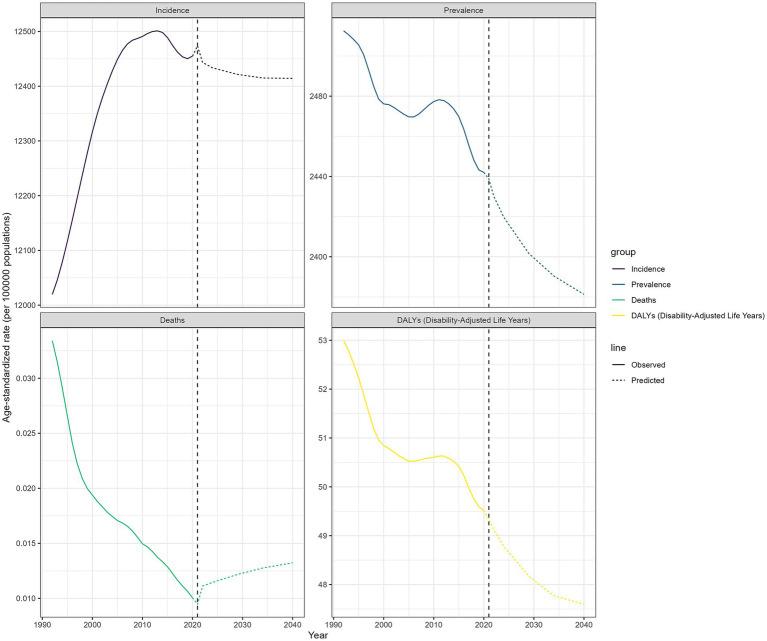
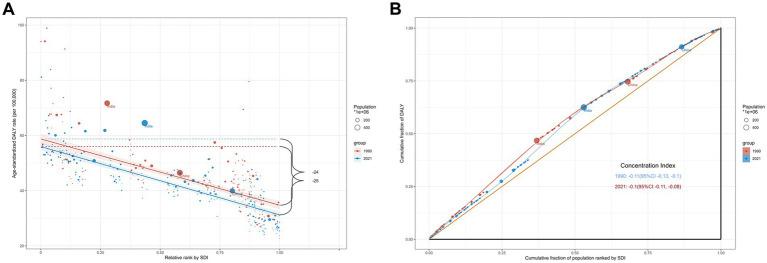
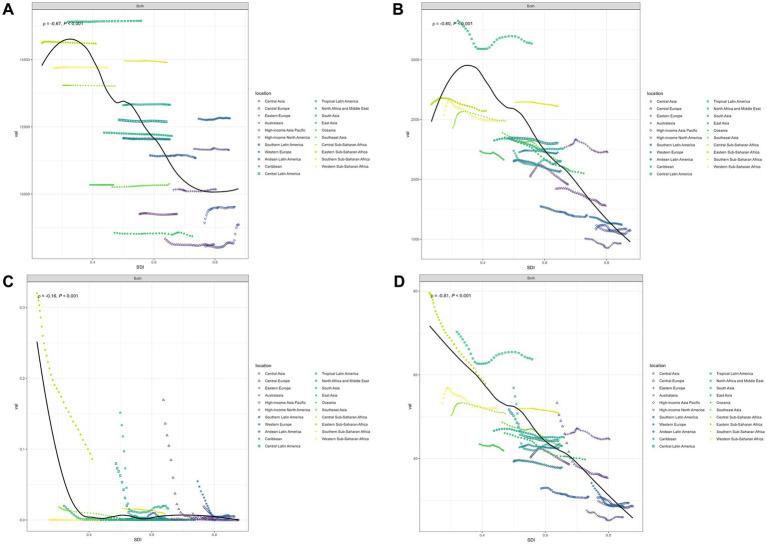
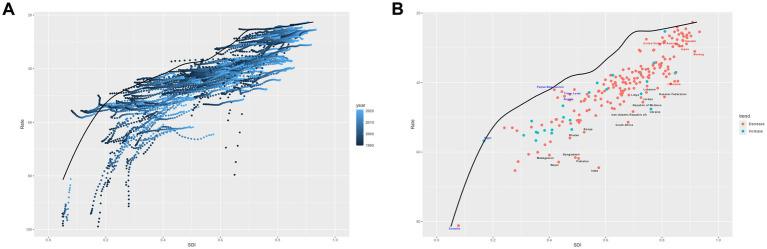
Globally, the rates with their 95% uncertainty intervals (UI) in 2021 were 12473.66 (7287.91-19931.88) for incidence, 2438.73 (1918.03-3055.21) for prevalence, 0.0095 (0.0022-0.0320) for deaths, and 49.33 (27.68-78.84) for DALYs. From 1990 to 2021, the EAPC and its 95% UI of incidence rate increased by 0.13 (0.11-0.16), while EAPC of deaths -3.79 (-4.07 to -3.52), prevalence -0.08 (-0.09 to -0.07), and DALYs -0.2 (-0.23 to -0.17) decreased. The aforementioned indicators are negatively correlated with the SDI. Regionally, both mortality rates and DALYs significantly decrease with increasing SDI. Sub-Saharan Africa and South Asia have high levels of incidence and prevalence. At the national level, countries with a high burden of OM are primarily concentrated in Sub-Saharan Africa and South Asia. For example: Pakistan, India, Ethiopia, Kenya, Nepal, Bangladesh, Somalia, South Sudan, Mozambique, Burundi, and Madagascar. From 2022 to 2040, the incidence rate, prevalence, and DALYs of OM are expected to show a downward trend. However, the mortality rate may slightly increase.
CONCLUSION
From 1990 to 2021, there has been some progress in the management of OM. However, the incidence in CAAs has increased. Epidemiological data vary across different regions and countries, with regions and countries with lower SDI typically experiencing a heavier burden. It is necessary to implement dynamic monitoring of OM in CAAs and develop strategies to mitigate the future burden of this disease.
背景
中耳炎(OM),包括急性中耳炎、慢性中耳炎和分泌性中耳炎,与不同程度的听力损害相关。儿童和青少年(CAAs)尤其易患中耳炎。然而,关于CAAs中耳炎的流行病学数据相对较少。本研究调查了1990年至2021年全球、区域和国家CAAs中耳炎的负担,并预测至2040年。
方法
从《2021年全球疾病负担》(GBD 2021)中提取发病率、患病率、死亡人数和伤残调整生命年(DALYs)的数据。使用估计年百分比变化(EAPC)指标评估趋势。根据社会人口指数(SDI)和年龄进行亚组分析。此外,使用Nordpred模型对2040年进行了预测。
结果
在全球范围内,2021年发病率及其95%不确定区间(UI)为12473.66(7287.91 - 19931.88),患病率为2438.73(1918.03 - 3055.21),死亡率为0.0095(0.0022 - 0.0320),DALYs为49.33(27.68 - 78.84)。从1990年到2021年,发病率的EAPC及其95% UI上升了0.13(0.11 - 0.16),而死亡率的EAPC为 - 3.79( - 4.07至 - 3.52),患病率为 - 0.08( - 0.09至 - 0.07),DALYs为 - 0.2( - 0.23至 - 0.17),呈下降趋势。上述指标与SDI呈负相关。在区域层面,死亡率和DALYs均随SDI的增加而显著下降。撒哈拉以南非洲和南亚的发病率和患病率较高。在国家层面,中耳炎负担较高的国家主要集中在撒哈拉以南非洲和南亚。例如:巴基斯坦、印度、埃塞俄比亚、肯尼亚、尼泊尔、孟加拉国、索马里、南苏丹、莫桑比克、布隆迪和马达加斯加。从2022年到2040年,预计中耳炎的发病率、患病率和DALYs将呈下降趋势。然而,死亡率可能会略有上升。
结论
从1990年到2021年,中耳炎的管理取得了一些进展。然而,CAAs的发病率有所上升。不同地区和国家的流行病学数据各不相同,SDI较低的地区和国家通常负担较重。有必要对CAAs的中耳炎实施动态监测,并制定策略以减轻该疾病未来的负担。



 Zotero 插件