
睡眠模式、身体活动、遗传易感性与类风湿关节炎发病:一项前瞻性队列研究。
Sleep patterns, physical activity, genetic susceptibility, and incident rheumatoid arthritis: a prospective cohort study.
机构信息
Department of Epidemiology and Biostatistics, School of Public Health, Anhui Medical University, Hefei, Anhui, China.
Inflammation and Immune Mediated Diseases Laboratory of Anhui Province, Hefei, Anhui, China.
出版信息
BMC Med. 2024 Sep 13;22(1):390. doi: 10.1186/s12916-024-03615-5.
BACKGROUND
Sleep and physical activity (PA) are thought to be interconnected with the development of rheumatoid arthritis (RA). However, the precise nature and extent of these relationships have yet to be fully quantified. This study aimed to quantify the longitudinal effects of sleep behaviors, PA, and genetic susceptibility on the incidence of RA and to estimate the combined effects and interactions among these exposures.
METHODS
A total of 363,211 adults were derived from a large European cohort. We incorporated five sleep behaviors (sleep duration, insomnia, snoring, chronotype, and daytime sleepiness) to generate sleep patterns, which were defined based on healthy sleep scores. Multivariate-adjusted Cox proportional hazard models were conducted to assess the individual and combined associations of sleep patterns, PA, and genetic susceptibility with the risk of RA occurrence. Multiplicative and additive interactions were estimated by P and relative excess risk due to interaction (RERI) between each of the two exposures.
RESULTS
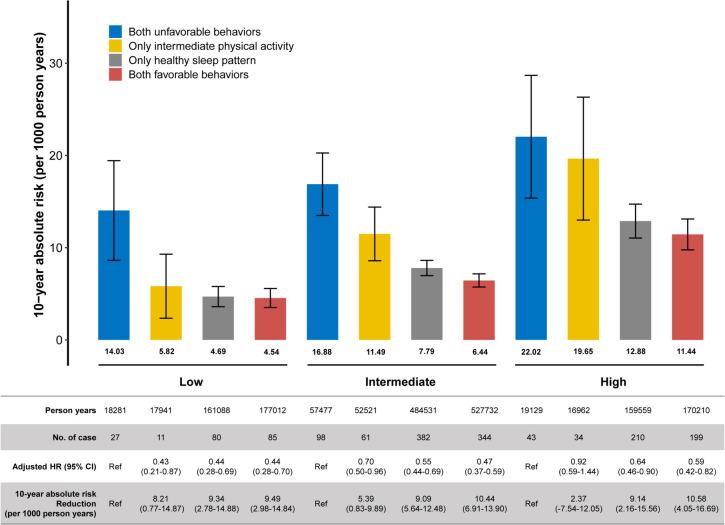
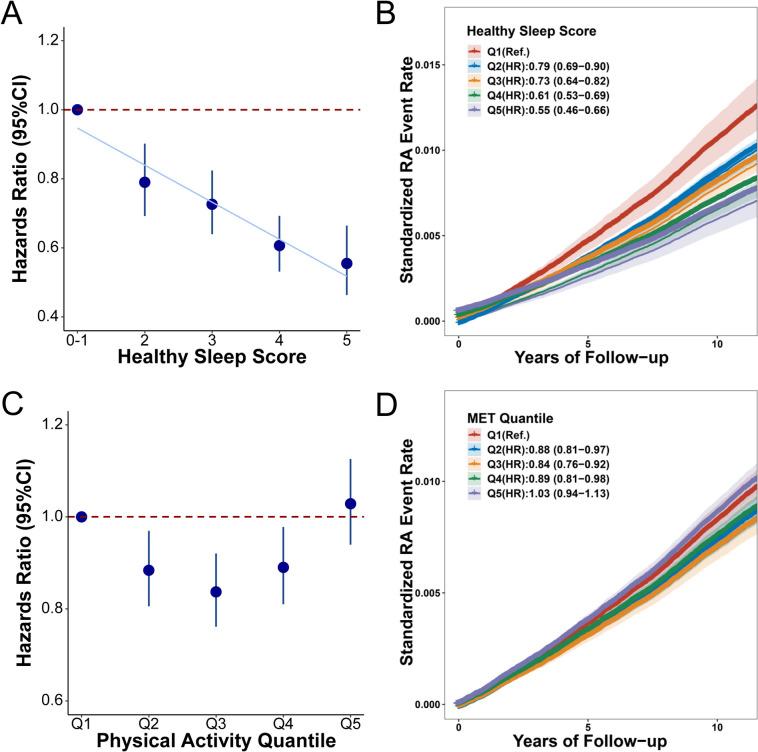
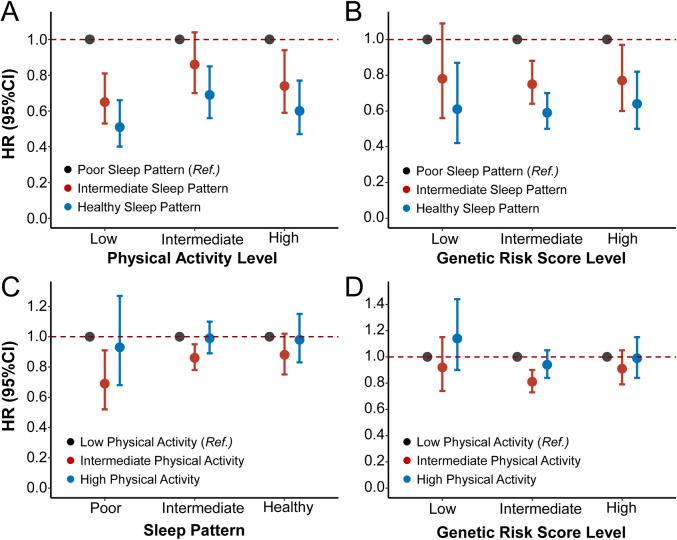
During a follow-up of 12.5 years, 4262 RA cases were ascertained. A healthy sleep pattern was associated with a decreased risk of RA in a dose-response manner, with an adjusted hazard ratio (HR) of 0.79 (95% confidence interval [CI] = 0.75-0.84), independent of traditional risk factors and genetic predisposition. Under the restricted cubic splines model, a non-linear association was detected for PA and RA risk. Participants in the intermediate quintile 3 showed the lowest risk for developing RA, with a HR 95% CI of 0.84 (0.76-0.92). Moreover, there was an additive interaction effect of intermediate sleep pattern and PA, with a 0.45 (95% CI = 0.02-0.87) RERI of developing RA. Additionally, individuals at high genetic risk had the greatest 10-year absolute risk reduction (10.58 per 1000 person-years) when adopting both favorable behaviors.
CONCLUSIONS
A healthy sleep pattern and moderate PA were associated with a reduced risk of developing RA, which can offset the deleterious effects of predisposing genetic components. Implementing these modifiable lifestyle factors into public health practices is beneficial for RA prevention.
背景
睡眠和身体活动(PA)被认为与类风湿关节炎(RA)的发展有关。然而,这些关系的确切性质和程度尚未得到充分量化。本研究旨在量化睡眠行为、PA 和遗传易感性对 RA 发病的纵向影响,并估计这些暴露因素的综合效应和相互作用。
方法
本研究共纳入了来自一个大型欧洲队列的 363211 名成年人。我们纳入了五种睡眠行为(睡眠时间、失眠、打鼾、昼夜节律和白天嗜睡)来生成睡眠模式,这些模式是根据健康睡眠评分来定义的。采用多变量调整的 Cox 比例风险模型评估睡眠模式、PA 和遗传易感性与 RA 发病风险的个体和综合关联。通过 P 值和交互超额相对风险(RERI)来估计每种两种暴露之间的乘法和加法交互作用。
结果
在 12.5 年的随访期间,共确定了 4262 例 RA 病例。健康的睡眠模式与 RA 发病风险呈剂量反应关系,调整后的风险比(HR)为 0.79(95%置信区间[CI] = 0.75-0.84),独立于传统危险因素和遗传易感性。在受限立方样条模型中,PA 和 RA 风险之间存在非线性关联。处于中间五分位数 3 的参与者患 RA 的风险最低,HR 95%CI 为 0.84(0.76-0.92)。此外,中等睡眠模式和 PA 之间存在相加交互作用,RA 的发病 RERI 为 0.45(95%CI=0.02-0.87)。此外,当采用两种有利行为时,高遗传风险个体的 10 年绝对风险降低幅度最大(每 1000 人年 10.58 人)。
结论
健康的睡眠模式和适度的 PA 与降低患 RA 的风险相关,这可以抵消遗传易感性成分的有害影响。将这些可改变的生活方式因素纳入公共卫生实践中有利于 RA 的预防。
 Zotero 插件