
一种用于主动脉夹层分诊优先级排序和分类的深度学习驱动应用程序的诊断性能
Diagnostic Performance of a Deep Learning-Powered Application for Aortic Dissection Triage Prioritization and Classification.
作者信息
Laletin Vladimir, Ayobi Angela, Chang Peter D, Chow Daniel S, Soun Jennifer E, Junn Jacqueline C, Scudeler Marlene, Quenet Sarah, Tassy Maxime, Avare Christophe, Roca-Sogorb Mar, Chaibi Yasmina
机构信息
Avicenna.AI, 375 Avenue du Mistral, 13600 La Ciotat, France.
Department of Radiological Sciences, University of California Irvine, Irvine, CA 92697, USA.
出版信息
Diagnostics (Basel). 2024 Aug 27;14(17):1877. doi: 10.3390/diagnostics14171877.
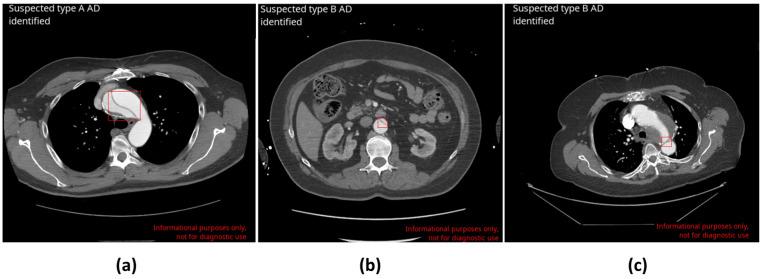
This multicenter retrospective study evaluated the diagnostic performance of a deep learning (DL)-based application for detecting, classifying, and highlighting suspected aortic dissections (ADs) on chest and thoraco-abdominal CT angiography (CTA) scans. CTA scans from over 200 U.S. and European cities acquired on 52 scanner models from six manufacturers were retrospectively collected and processed by CINA-CHEST (AD) (Avicenna.AI, La Ciotat, France) device. The diagnostic performance of the device was compared with the ground truth established by the majority agreement of three U.S. board-certified radiologists. Furthermore, the DL algorithm's time to notification was evaluated to demonstrate clinical effectiveness. The study included 1303 CTAs (mean age 58.8 ± 16.4 years old, 46.7% male, 10.5% positive). The device demonstrated a sensitivity of 94.2% [95% CI: 88.8-97.5%] and a specificity of 97.3% [95% CI: 96.2-98.1%]. The application classified positive cases by the AD type with an accuracy of 99.5% [95% CI: 98.9-99.8%] for type A and 97.5 [95% CI: 96.4-98.3%] for type B. The application did not miss any type A cases. The device flagged 32 cases incorrectly, primarily due to acquisition artefacts and aortic pathologies mimicking AD. The mean time to process and notify of potential AD cases was 27.9 ± 8.7 s. This deep learning-based application demonstrated a strong performance in detecting and classifying aortic dissection cases, potentially enabling faster triage of these urgent cases in clinical settings.
这项多中心回顾性研究评估了一种基于深度学习(DL)的应用程序在胸部和胸腹CT血管造影(CTA)扫描中检测、分类和突出显示疑似主动脉夹层(AD)的诊断性能。回顾性收集了来自美国和欧洲200多个城市、由六个制造商的52种扫描仪型号采集的CTA扫描数据,并通过CINA-CHEST(AD)(Avicenna.AI,法国拉西奥塔)设备进行处理。将该设备的诊断性能与三位美国董事会认证放射科医生的多数意见确定的地面真相进行比较。此外,评估了DL算法的通知时间以证明其临床有效性。该研究包括1303例CTA(平均年龄58.8±16.4岁,男性46.7%,阳性10.5%)。该设备的敏感性为94.2%[95%CI:88.8-97.5%],特异性为97.3%[95%CI:96.2-98.1%]。该应用程序按AD类型对阳性病例进行分类,A型的准确率为99.5%[95%CI:98.9-99.8%],B型的准确率为97.5[95%CI:96.4-98.3]%。该应用程序没有遗漏任何A型病例。该设备错误标记了32例病例,主要是由于采集伪影和模仿AD的主动脉病变。处理并通知潜在AD病例的平均时间为27.9±8.7秒。这种基于深度学习的应用程序在检测和分类主动脉夹层病例方面表现出强大的性能,有可能在临床环境中更快地对这些紧急病例进行分诊。

 Zotero 插件