
一种用于预测主动脉夹层的创新型双模态计算机断层扫描数据驱动深度学习模型:一项多中心研究。
An innovative bimodal computed tomography data-driven deep learning model for predicting aortic dissection: a multi-center study.
作者信息
Li Ziqian, Chen Lintao, Zhang Shengxuming, Zhang Xiuming, Zhang Jing, Ying Mingliang, Zhu Jianyong, Li Ruiyang, Song Mingli, Feng Zunlei, Zhang Jianjun, Liang Wenjie
机构信息
Department of Radiology, the First Affiliated Hospital, Zhejiang University School of Medicine, Hangzhou, China.
Department of Computer Science and Technology, Zhejiang University, Hangzhou, China.
出版信息
Quant Imaging Med Surg. 2025 Sep 1;15(9):8359-8371. doi: 10.21037/qims-2024-2807. Epub 2025 Aug 18.
BACKGROUND
Aortic dissection (AD) is a lethal emergency requiring prompt diagnosis. Current computed tomography angiography (CTA)-based diagnosis requires contrast agents, which expends time, whereas existing deep learning (DL) models only support single-modality inputs [non-contrast computed tomography (CT) or CTA]. In this study, we propose a bimodal DL framework to independently process both types, enabling dual-path detection and improving diagnostic efficiency.
METHODS
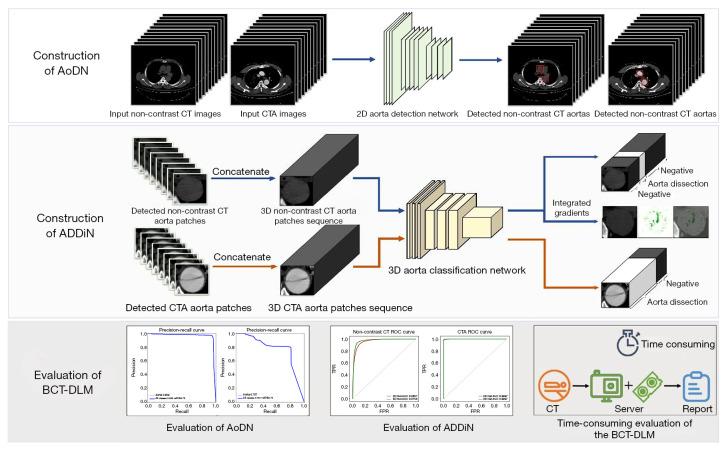
Patients who underwent non-contrast CT and CTA from February 2016 to September 2021 were retrospectively included from three institutions, including the First Affiliated Hospital, Zhejiang University School of Medicine (Center I), Zhejiang Hospital (Center II), and Yiwu Central Hospital (Center III). A two-stage DL model for predicting AD was developed. The first stage used an aorta detection network (AoDN) to localize the aorta in non-contrast CT or CTA images. Image patches that contained detected aorta were cut from CT images and combined to form an image patch sequence, which was inputted to an aortic dissection diagnosis network (ADDiN) to diagnose AD in the second stage. The following performances were assessed: aorta detection and diagnosis using average precision at the intersection over union threshold 0.5 (AP@0.5) and area under the receiver operating characteristic curve (AUC).
RESULTS
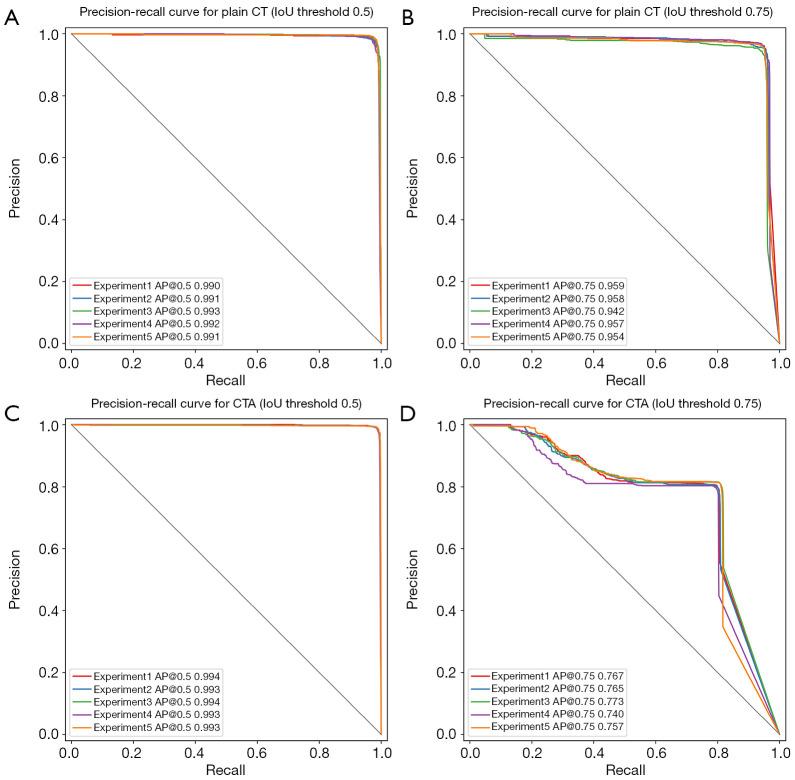
The first cohort, comprising 102 patients (53±15 years, 80 men) from two institutions, was used for the AoDN, whereas the second cohort, consisting of 861 cases (55±15 years, 623 men) from three institutions, was used for the ADDiN. For the AD task, the AoDN achieved AP@0.5 99.14% on the non-contrast CT test set and 99.34% on the CTA test set, respectively. For the AD diagnosis task, the ADDiN obtained an AUCs of 0.98 on the non-contrast CT test set and 0.99 on the CTA test set.
CONCLUSIONS
The proposed bimodal CT data-driven DL model accurately diagnoses AD, facilitating prompt hospital diagnosis and treatment of AD.
背景
主动脉夹层(AD)是一种致命的急症,需要迅速诊断。当前基于计算机断层扫描血管造影(CTA)的诊断需要使用造影剂,这会耗费时间,而现有的深度学习(DL)模型仅支持单模态输入[非增强计算机断层扫描(CT)或CTA]。在本研究中,我们提出了一种双模态DL框架,以独立处理这两种类型,实现双路径检测并提高诊断效率。
方法
回顾性纳入2016年2月至2021年9月期间在三个机构接受非增强CT和CTA检查的患者,包括浙江大学医学院附属第一医院(中心I)、浙江省立医院(中心II)和义乌市中心医院(中心III)。开发了一种用于预测AD的两阶段DL模型。第一阶段使用主动脉检测网络(AoDN)在非增强CT或CTA图像中定位主动脉。从CT图像中裁剪出包含检测到的主动脉的图像块,并将其组合形成一个图像块序列,该序列在第二阶段输入到主动脉夹层诊断网络(ADDiN)中以诊断AD。评估了以下性能:使用交并比阈值0.5处的平均精度(AP@0.5)和受试者工作特征曲线下面积(AUC)进行主动脉检测和诊断。
结果
第一个队列由来自两个机构的102例患者(53±15岁,80名男性)组成,用于AoDN,而第二个队列由来自三个机构的861例病例(55±15岁,623名男性)组成,用于ADDiN。对于AD任务,AoDN在非增强CT测试集上的AP@0.5分别为99.14%,在CTA测试集上为99.34%。对于AD诊断任务,ADDiN在非增强CT测试集上的AUC为0.98,在CTA测试集上为0.99。
结论
所提出的双模态CT数据驱动的DL模型能够准确诊断AD,有助于医院对AD进行及时的诊断和治疗。


 Zotero 插件