
真菌性植物病害早期检测与管理的直接和间接技术指南。
Direct and indirect technical guide for the early detection and management of fungal plant diseases.
作者信息
Sharma Gargi, Dwibedi Vagish, Seth Chandra Shekhar, Singh Simranjeet, Ramamurthy Praveen C, Bhadrecha Pooja, Singh Joginder
机构信息
Department of Biotechnology, University Institute of Biotechnology, Chandigarh University, Gharuan, 140413, Punjab, India.
Agriculture Research Organization, Volcani Center, Rishon LeZion 7505101, Israel.
出版信息
Curr Res Microb Sci. 2024 Sep 12;7:100276. doi: 10.1016/j.crmicr.2024.100276. eCollection 2024.
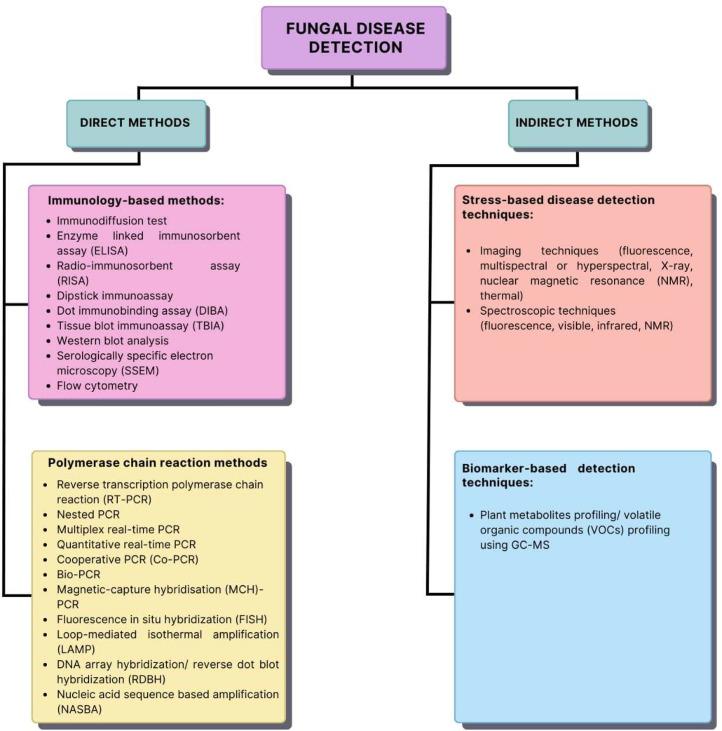
Fungal plant diseases are a major threat to plants and vegetation worldwide. Recent technological advancements in biotechnological tools and techniques have made it possible to identify and manage fungal plant diseases at an early stage. These techniques include direct methods, such as ELISA, immunofluorescence, PCR, flow cytometry, and in-situ hybridization, as well as indirect methods, such as fluorescence imaging, hyperspectral techniques, thermography, biosensors, nanotechnology, and nano-enthused biosensors. Early detection of fungal plant diseases can help to prevent major losses to plantations. This is because early detection allows for the implementation of control measures, such as the use of fungicides or resistant varieties. Early detection can also help to minimize the spread of the disease to other plants. The techniques discussed in this review provide a valuable resource for researchers and farmers who are working to prevent and manage fungal plant diseases. These techniques can help to ensure food security and protect our valuable plant resources.
真菌性植物病害是全球植物和植被面临的主要威胁。生物技术工具和技术方面的最新技术进步使得在早期阶段识别和管理真菌性植物病害成为可能。这些技术包括直接方法,如酶联免疫吸附测定(ELISA)、免疫荧光、聚合酶链反应(PCR)、流式细胞术和原位杂交,以及间接方法,如荧光成像、高光谱技术、热成像、生物传感器、纳米技术和纳米激发生物传感器。早期检测真菌性植物病害有助于防止种植园遭受重大损失。这是因为早期检测能够实施控制措施,如使用杀菌剂或抗性品种。早期检测还可以帮助最大限度地减少病害向其他植物的传播。本综述中讨论的技术为致力于预防和管理真菌性植物病害的研究人员和农民提供了宝贵资源。这些技术有助于确保粮食安全并保护我们宝贵的植物资源。

 Zotero 插件