
2020 年 3 月至 2022 年 9 月,伊利诺伊州一家学术医疗系统中 COVID-19 住院期间早期开始使用他汀类药物与住院死亡率的关联:使用观察性数据进行的目标试验模拟。
Association of early statin initiation during COVID-19 admission with inpatient mortality at an academic health system in Illinois, March 2020 to September 2022: a target trial emulation using observational data.
机构信息
Department of Research and Evaluation, Kaiser Permanente Southern California, Pasadena, California, USA.
Department of Medical Social Sciences, Northwestern University Feinberg School of Medicine, Chicago, Illinois, USA.
出版信息
BMJ Open. 2024 Oct 1;14(10):e085547. doi: 10.1136/bmjopen-2024-085547.
OBJECTIVE
We assessed the association of early statin initiation with inpatient mortality among hospitalised COVID-19 patients.
DESIGN, SETTING AND PARTICIPANTS: This observational study emulated a hypothetical target trial using electronic health records data from Northwestern Medicine Health System, Illinois, 2020-2022. We included patients who were ≥40 years, admitted ≥48 hours for COVID-19 from March 2020 to August 2022 and had no evidence of statin use before admission.
INTERVENTIONS
Individuals who initiated any statins within 48 hours of admission were compared with individuals who did not initiate statins during this period.
PRIMARY OUTCOME MEASURES
Inpatient mortality at hospital days 7, 14, 21 and 28 were determined using hospital records. Risk differences between exposure groups were calculated using augmented inverse propensity weighting (AIPW) with SuperLearner.
RESULTS
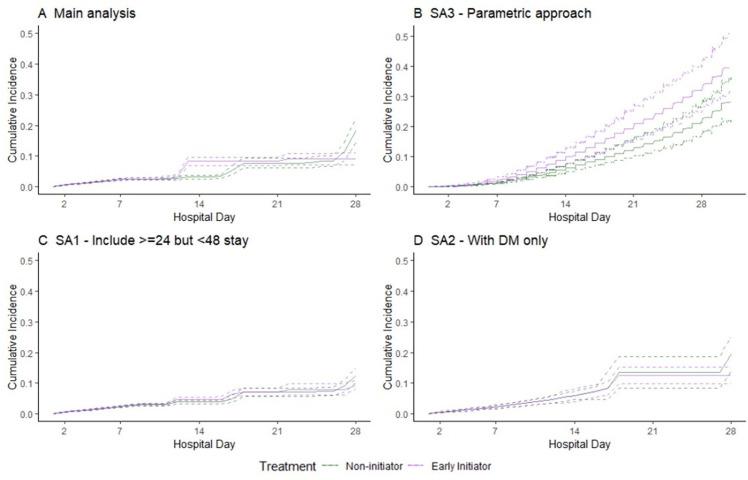
A total of 8893 individuals (24.5% early statin initiators) were included. Early initiators tended to be older, male and have higher comorbidity burdens. Unadjusted day 28 mortality was higher in early initiators (6.0% vs 3.6%). Adjusted analysis showed slightly higher inpatient mortality risk at days 7 (RD: 0.5%, 95% CI: 0.2 to 0.8) and 21 (RD: 0.6%, 95% CI: 0.04 to 1.1), but not days 14 (RD: 0.4%, 95% CI: -0.03 to 0.9) and 28 (RD: 0.4%, 95% CI: -0.2 to 1.1). Sensitivity analyses using alternative modelling approaches showed no difference between groups.
CONCLUSIONS
Early statin initiation was not associated with lower mortality contrasting with findings of previous observational studies. Trial emulation helped in identifying and addressing sources of bias incompletely addressed by previous work. Statin use may be indicated for other conditions but not COVID-19.
目的
评估 COVID-19 住院患者早期开始使用他汀类药物与住院死亡率的相关性。
设计、地点和参与者:本观察性研究使用 2020 年至 2022 年伊利诺伊州西北医学健康系统的电子健康记录数据模拟了一个假设的目标试验。我们纳入了年龄≥40 岁、因 COVID-19 住院≥48 小时且入院前无他汀类药物使用证据的患者。
干预措施
在入院后 48 小时内开始使用任何他汀类药物的个体与在此期间未开始使用他汀类药物的个体进行比较。
主要结局测量
使用医院记录确定住院第 7、14、21 和 28 天的住院死亡率。使用增强逆概率加权(AIPW)和 SuperLearner 计算暴露组之间的风险差异。
结果
共纳入 8893 名患者(24.5%为早期他汀类药物使用者)。早期使用者往往年龄较大、男性且合并症负担较高。未调整的第 28 天死亡率在早期使用者中较高(6.0% vs. 3.6%)。调整分析显示,第 7 天(RD:0.5%,95%CI:0.2 至 0.8)和第 21 天(RD:0.6%,95%CI:0.04 至 1.1)的住院死亡率风险略高,但第 14 天(RD:0.4%,95%CI:-0.03 至 0.9)和第 28 天(RD:0.4%,95%CI:-0.2 至 1.1)的住院死亡率风险无差异。使用替代建模方法的敏感性分析显示两组之间无差异。
结论
与先前的观察性研究结果相反,早期他汀类药物的使用与死亡率的降低无关。试验模拟有助于发现和解决以前的工作未充分解决的偏倚来源。他汀类药物的使用可能适用于其他疾病,但不适用于 COVID-19。
 Zotero 插件