
185 个国家消除烟草策略对肺癌死亡率的预估影响:基于人口出生队列的模拟研究。
Estimated impact of a tobacco-elimination strategy on lung-cancer mortality in 185 countries: a population-based birth-cohort simulation study.
机构信息
Department of Preventive Medicine and Public Health, Universidade de Santiago de Compostela, Santiago de Compostela, Spain; Consortium for Biomedical Research in Epidemiology and Public Health, Centro de Investigación Biomédica En Red en Epidemiología y Salud Pública, Madrid, Spain.
Cancer Surveillance Branch, International Agency for Research on Cancer, Lyon, France.
出版信息
Lancet Public Health. 2024 Oct;9(10):e745-e754. doi: 10.1016/S2468-2667(24)00185-3.
BACKGROUND
The tobacco-free generation aims to prevent the sale of tobacco to people born after a specific year. We aimed to estimate the impact of eliminating tobacco smoking on lung-cancer mortality in people born during 2006-10 in 185 countries.
METHODS
For this population-based birth-cohort simulation study, we proposed a scenario in which tobacco sales were banned for people born between Jan 1, 2006, and Dec 31, 2010, and in which this intervention was perfectly enforced, quantified until Dec 31, 2095. To predict future lung-cancer mortality rates, we extracted lung-cancer mortality data by sex, 5-year age group, and 5-year calendar period for countries with at least 15 years of data from the WHO Mortality Database. For countries for which mortality data were not available, we extracted data on lung-cancer incidence from the Cancer Incidence in Five Continents. To establish the number of lung-cancer deaths that could be prevented in the birth cohort if tobacco smoking was eliminated, we subtracted reported age-specific rate of deaths in people who had never smoked tobacco (hereafter referred to as never smokers) from a previous study from the expected rate of lung-cancer deaths in our birth cohort and applied this difference to the size of the population. We computed population impact fractions (PIFs), the percentage of lung-cancer deaths that could be prevented, by dividing the number of preventable lung-cancer deaths by the expected lung-cancer deaths in the birth cohort. We also aggregated expected and prevented deaths into the four World Bank income groups (ie, high-income, upper-middle-income, lower-middle-income, and low-income). The primary outcome was the impact on lung-cancer mortality of implementing a tobacco-free generation.
FINDINGS
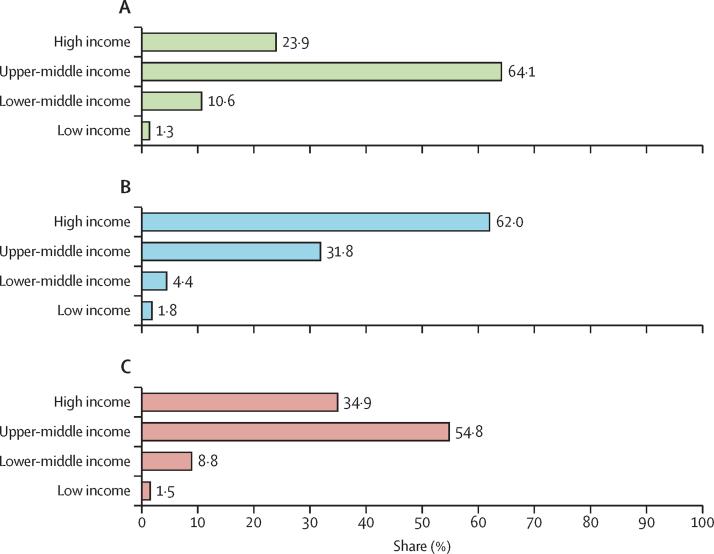
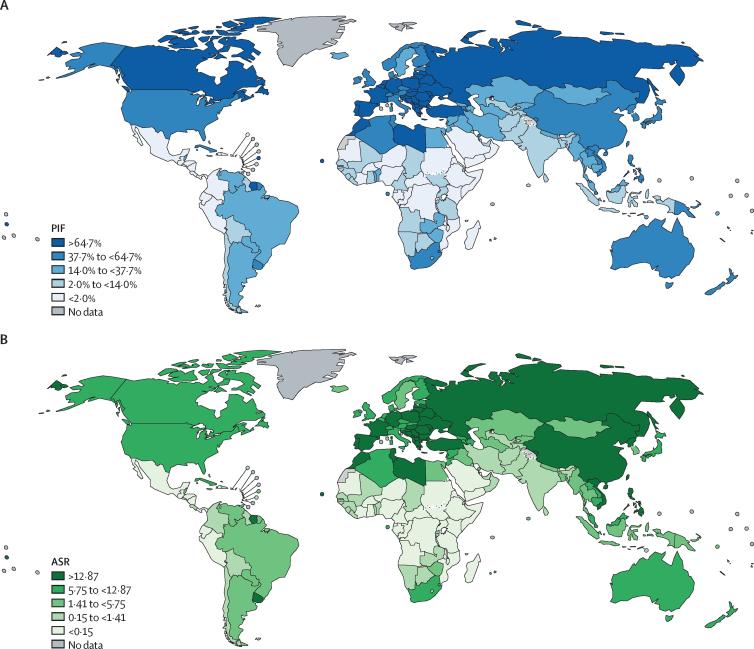
Our birth cohort included a total population of 650 525 800 people. Globally, we predicted that 2 951 400 lung-cancer deaths could occur in the population born during 2006-10 if lung-cancer rates continue to follow trends observed during the past 15 years. Of these deaths, 1 842 900 (62·4%) were predicted to occur in male individuals and 1 108 500 (37·6%) were expected to occur in female individuals. We estimated that 1 186 500 (40·2%) of 2 951 400 lung-cancer deaths in people born during 2006-10 could be prevented if tobacco elimination (ie, a tobacco-free generation) was achieved. We estimated that more lung-cancer deaths could be prevented in male individuals (844 200 [45·8%] of 1 842 900 deaths) than in female individuals (342 400 [30·9%] of 1 108 500 deaths). In male individuals, central and eastern Europe had the highest PIF (48 900 [74·3%] of 65 800 deaths) whereas in female individuals, western Europe had the highest PIF (56 200 [77·7%] of 72 300 deaths). Middle Africa was the region with the lowest PIF in both male individuals (180 [2·1%] of 8600 deaths) and female individuals (60 [0·9%] of 6400 deaths). In both sexes combined, PIF was 17 400 (13·5%) of 128 900 deaths in low-income countries, 104 900 (15·8%) of 662 800 deaths in lower-middle-income countries, 650 100 (43·9%) of 1 482 200 deaths in upper-middle-income countries, and 414 100 (61·1%) of 677 600 deaths in high-income countries.
INTERPRETATION
The implementation of a tobacco-free generation could substantially reduce global lung-cancer mortality. However, data from low-income countries were scarce and our estimates should be interpreted with caution.
FUNDING
Spanish Society of Pneumology and Thoracic Surgery.
背景
禁烟一代旨在阻止向特定年份以后出生的人出售烟草。我们旨在估计在 185 个国家中,2006 年至 2010 年出生的人群中消除吸烟对肺癌死亡率的影响。
方法
本项基于人群的出生队列模拟研究提出了一种方案,即禁止在 2006 年 1 月 1 日至 2010 年 12 月 31 日期间出生的人群中销售烟草,并对该干预措施进行量化,直到 2095 年 12 月 31 日为止。为了预测未来的肺癌死亡率,我们从世界卫生组织死亡率数据库中提取了至少有 15 年数据的国家中,按性别、5 岁年龄组和 5 年日历期划分的肺癌死亡率数据。对于没有死亡率数据的国家,我们从《五大洲癌症发病率》中提取了肺癌发病率数据。为了确定如果消除吸烟,出生队列中可能预防的肺癌死亡人数,我们从先前的研究中减去了从未吸烟的人群(以下简称从不吸烟者)的报告年龄特异性死亡率,然后将此差异应用于人口规模。我们计算了人口影响分数(PIF),即通过将可预防的肺癌死亡人数除以出生队列中的预期肺癌死亡人数来表示可预防的肺癌死亡人数的百分比。我们还将预期和预防的死亡人数汇总到世界银行的四个收入组(即高收入、中上收入、中下收入和低收入)中。主要结果是实施禁烟一代对肺癌死亡率的影响。
发现
我们的出生队列共包括 650525800 人。全球范围内,如果肺癌发病率继续遵循过去 15 年的趋势,预计在 2006 年至 2010 年期间出生的人群中,将有 295.14 万人死于肺癌。在这些死亡人数中,预计 184.29 万人(62.4%)将发生在男性个体中,110.85 万人(37.6%)将发生在女性个体中。我们估计,如果实现烟草消除(即禁烟一代),出生于 2006 年至 2010 年的人群中,295.14 万人的肺癌死亡人数中有 118.65 万人(40.2%)可以预防。我们估计,男性个体中可预防的肺癌死亡人数(1842900 人中有 844200 人[45.8%])多于女性个体中可预防的肺癌死亡人数(1108500 人中有 342400 人[30.9%])。在男性个体中,中欧和东欧的 PIF 最高(65800 人中有 48900 人[74.3%]),而在女性个体中,西欧的 PIF 最高(72300 人中有 56200 人[77.7%])。在男性个体中,中部非洲的 PIF 最低(8600 人中有 180 人[2.1%]),而在女性个体中,西非的 PIF 最低(6400 人中有 60 人[0.9%])。在两性合并的情况下,低收入国家的 PIF 为 128900 人中有 17400 人(13.5%),中下收入国家为 662800 人中有 104900 人(15.8%),中上收入国家为 1482200 人中有 650100 人(43.9%),高收入国家为 677600 人中有 414100 人(61.1%)。
解释
实施禁烟一代可以显著降低全球肺癌死亡率。然而,来自低收入国家的数据稀缺,我们的估计应谨慎解读。
资金
西班牙肺病学和胸腔外科学会。

 Zotero 插件