
可测量残留病作为成人急性髓系白血病同种异体移植后+100天复发的预测指标。
Measurable residual disease as predictor of post-day +100 relapses after allografting in adult AML.
作者信息
Ali Naveed, Othus Megan, Rodríguez-Arbolí Eduardo, Orvain Corentin, Milano Filippo, Sandmaier Brenda M, Davis Chris, Basom Ryan S, Appelbaum Frederick R, Walter Roland B
机构信息
Clinical Research Division, Fred Hutchinson Cancer Center, Seattle, WA.
Division of Hematology and Oncology, Department of Medicine, University of Washington, Seattle, WA.
出版信息
Blood Adv. 2025 Feb 11;9(3):558-570. doi: 10.1182/bloodadvances.2024013214.
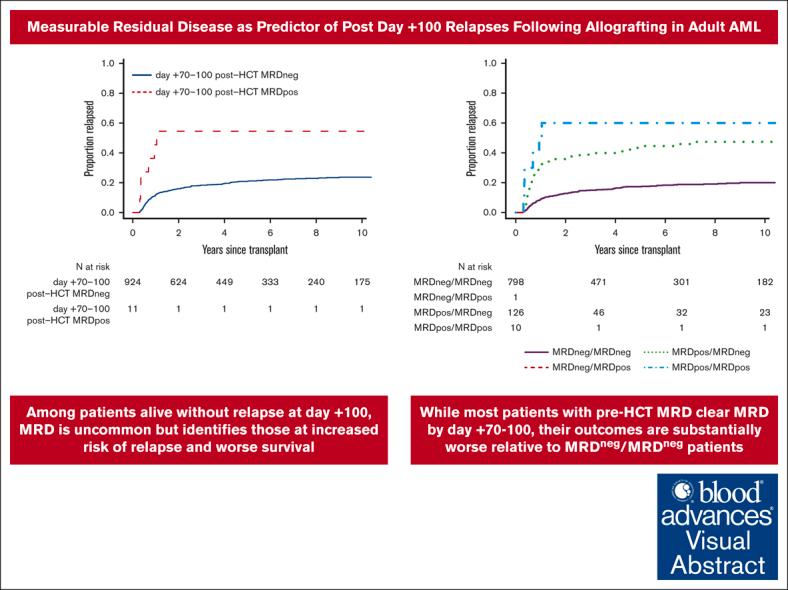
Measurable residual disease (MRD) by multiparametric flow cytometry (MFC) before allogeneic hematopoietic cell transplantation (HCT) identifies patients at high risk of acute myeloid leukemia (AML) relapse, often occurring early after allografting. To examine the role of MFC MRD testing to predict later relapses, we examined 935 adults with AML or myelodysplastic neoplasm/AML transplanted in first or second morphologic remission who underwent bone marrow restaging studies between day 70 and 100 after HCT and were alive and without relapse by day +100. Of 935 adults, 136 (15%) had MRD before HCT, whereas only 11 (1%) had MRD at day +70 to +100. In day +100 landmark analyses, pre-HCT and day +70 to +100 MFC MRD were both associated with relapse (both P < .001), relapse-free survival (RFS; both P < .001) overall survival (OS; both P < .001), and, for post-HCT MRD, nonrelapse mortality (P = .001) after multivariable adjustment. Importantly, although 126/136 patients (92%) with MRD before HCT tested negative for MRD at day +70 to +100, their outcomes were inferior to those without MRD before HCT and at day +70 to +100, with 3-year relapse risk of 40% vs 15% (P < .001), 3-year RFS of 50% vs 72% (P < .001), and 3-year OS of 56% vs 76% (P < .001), whereas 3-year nonrelapse mortality estimates were similar (P = .53). Thus, despite high MRD conversion rates, outcomes MRD positive/MRD negative (MRDneg) patients are inferior to those of MRDneg/MRDneg patients, suggesting all patients with pre-HCT MRD should be considered for preemptive therapies after allografting.
异基因造血细胞移植(HCT)前通过多参数流式细胞术(MFC)检测到的可测量残留病(MRD)可识别急性髓系白血病(AML)复发风险高的患者,这种复发通常在移植后早期发生。为了研究MFC MRD检测在预测后期复发中的作用,我们对935例患有AML或骨髓增生异常综合征/AML的成人进行了研究,这些患者在首次或第二次形态学缓解期接受了移植,在HCT后第70天至100天进行了骨髓再分期研究,并且在第+100天时尚存活且未复发。在935例成人中,136例(15%)在HCT前存在MRD,而在第+70天至+100天只有11例(1%)存在MRD。在第+100天的标志性分析中,HCT前和第+70天至+100天的MFC MRD均与复发相关(P均<0.001)、无复发生存期(RFS;P均<0.001)、总生存期(OS;P均<0.001),并且对于HCT后的MRD,多变量调整后与非复发死亡率相关(P = 0.001)。重要的是,尽管136例HCT前存在MRD的患者中有126例(92%)在第+70天至+100天MRD检测为阴性,但他们的结局仍劣于HCT前和第+70天至+100天均无MRD的患者,3年复发风险分别为40%和15%(P<0.001),3年RFS分别为50%和72%(P<0.001),3年OS分别为56%和76%(P<0.001),而3年非复发死亡率估计相似(P = 0.53)。因此,尽管MRD转化率很高,但MRD阳性/MRD阴性(MRDneg)患者的结局仍劣于MRDneg/MRDneg患者,这表明所有HCT前存在MRD的患者在移植后均应考虑进行抢先治疗。


 Zotero 插件