
成人 AML 中的移植前流式细胞术微小残留病动力学与预处理强度
Conditioning intensity and peritransplant flow cytometric MRD dynamics in adult AML.
机构信息
Department of Medicine, Residency Program, University of Washington, Seattle, WA.
Clinical Research Division, Fred Hutchinson Cancer Research Center, Seattle, WA.
出版信息
Blood. 2022 Mar 17;139(11):1694-1706. doi: 10.1182/blood.2021014804.
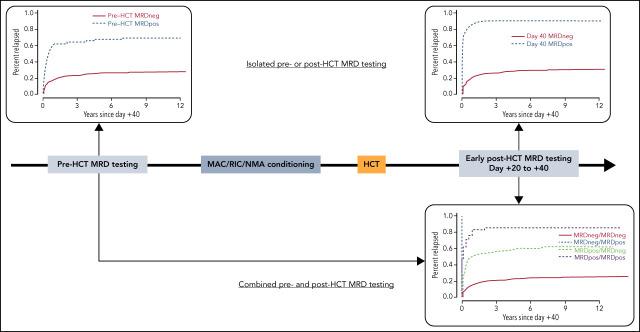
In acute myeloid leukemia (AML), measurable residual disease (MRD) before or after allogeneic hematopoietic cell transplantation (HCT) is an established independent indicator of poor outcome. To address how peri-HCT MRD dynamics could refine risk assessment across different conditioning intensities, we analyzed 810 adults transplanted in first or second remission after myeloablative conditioning (MAC; n = 515) or non-MAC (n = 295) who underwent multiparameter flow cytometry-based MRD testing before as well as 20 to 40 days after allografting. Patients without pre- and post-HCT MRD (MRDneg/MRDneg) had the lowest risks of relapse and highest relapse-free survival (RFS) and overall survival (OS). Relative to those patients, outcomes for MRDpos/MRDpos and MRDneg/MRDpos patients were poor regardless of conditioning intensity. Outcomes for MRDpos/MRDneg patients were intermediate. Among 161 patients with MRD before HCT, MRD was cleared more commonly with a MAC (85 of 104; 81.7%) than non-MAC (33 of 57; 57.9%) regimen (P = .002). Although non-MAC regimens were less likely to clear MRD, if they did, the impact on outcome was greater. Thus, there was a significant interaction between conditioning intensity and "MRD conversion" for relapse (P = .020), RFS (P = .002), and OS (P = .001). Similar findings were obtained in the subset of 590 patients receiving HLA-matched allografts. C-statistic values were higher (indicating higher predictive accuracy) for peri-HCT MRD dynamics compared with the isolated use of pre-HCT MRD status or post-HCT MRD status for prediction of relapse, RFS, and OS. Across conditioning intensities, peri-HCT MRD dynamics improve risk assessment over isolated pre- or post-HCT MRD assessments in patients with AML.
在急性髓系白血病 (AML) 中,异体造血细胞移植 (HCT) 前后的可测量残留疾病 (MRD) 是预后不良的独立指标。为了研究移植前 MRD 动力学如何改善不同强度预处理条件下的风险评估,我们分析了 810 例接受清髓性预处理 (MAC;n = 515) 或非清髓性预处理 (n = 295) 后处于缓解期的成人患者,这些患者在移植前及移植后 20 至 40 天接受了基于多参数流式细胞术的 MRD 检测。无移植前和移植后 MRD(MRDneg/MRDneg)的患者复发风险最低,无复发生存率 (RFS) 和总生存率 (OS) 最高。与这些患者相比,MRDpos/MRDpos 和 MRDneg/MRDpos 患者的结局较差,且与预处理强度无关。MRDpos/MRDneg 患者的结局则处于中间水平。在 161 例移植前有 MRD 的患者中,MAC 方案(104 例中有 85 例,81.7%)比非 MAC 方案(57 例中有 33 例,57.9%)更常清除 MRD(P =.002)。尽管非 MAC 方案清除 MRD 的可能性较小,但如果清除了,对结局的影响更大。因此,预处理强度与“MRD 转换”对复发(P =.020)、RFS(P =.002)和 OS(P =.001)的交互作用具有显著意义。在接受 HLA 匹配同种异体移植的 590 例患者亚组中也得到了类似的结果。与孤立使用移植前 MRD 状态或移植后 MRD 状态相比,移植前和移植后 MRD 动力学对预测复发、RFS 和 OS 的 C 统计值更高(提示预测准确性更高)。在不同的预处理强度下,移植前和移植后 MRD 动力学改善了 AML 患者的风险评估,优于孤立使用移植前或移植后 MRD 评估。
 Zotero 插件