
揭示脑容量种族和社会经济差异背后的中介途径:来自英国生物银行研究的见解。
Uncovering mediational pathways behind racial and socioeconomic disparities in brain volumes: insights from the UK Biobank study.
作者信息
Beydoun May A, Beydoun Hind A, Fanelli-Kuczmarski Marie T, Hu Yi-Han, Shaked Danielle, Weiss Jordan, Waldstein Shari R, Launer Lenore J, Evans Michele K, Zonderman Alan B
机构信息
Laboratory of Epidemiology and Population Sciences, National Institute On Aging, NIA/NIH/IRP, 251 Bayview Blvd., Suite 100, Room #: 04B118, Baltimore, MD, 21224, USA.
Department of Research Programs, Fort Belvoir Community Hospital, Fort Belvoir, VA, 22060, USA.
出版信息
Geroscience. 2025 Apr;47(2):1837-1858. doi: 10.1007/s11357-024-01371-1. Epub 2024 Oct 10.
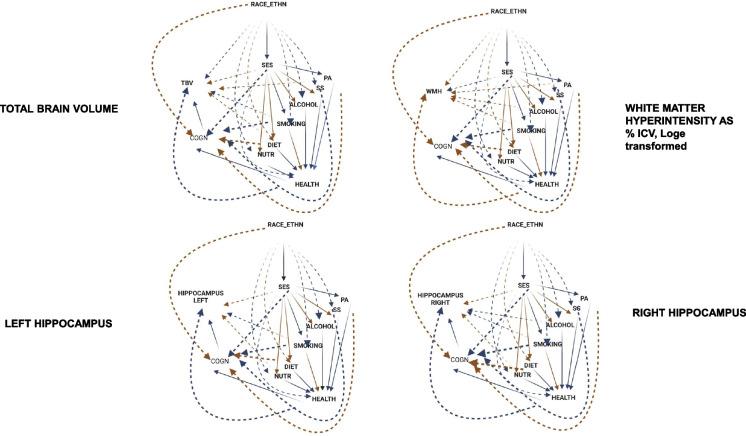
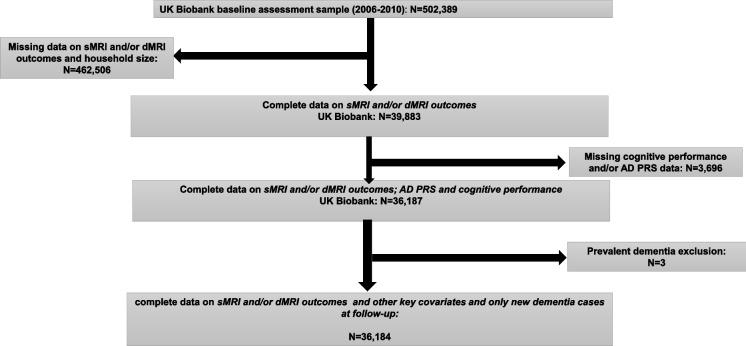
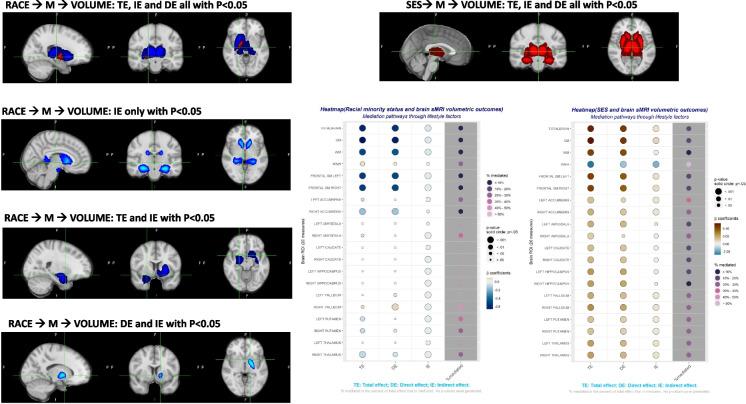
Mediation pathways explaining racial/ethnic and socioeconomic (SES) disparities in structural MRI markers of brain health remain underexplored. We examined racial/ethnic and SES disparities in sMRI markers and tested total, direct, and indirect effects through lifestyle, health-related, and cognition factors using a structural equations modeling approach among 36,184 UK Biobank participants aged 40-70 years at baseline assessment (47% men). Race (non-White vs. White) and lower SES-predicted poorer brain sMRI volumetric outcomes at follow-up, with racial/ethnic disparities in sMRI outcomes involving multiple pathways and SES playing a central role in those pathways. Mediational patterns differed across outcomes, with the SES-sMRI total effect being partially mediated for all outcomes. Over 20% of the total effect (TE) of race/ethnicity on WMH was explained by the indirect effect (IE), by a combination of different pathways going through SES, lifestyle, health-related, and cognition factors. This is in contrast to < 10% for total brain, gray matter (GM), white matter (WM), and frontal GM left/right. Another significant finding is that around 57% of the total effect for SES and the normalized white matter hyperintensity (WMH) was attributed to an indirect effect. This effect encompasses many pathways that involve lifestyle, health-related, and cognitive aspects. Aside from WMH, the percent of TE of SES mediated through various pathways ranged from ~ 5% for WM to > 15% up to 36% for most of the remaining sMRI outcomes, which are composed mainly of GM phenotypes. Race and SES were important determinants of brain volumetric outcomes, with partial mediation of racial/ethnic disparities through SES, lifestyle, health-related, and cognition factors.
解释大脑健康结构MRI标志物中种族/民族和社会经济(SES)差异的中介途径仍未得到充分探索。我们在36184名年龄在40 - 70岁的英国生物银行参与者(47%为男性)中,采用结构方程模型方法,研究了sMRI标志物中的种族/民族和SES差异,并测试了通过生活方式、健康相关和认知因素产生的总效应、直接效应和间接效应。种族(非白人与白人)和较低的SES预测随访时大脑sMRI体积结果较差,sMRI结果中的种族/民族差异涉及多种途径,且SES在这些途径中起核心作用。中介模式因结果而异,SES - sMRI总效应在所有结果中均有部分中介作用。种族/民族对WMH的总效应(TE)中,超过20%由间接效应(IE)解释,这是通过SES、生活方式、健康相关和认知因素的不同途径组合产生的。这与全脑、灰质(GM)、白质(WM)以及额叶GM左/右的情况形成对比,后者的间接效应小于10%。另一个重要发现是,SES与标准化白质高信号(WMH)的总效应中约57%归因于间接效应。这种效应包括许多涉及生活方式、健康相关和认知方面的途径。除WMH外,SES通过各种途径介导的TE百分比范围从WM的约5%到其余主要由GM表型组成的大多数sMRI结果的>15%至36%不等。种族和SES是大脑体积结果的重要决定因素,种族/民族差异通过SES、生活方式、健康相关和认知因素得到部分中介。
 Zotero 插件