
乌兹别克斯坦全科医生、患者和农民的抗菌药物耐药性相关知识、态度和行为:一项横断面研究
Antimicrobial resistance related knowledge, attitude and practice of general practitioners, patients and farmers: A cross-sectional study in Uzbekistan.
作者信息
Aniyozova Dilfuza, Akilov Habibulla, Kasimova Munirakhon, Favaretti Caterina, Sadyrova Muborak, Egamberdieva Zarina, Botirova Laylo, Deckert Andreas
机构信息
Tashkent Institute of Postgraduate Medical Education, Tashkent, Uzbekistan, 51, Parkentskaya Street, 10007, Tashkent City, Uzbekistan.
Heidelberg Institute of Global Health, Heidelberg, Germany, Neuenheimer Feld 672, 69120, Heidelberg, Germany.
出版信息
Heliyon. 2024 Sep 8;10(19):e37566. doi: 10.1016/j.heliyon.2024.e37566. eCollection 2024 Oct 15.
OBJECTIVES
The objective was to identify antimicrobial resistance related knowledge, attitudes and practice gaps of general practitioners, patients and farmers.
METHODS
Cross-sectional, mixed-mode (in-person and distance) survey conducted out among the key antimicrobial prescribers and consumers in Uzbekistan, from March to October 2020. We calculated knowledge and attitude scores and applied multivariable adaptive linear regression.
RESULTS
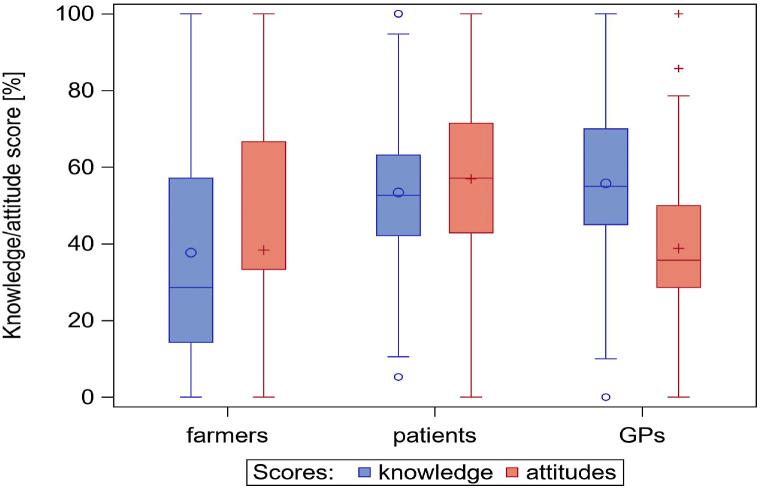
Data were collected from 718 adults (236 - GPs, 251 - patients and 231 - farmers) aged 18 years and older. 66.5 % (n = 157) of general practitioners didn't base their antimicrobials prescription on guidelines. A third were not familiar with the delayed antibiotic prescriptions strategy. Most general practitioners prescribe antibiotics on patients' request; one third if patients have fever, almost 60 % (n = 142) if patients have cough with sputum.Majority of patients believed that antibiotics can cure influenza and cold. Every third farmer thought that antibiotics is an antiviral and every fifth a tool to increase productivity. Almost two third of them used antibiotics to protect livestock/poultry/fish from disease.For all three groups, the strongest predictor for the right attitude was the knowledge level.
CONCLUSIONS
All three groups had knowledge gaps in the form of misconception and problem underestimation which manifests itself as a wrong practice. Interventions are needed at the national, institutional and individual levels, in particular in the trainings of general practitioners and farmers.
目的
旨在确定全科医生、患者和农民在抗菌药物耐药性相关知识、态度和行为方面的差距。
方法
2020年3月至10月,在乌兹别克斯坦主要抗菌药物开处方者和消费者中开展了横断面、混合模式(面对面和远程)调查。我们计算了知识和态度得分,并应用多变量自适应线性回归分析。
结果
收集了718名18岁及以上成年人的数据(236名全科医生、251名患者和231名农民)。66.5%(n = 157)的全科医生开抗菌药物处方时未遵循指南。三分之一的人不熟悉延迟抗生素处方策略。大多数全科医生根据患者要求开抗生素;三分之一是在患者发烧时,近60%(n = 142)是在患者有咳痰咳嗽时。大多数患者认为抗生素能治愈流感和感冒。每三名农民中就有一人认为抗生素是抗病毒药物,每五人中就有一人认为是提高生产力的工具。近三分之二的农民用抗生素来保护牲畜/家禽/鱼类免受疾病侵害。对于所有三组人群,正确态度的最强预测因素是知识水平。
结论
所有三组人群都存在以误解和问题低估形式出现的知识差距,表现为错误的行为。需要在国家、机构和个人层面进行干预,特别是在全科医生和农民的培训方面。


 Zotero 插件