
16S rRNA 基因中的点突变 A1387G 赋予 和 对氨基糖苷类药物的耐药性。
The point mutation A1387G in the 16S rRNA gene confers aminoglycoside resistance in and .
机构信息
German Federal Institute for Risk Assessment (BfR), Department of Biological Safety, National Reference Laboratory for Campylobacter, Berlin, Germany.
Lower Saxony State Office for Consumer Protection and Food Safety (LAVES), Food and Veterinary Institute, Oldenburg, Germany.
出版信息
Antimicrob Agents Chemother. 2024 Nov 6;68(11):e0083324. doi: 10.1128/aac.00833-24. Epub 2024 Oct 15.
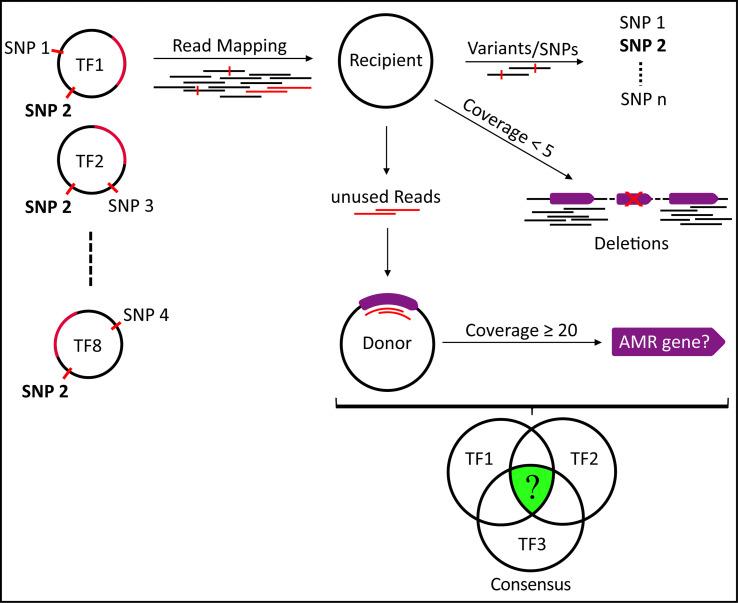
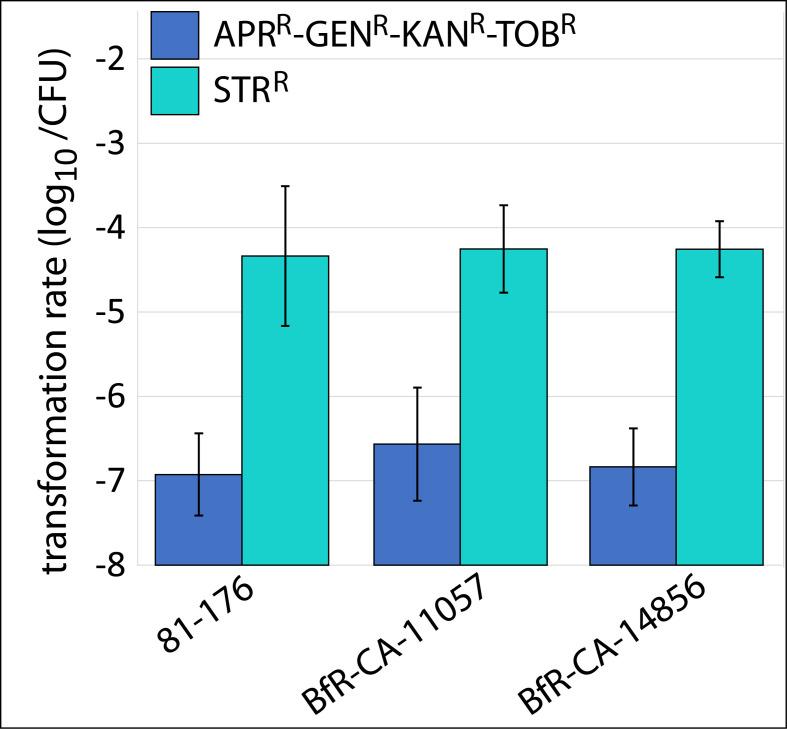
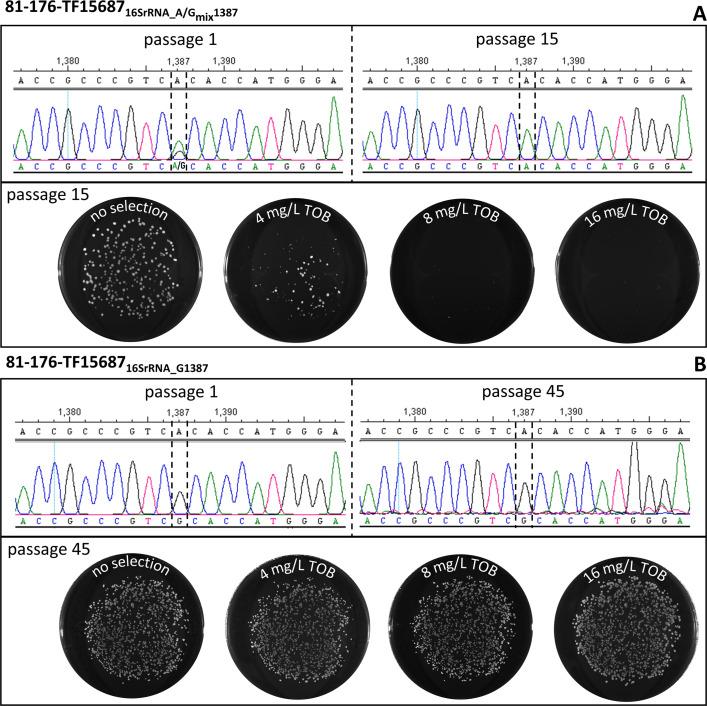
Thermotolerant spp. are the most frequent cause of foodborne bacterial diarrhea and high-priority antibiotic-resistant pathogens, according to the World Health Organization (WHO). Monitoring revealed current low prevalence of gentamicin resistance in European spp. isolates but substantial presence of gentamicin modifying genes circulating globally. Using a combined approach of natural transformation and whole-genome sequencing, we revealed a novel gentamicin resistance mechanism, namely the point mutation A1387G in the 16S rRNA gene, originally identified in a isolate from turkey caecal content. The transformation rate of the resistance using genomic DNA of the resistant donor to sensitive recipient and was ~2.5 log lower compared to the control -A128G point mutation conferring streptomycin resistance. Antimicrobial susceptibility tests showed cross-resistance to apramycin, kanamycin, and tobramycin, with transformants exhibiting more than 4- to 8-fold increased MICs to apramycin and tobramycin and over 64-fold higher MICs to kanamycin compared to wild-type isolates. Although transformants showed 177-1,235 variations relative to the recipient, only the A1387G point mutation in the 16S rRNA was in common. This mutation was causal for resistance, as transformation of a 16S rRNA_A1387G PCR fragment into susceptible isolates also led to resistant transformants. Sanger sequencing of the 16S rRNA genes and Oxford nanopore whole-genome sequencing of transformants identified clones harboring either all three copies with A1387G or a mixed population of wild-type and mutated 16S rRNA gene alleles. Within 15 passages on non-selective medium, transformants with mixed populations of the 16S rRNA gene copies partially reverted to wild type, both geno- and phenotypically. In contrast, transformants harboring the A1387G point mutation in all three 16S rRNA gene copies kept full resistance within at least 45 passages. We speculate that partial acquisition and rapid loss of the point mutation limited its spread among . spp. isolates. In-depth knowledge on resistance mechanisms contributes to optimal diagnosis and preventative measures.
根据世界卫生组织(WHO)的说法,耐热 spp. 是食源性细菌性腹泻和高优先级抗生素耐药病原体的最常见原因。监测显示,目前欧洲 spp. 分离株的庆大霉素耐药率较低,但全球普遍存在庆大霉素修饰基因。我们采用自然转化和全基因组测序相结合的方法,揭示了一种新的庆大霉素耐药机制,即在来自火鸡盲肠内容物的 分离株中最初发现的 16S rRNA 基因中的点突变 A1387G。与控制 -A128G 点突变赋予链霉素耐药性相比,用耐药供体的基因组 DNA 对敏感受体 和 进行转化的耐药率低约 2.5 个对数。药敏试验显示对氨曲南、卡那霉素和妥布霉素的交叉耐药性,转化子对氨曲南和妥布霉素的 MICs 增加了 4-8 倍以上,对卡那霉素的 MICs 增加了 64 倍以上。与野生型分离株相比,虽然转化子相对于受体有 177-1,235 个变异,但只有 16S rRNA 中的 A1387G 点突变是共同的。该突变是耐药的原因,因为将 16S rRNA_A1387G PCR 片段转入敏感分离株也导致了耐药转化子。对 16S rRNA 基因的 Sanger 测序和转化子的牛津纳米孔全基因组测序鉴定出携带 A1387G 的三个拷贝或野生型和突变型 16S rRNA 基因等位基因混合群体的克隆。在非选择性培养基上传代 15 代后,16S rRNA 基因拷贝混合群体的转化子部分回复为野生型,表型和基因型均如此。相比之下,在至少 45 代传代中,携带三个 16S rRNA 基因拷贝中的 A1387G 点突变的转化子仍保持完全耐药性。我们推测,该点突变的部分获得和快速丢失限制了其在 spp. 分离株中的传播。深入了解耐药机制有助于进行最佳诊断和预防措施。


 Zotero 插件