
地中海饮食对粪便长链脂肪酸组成及肠道屏障完整性的影响:随机对照LIBRE试验的探索性分析
Effect of the Mediterranean diet on the faecal long-chain fatty acid composition and intestinal barrier integrity: an exploratory analysis of the randomised controlled LIBRE trial.
作者信息
Seethaler Benjamin, Basrai Maryam, Neyrinck Audrey M, Vetter Walter, Delzenne Nathalie M, Kiechle Marion, Bischoff Stephan C
机构信息
Institute of Nutritional Medicine, University of Hohenheim, Stuttgart, Germany.
Metabolism and Nutrition Research Group, Louvain Drug Research Institute, UCLouvain, Université Catholique de Louvain, Brussels, Belgium.
出版信息
Br J Nutr. 2024 Oct 21;132(9):1-9. doi: 10.1017/S0007114524001788.
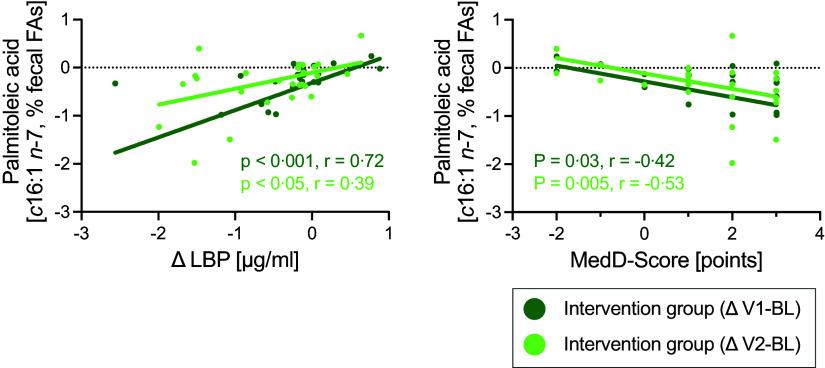
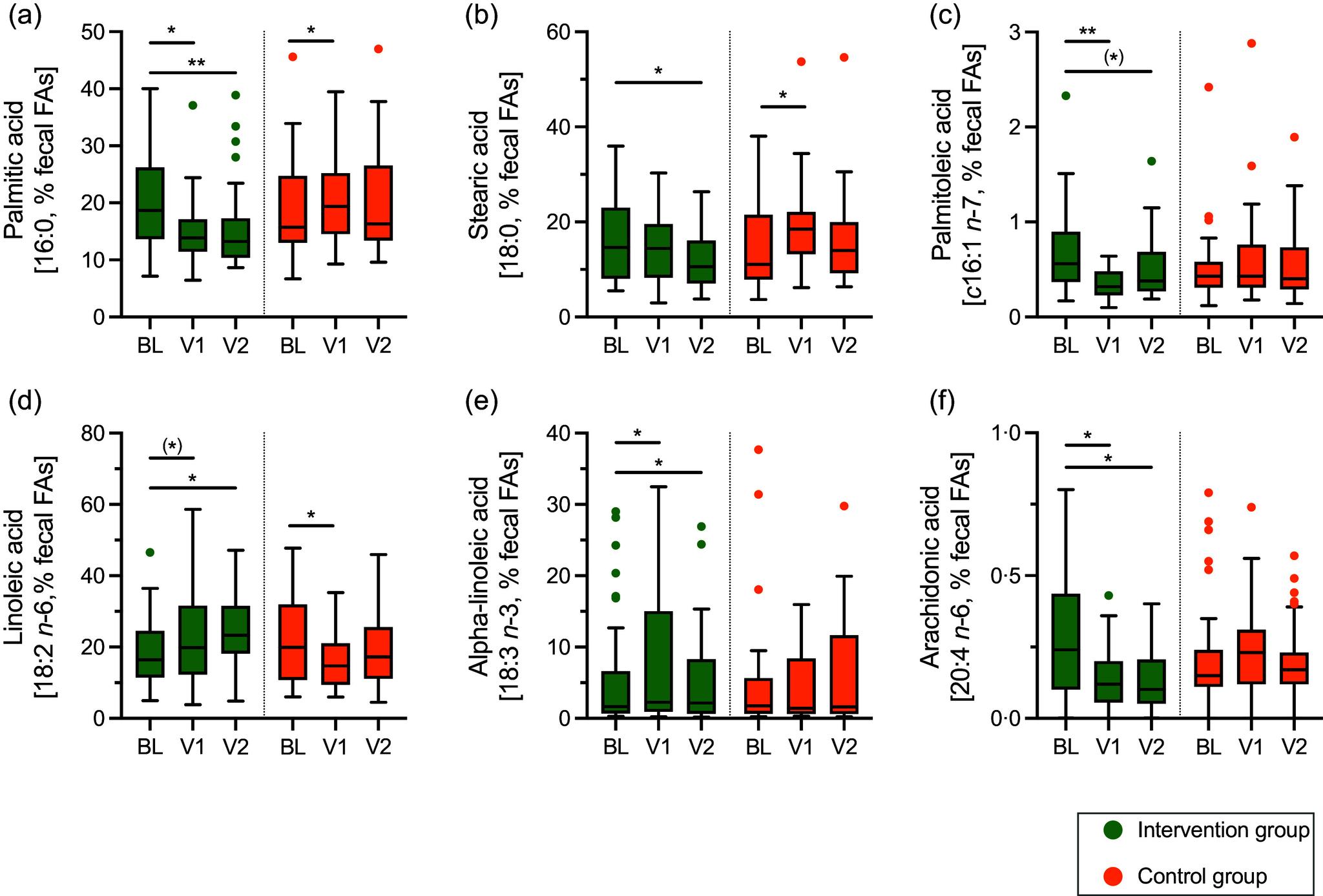
We recently showed that adherence to the Mediterranean diet increased the proportion of plasma -3 PUFA, which was associated with an improved intestinal barrier integrity. In the present exploratory analysis, we assessed faecal fatty acids in the same cohort, aiming to investigate possible associations with intestinal barrier integrity. Women from the Lifestyle Intervention Study in Women with Hereditary Breast and Ovarian Cancer (LIBRE) randomised controlled trial, characterised by an impaired intestinal barrier integrity, followed either a Mediterranean diet (intervention group, 33) or a standard diet (control group, 35). At baseline (BL), month 3 (V1) and month 12 (V2), plasma lipopolysaccharide-binding protein, faecal zonulin and faecal fatty acids were measured. In the intervention group, faecal proportions of palmitoleic acid (16:1, -7) and arachidonic acid (20:4, -6) decreased, while the proportion of linoleic acid (18:2, -6) and linoleic acid (18:3, -3) increased (BL-V1 and BL-V2, all < 0·08). In the control group, faecal proportions of palmitic acid and arachidic acid increased, while the proportion of linoleic acid decreased (BL-V1, all < 0·05). The decrease in the proportion of palmitoleic acid correlated with the decrease in plasma lipopolysaccharide-binding protein (ΔV1-BL = 0·72, < 0·001; ΔV2-BL = 0·39, < 0·05) and correlated inversely with adherence to the Mediterranean diet (Mediterranean diet score; ΔV1-BL = -0·42, = 0·03; ΔV2-BL = -0·53, = 0·005) in the intervention group. Our data show that adherence to the Mediterranean diet induces distinct changes in the faecal fatty acid composition. Furthermore, our data indicate that the faecal proportion of palmitoleic acid, but not faecal -3 PUFA, is associated with intestinal barrier integrity in the intervention group.
我们最近发现,坚持地中海饮食可提高血浆ω-3多不饱和脂肪酸(PUFA)的比例,这与肠道屏障完整性的改善相关。在本次探索性分析中,我们评估了同一队列中的粪便脂肪酸,旨在研究其与肠道屏障完整性之间可能存在的关联。来自遗传性乳腺癌和卵巢癌女性生活方式干预研究(LIBRE)随机对照试验的女性,其肠道屏障完整性受损,她们分别遵循地中海饮食(干预组,33人)或标准饮食(对照组,35人)。在基线(BL)、第3个月(V1)和第12个月(V2)时,测量血浆脂多糖结合蛋白、粪便连蛋白和粪便脂肪酸。在干预组中,棕榈油酸(16:1,ω-7)和花生四烯酸(20:4,ω-6)的粪便比例降低,而亚油酸(18:2,ω-6)和α-亚麻酸(18:3,ω-3)的比例增加(BL-V1和BL-V2,均P<0.08)。在对照组中,棕榈酸和花生酸的粪便比例增加,而亚油酸的比例降低(BL-V1,均P<0.05)。在干预组中,棕榈油酸比例的降低与血浆脂多糖结合蛋白的降低相关(ΔV1-BL = 0.72,P<0.001;ΔV2-BL = 0.39,P<0.05),并且与对地中海饮食的依从性呈负相关(地中海饮食评分;ΔV1-BL = -0.42,P = 0.03;ΔV2-BL = -0.53,P = 0.005)。我们的数据表明,坚持地中海饮食会引起粪便脂肪酸组成的明显变化。此外,我们的数据表明,在干预组中,棕榈油酸的粪便比例而非粪便ω-3 PUFA与肠道屏障完整性相关。
 Zotero 插件