
黏膜纳米颗粒免疫导致雄性猕猴 HIV 候选疫苗效力丧失,通过 V2 特异性反应得到挽救。
Loss of HIV candidate vaccine efficacy in male macaques by mucosal nanoparticle immunization rescued by V2-specific response.
机构信息
Animal Models and Retroviral Vaccines Section, Vaccine Branch, Center for Cancer Research, National Cancer Institute, National Institutes of Health, Bethesda, MD, USA.
Vaccine Branch, Center for Cancer Research, National Cancer Institute, National Institutes of Health, Bethesda, MD, USA.
出版信息
Nat Commun. 2024 Oct 22;15(1):9102. doi: 10.1038/s41467-024-53359-2.
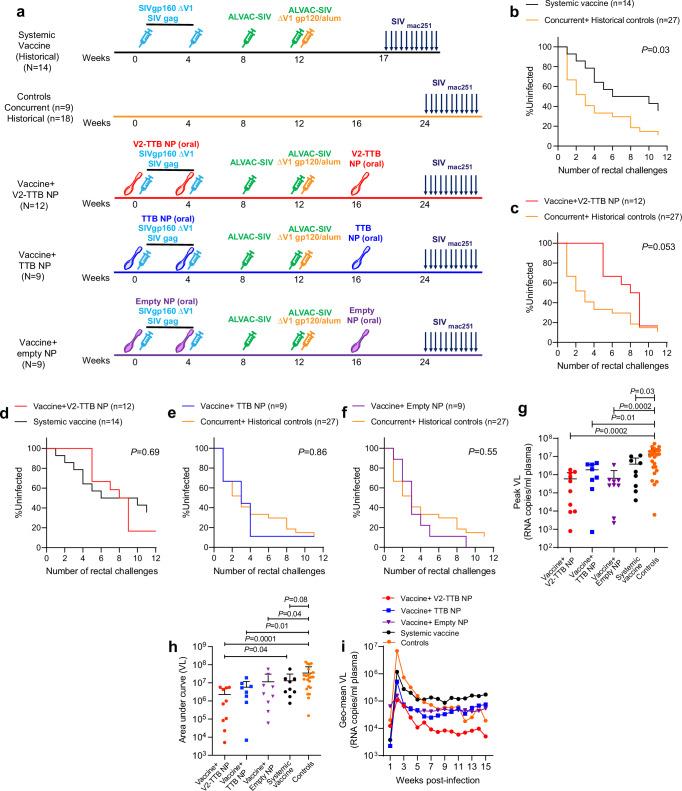
Systemic vaccination of macaques with V1-deleted (ΔV1) envelope immunogens reduce the risk of SIV acquisition by approximately 60%, with protective roles played by V2-specific ADCC and envelope-specific mucosal IL-17NKp44 innate lymphoid cells (ILCs). We investigated whether increased mucosal responses to V2 benefit vaccine efficacy by delivering oral nanoparticles (NPs) that release V2-scaffolded on Typhoid Toxin B (TTB) to the large intestine. Strikingly, mucosal immunization of male macaques abrogated vaccine efficacy with control TTB or empty NPs, but vaccine efficacy of up to 47.6% was preserved with V2-TTB NPs. The deleterious effects of NPs were linked to preferential recruitment of mucosal plasmacytoid dendritic cells (pDCs), reduction of protective mucosal NKp44 ILCs, increased non-protective mucosal PMA/Ionomycin-induced IFN-γNKG2ANKp44ILCs, and increased levels of mucosal activated Ki67CD4 T cells, a potential target for virus infection. V2-TTB NP mucosal boosting rescued vaccine efficacy, likely via high avidity V2-specific antibodies mediating ADCC, and higher frequencies of mucosal NKp44 ILCs and of ∆V1gp120 binding antibody-secreting B cells in the rectal mucosa. These findings emphasize the central role of systemic immunization and mucosal V2-specific antibodies in the protection afforded by ΔV1 envelope immunogens and encourage careful evaluation of vaccine delivery platforms to avoid inducing immune responses favorable to HIV transmission.
系统性接种 V1 缺失(ΔV1)包膜免疫原的猕猴,可将 SIV 感染风险降低约 60%,其保护作用由 V2 特异性 ADCC 和包膜特异性黏膜 IL-17NKp44 固有淋巴样细胞(ILCs)发挥。我们研究了增加对 V2 的黏膜反应是否通过递送至大肠的口服纳米颗粒(NPs)释放 V2-骨架在伤寒毒素 B(TTB)上从而提高疫苗功效。引人注目的是,雄性猕猴的黏膜免疫接种会破坏对照 TTB 或空 NPs 的疫苗功效,但 V2-TTB NPs 保留了高达 47.6%的疫苗功效。NPs 的有害作用与黏膜浆细胞样树突细胞(pDC)的优先募集、保护性黏膜 NKp44 ILC 的减少、增加的非保护性黏膜 PMA/离子霉素诱导的 IFN-γNKG2ANKp44ILC 以及增加的黏膜活化 Ki67CD4 T 细胞(病毒感染的潜在靶标)有关。V2-TTB NP 黏膜加强免疫挽救了疫苗功效,这可能是通过高亲和力 V2 特异性抗体介导的 ADCC 以及直肠黏膜中更高频率的黏膜 NKp44 ILC 和 ΔV1gp120 结合的抗体分泌 B 细胞实现的。这些发现强调了系统免疫接种和黏膜 V2 特异性抗体在 ΔV1 包膜免疫原提供的保护中的核心作用,并鼓励对疫苗传递平台进行仔细评估,以避免诱导有利于 HIV 传播的免疫反应。



 Zotero 插件