
基于TRPV2和TRPV4离子通道探究PGLA埋植于大鼠足三里(ST36)穴位的局部刺激效应
Investigation of local stimulation effects of embedding PGLA at Zusanli (ST36) acupoint in rats based on TRPV2 and TRPV4 ion channels.
作者信息
Hou Xunrui, Liang Xin, Lu Yuwei, Zhang Qian, Wang Yujia, Xu Ming, Luo Yuheng, Fan Tongtao, Zhang Yiyi, Ye Tingting, Zhou Kean, Shi Jiahui, Li Min, Li Lihong
机构信息
Clinical Medical College of Acupuncture Moxibustion and Rehabilitation, Guangzhou University of Chinese Medicine, Guangzhou, China.
Affiliated Hospital of Guizhou Medical University, Guiyang, China.
出版信息
Front Neurosci. 2024 Oct 9;18:1469142. doi: 10.3389/fnins.2024.1469142. eCollection 2024.
INTRODUCTION
Acupoint Catgut Embedding (ACE) is an extended and developed form of traditional acupuncture that serves as a composite stimulation therapy for various diseases. However, its local stimulation effects on acupoints remain unclear. Acupuncture can activate mechanically sensitive calcium ion channels, TRPV2 and TRPV4, located on various cell membranes, promoting Ca influx in acupoint tissues to exert effects. Whether ACE can form mechanical physical stimulation to regulate these channels and the related linkage effect requires validation.
METHODS
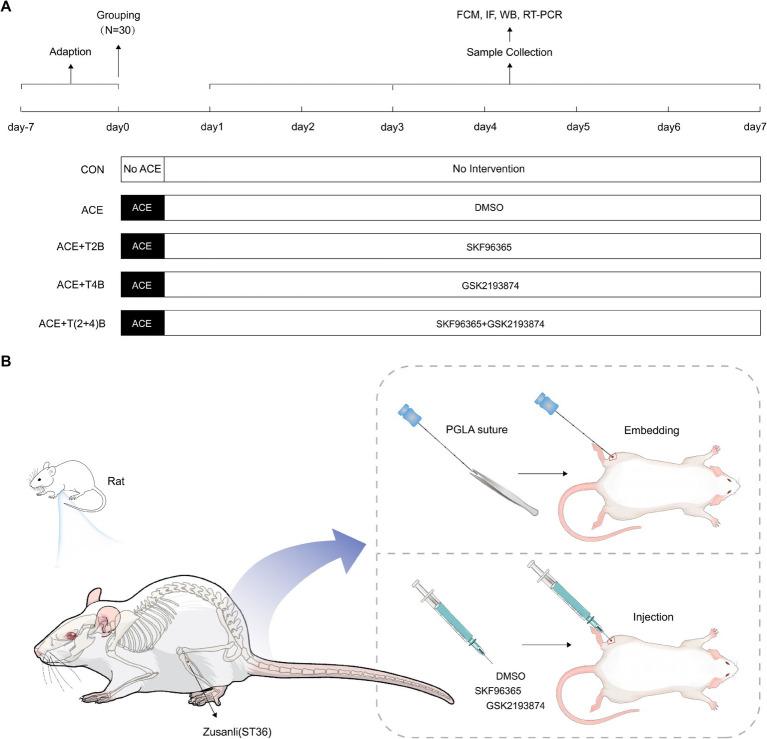
This study investigates the influence of TRPV2 and TRPV4 ion channels on the local stimulation effects of ACE by embedding PGLA suture at the Zusanli (ST36) acupoint in rats and using TRPV2 and TRPV4 inhibitors. Flow cytometry, immunofluorescence, Western blot, and Real-time quantitative PCR were employed to detect intracellular Ca fluorescence intensity, the expression of macrophage (Mac) CD68 and mast cell (MC) tryptase, as well as the protein and mRNA expression of TRPV2 and TRPV4 in acupoint tissues after PGLA embedding.
RESULTS
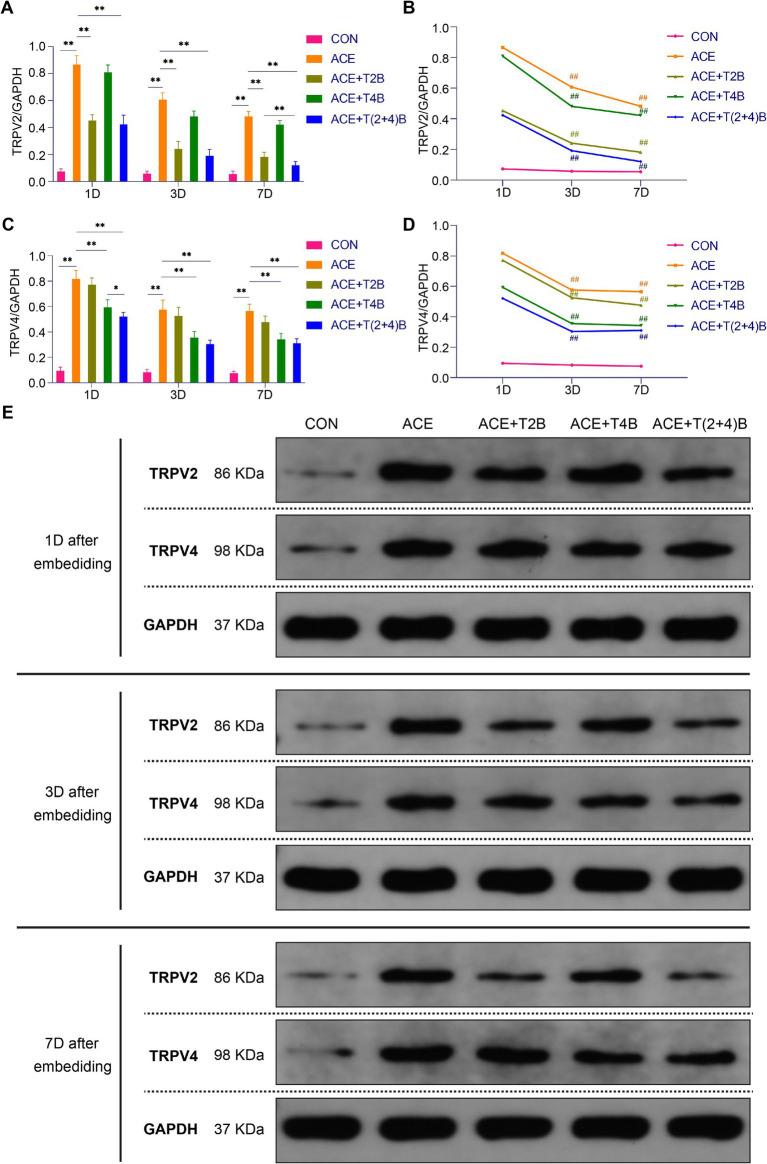
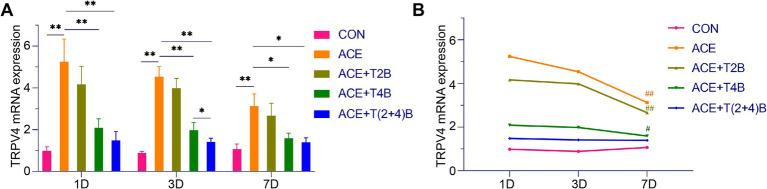
The results indicate that ACE using PGLA suture significantly increases the mRNA and protein expression of TRPV2 and TRPV4, Ca fluorescence intensity, and the expression of Mac CD68 and MC tryptase in acupoint tissues, with these effects diminishing over time. The increasing trends are reduced after using inhibitors, particularly when both inhibitors are used simultaneously. Furthermore, correlation analysis shows that embedding PGLA suture at the ST36 acupoint regulates Mac and MC functions through Ca2+ signaling involving not only TRPV2 and TRPV4 but multiple pathways.
DISCUSSION
These results suggest that embedding PGLA suture at the ST36 acupoint generates mechanical physical stimulation and regulates TRPV2 and TRPV4 ion channels, which couple with Ca signaling to form a linkage effect that gradually weakens over time. This provides new reference data for further studies on the stimulation effects and clinical promotion of ACE.
引言
穴位埋线是传统针灸的一种拓展和发展形式,是用于治疗各种疾病的综合刺激疗法。然而,其对穴位的局部刺激作用仍不明确。针灸可激活位于各种细胞膜上的机械敏感钙离子通道TRPV2和TRPV4,促进钙离子流入穴位组织以发挥作用。穴位埋线是否能形成机械物理刺激来调节这些通道以及相关的连锁效应尚需验证。
方法
本研究通过在大鼠足三里(ST36)穴位埋植聚乙丙交酯缝线并使用TRPV2和TRPV4抑制剂,研究TRPV2和TRPV4离子通道对穴位埋线局部刺激作用的影响。采用流式细胞术、免疫荧光、蛋白质免疫印迹法和实时定量聚合酶链反应检测聚乙丙交酯埋植后穴位组织中细胞内钙荧光强度、巨噬细胞(Mac)CD68和肥大细胞(MC)类胰蛋白酶的表达,以及TRPV2和TRPV4的蛋白质和信使核糖核酸表达。
结果
结果表明,使用聚乙丙交酯缝线进行穴位埋线可显著增加穴位组织中TRPV2和TRPV4的信使核糖核酸和蛋白质表达、钙荧光强度以及Mac CD68和MC类胰蛋白酶的表达,且这些作用随时间逐渐减弱。使用抑制剂后增加趋势降低,尤其是同时使用两种抑制剂时。此外,相关性分析表明,在ST36穴位埋植聚乙丙交酯缝线通过涉及TRPV2和TRPV4以及多种途径的钙离子信号传导调节Mac和MC功能。
讨论
这些结果表明,在ST36穴位埋植聚乙丙交酯缝线产生机械物理刺激并调节TRPV2和TRPV4离子通道,其与钙信号传导耦合形成连锁效应,该效应随时间逐渐减弱。这为穴位埋线刺激作用及临床推广的进一步研究提供了新的参考数据。




 Zotero 插件