
表观遗传衰老与生育力:挪威母婴队列研究
Epigenetic aging and fecundability: the Norwegian Mother, Father and Child Cohort Study.
作者信息
Arge Lise Andrea, Lee Yunsung, Skåra Karoline Hansen, Myrskylä Mikko, Ramlau-Hansen Cecilia Høst, Håberg Siri Eldevik, Magnus Maria Christine
机构信息
Centre for Fertility and Health, Norwegian Institute of Public Health, Oslo, Norway.
Department of Community Medicine and Global Health, Institute of Health and Society, University of Oslo, Oslo, Norway.
出版信息
Hum Reprod. 2024 Dec 1;39(12):2806-2815. doi: 10.1093/humrep/deae242.
STUDY QUESTION
Is there an association between male or female epigenetic age acceleration (EAA) or deceleration (EAD) and fecundability?
SUMMARY ANSWER
We do not find compelling evidence of an association between EAA or EAD and fecundability.
WHAT IS KNOWN ALREADY
Prior research has shown that female accelerated epigenetic aging is associated with unfavorable clinical fecundity outcomes and use of in vitro fertilization, and that epigenetic aging in sperm cells is associated with unfavorable sperm parameters. Studies of epigenetic aging and fecundability among individuals who conceive naturally are lacking.
STUDY DESIGN, SIZE, DURATION: This study is based on the Norwegian Mother, Father and Child Cohort Study (MoBa), a population-based pregnancy cohort which recruited pregnant couples between 1999 and 2008. We used data from 1657 couples (women and men) with planned naturally conceived pregnancies and available blood samples.
PARTICIPANTS/MATERIALS, SETTING, METHODS: Methylation levels were measured in DNA from blood samples taken recruitment (at ∼18 gestational weeks) from pregnant women and their partners using the Illumina Methylation EPIC Array. To obtain a measure of EAA/EAD, we performed a linear regression of each of seven different established epigenetic biomarkers (DNAmAge by Horvath, DNAmAge by Hannum et al., PhenoAge by Levine et al., DunedinPoAm by Belsky et al., DunedinPACE by Belsky et al., DNAmTL by Lu et al., and GrimAge by Lu et al.) against chronological age. We fitted proportional probability regression models to obtain fecundability ratios (FRs) for each standard deviation increase in epigenetic aging, and obtained crude and adjusted (for body mass index, smoking, and education level) estimates. Results were evaluated at a false discovery rate (FDR) of 5%. We evaluated all models for non-linear associations using categories of epigenetic age where appropriate.
MAIN RESULTS AND THE ROLE OF CHANCE
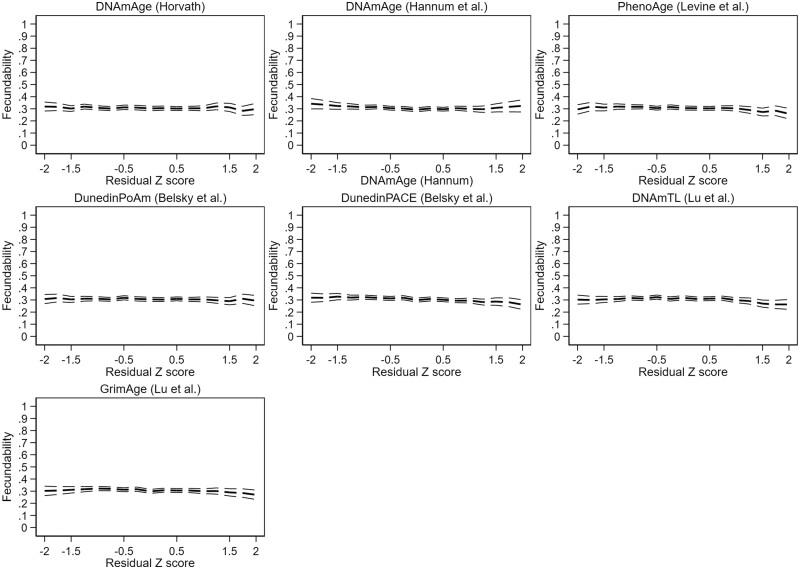
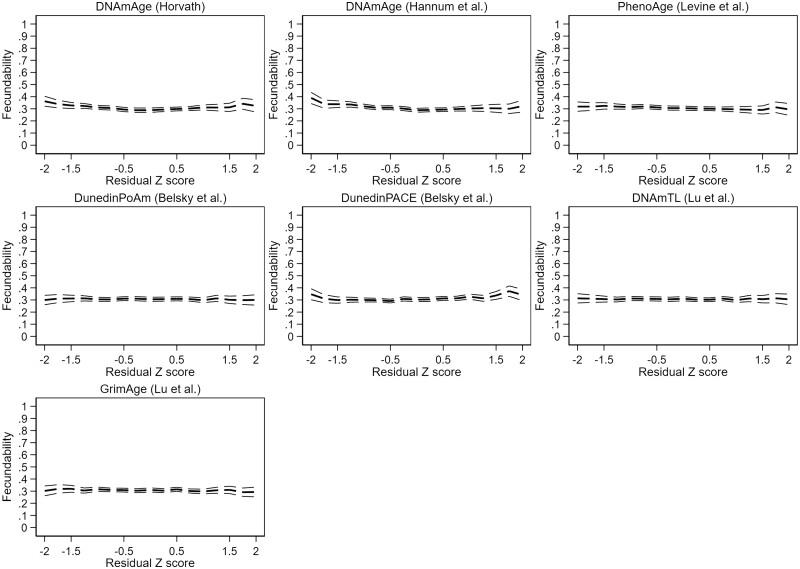
Although the DunedinPACE clock in males demonstrated slightly increasing fecundability with increasing EAA (adjusted FR 1.05 per one standard deviation increase in EAA, 95% CI 1.00-1.10), this was not robust when evaluated at an FDR of 5%. We found evidence of non-linearity between biological aging and fecundability in two models in females and three models in males, but non-linear associations were weak and conflicting.
LIMITATIONS, REASONS FOR CAUTION: As MoBa is a pregnancy cohort, our findings may not be generalizable to all couples attempting conception. Fecundability is a couple-level measure, and any impacts of epigenetic aging in each partner may be obscured by effects of the other partner.
WIDER IMPLICATIONS OF THE FINDINGS
Our findings contrast with those of prior studies, which have indicated an association between EAA and unfavorable clinical fertility outcomes in populations using fertility treatments, possibly due to less important effects of epigenetic aging among couples who conceive naturally. More research is needed on the association between blood-based EAA and clinical fertility parameters in both sexes.
STUDY FUNDING/COMPETING INTEREST(S): The study was supported by the Research Council of Norway through its Medical Student Research Program funding scheme (project number 271555/F20), its Centres of Excellence funding scheme (project number 262700), and a grant from the Women's Health Program (320656). Co-funding was also received from the Strategic Research Council (SRC), FLUX consortium, decision numbers 345130 and 345131; the National Institute on Aging (R01AG075208); grants to the Max Planck-University of Helsinki Center from the Max Planck Society (decision number 5714240218), Jane and Aatos Erkko Foundation, Faculty of Social Sciences at the University of Helsinki, and Cities of Helsinki, Vantaa, and Espoo; and the European Research Council; and the European Research Council (ERC Synergy, BIOSFER, grant number 101071773, and the Horizon 2020 research and innovation program, grant number 947684). The authors declare no conflicts of interest.
TRIAL REGISTRATION NUMBER
N/A.
研究问题
男性或女性的表观遗传年龄加速(EAA)或减速(EAD)与受孕能力之间是否存在关联?
总结答案
我们没有找到EAA或EAD与受孕能力之间存在关联的确凿证据。
已知信息
先前的研究表明,女性表观遗传衰老加速与不良的临床生育结果及体外受精的使用有关,并且精子细胞中的表观遗传衰老与不良的精子参数有关。缺乏对自然受孕个体的表观遗传衰老与受孕能力的研究。
研究设计、规模、持续时间:本研究基于挪威母亲、父亲和儿童队列研究(MoBa),这是一个基于人群的妊娠队列,在1999年至2008年期间招募怀孕夫妇。我们使用了1657对夫妇(女性和男性)的数据,这些夫妇计划自然受孕且有可用的血液样本。
参与者/材料、设置、方法:使用Illumina甲基化EPIC阵列测量孕妇及其伴侣在招募时(约妊娠18周)采集的血液样本中DNA的甲基化水平。为了获得EAA/EAD的测量值,我们对七个不同的既定表观遗传生物标志物(Horvath的DNAmAge、Hannum等人的DNAmAge、Levine等人的PhenoAge、Belsky等人的DunedinPoAm、Belsky等人的DunedinPACE、Lu等人的DNAmTL以及Lu等人的GrimAge)中的每一个与实际年龄进行线性回归。我们拟合比例概率回归模型,以获得表观遗传衰老每增加一个标准差时的受孕能力比率(FRs),并获得粗略估计值和调整后(针对体重指数、吸烟和教育水平)的估计值。结果在错误发现率(FDR)为5%时进行评估。我们在适当的情况下使用表观遗传年龄类别评估所有模型的非线性关联。
主要结果及机遇的作用
尽管男性的DunedinPACE时钟显示随着EAA增加受孕能力略有增加(EAA每增加一个标准差,调整后的FR为1.05,95%CI为1.00 - 1.10),但在FDR为5%时评估时,这并不稳健。我们在女性的两个模型和男性的三个模型中发现了生物衰老与受孕能力之间存在非线性的证据,但非线性关联较弱且相互矛盾。
局限性、谨慎的原因:由于MoBa是一个妊娠队列,我们的发现可能不适用于所有尝试受孕的夫妇。受孕能力是一个夫妇层面的指标,每个伴侣的表观遗传衰老的任何影响可能会被另一个伴侣的影响所掩盖。
研究结果的更广泛影响
我们的发现与先前的研究结果形成对比,先前的研究表明在接受生育治疗的人群中EAA与不良的临床生育结果之间存在关联,这可能是由于自然受孕夫妇中表观遗传衰老的影响不太重要。需要对基于血液的EAA与两性临床生育参数之间的关联进行更多研究。
研究资金/竞争利益:该研究由挪威研究理事会通过其医学生研究计划资助计划(项目编号271555/F20)、卓越中心资助计划(项目编号262700)以及妇女健康计划的一项赠款(320656)提供支持。还获得了战略研究理事会(SRC)、FLUX联盟(决策编号345130和345131);美国国立衰老研究所(R01AG075208);马克斯·普朗克学会授予马克斯·普朗克 - 赫尔辛基大学中心的赠款(决策编号5714240218)、简和阿托斯·埃尔科基金会、赫尔辛基大学社会科学学院以及赫尔辛基、万塔和埃斯波市;以及欧洲研究理事会;和欧洲研究理事会(ERC协同项目,BIOSFER,赠款编号101071773,以及地平线2020研究和创新计划,赠款编号947684)。作者声明无利益冲突。
试验注册号
无。



 Zotero 插件