
体重指数(BMI)与体重指数不一致的双胞胎中外周血单核细胞中加速的表观遗传衰老呈正相关。
BMI is positively associated with accelerated epigenetic aging in twin pairs discordant for body mass index.
机构信息
Institute for Molecular Medicine Finland (FIMM), HiLIFE, University of Helsinki, Helsinki, Finland.
Obesity Research Unit, Research Program for Clinical and Molecular Metabolism, Faculty of Medicine, University of Helsinki, Helsinki, Finland.
出版信息
J Intern Med. 2022 Oct;292(4):627-640. doi: 10.1111/joim.13528. Epub 2022 Jul 8.
BACKGROUND
Obesity is a heritable complex phenotype that can increase the risk of age-related outcomes. Biological age can be estimated from DNA methylation (DNAm) using various "epigenetic clocks." Previous work suggests individuals with elevated weight also display accelerated aging, but results vary by epigenetic clock and population. Here, we utilize the new epigenetic clock GrimAge, which closely correlates with mortality.
OBJECTIVES
We aimed to assess the cross-sectional association of body mass index (BMI) with age acceleration in twins to limit confounding by genetics and shared environment.
METHODS AND RESULTS
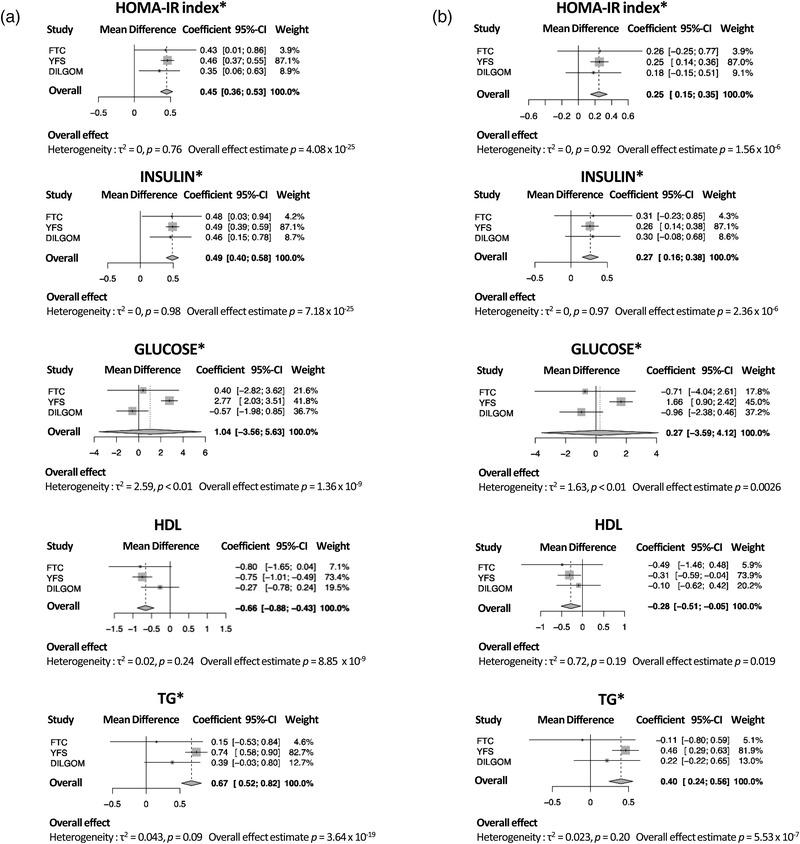
Participants were from the Finnish Twin Cohort (FTC; n = 1424), including monozygotic (MZ) and dizygotic (DZ) twin pairs, and DNAm was measured using the Illumina 450K array. Multivariate linear mixed effects models including MZ and DZ twins showed an accelerated epigenetic age of 1.02 months (p-value = 6.1 × 10 ) per one-unit BMI increase. Additionally, heavier twins in a BMI-discordant MZ twin pair (ΔBMI >3 kg/m ) had an epigenetic age 5.2 months older than their lighter cotwin (p-value = 0.0074). We also found a positive association between log (homeostatic model assessment of insulin resistance) and age acceleration, confirmed by a meta-analysis of the FTC and two other Finnish cohorts (overall effect = 0.45 years, p-value = 4.1 × 10 ) from adjusted models.
CONCLUSION
We identified significant associations of BMI and insulin resistance with age acceleration based on GrimAge, which were not due to genetic effects on BMI and aging. Overall, these results support a role of BMI in aging, potentially in part due to the effects of insulin resistance.
背景
肥胖是一种遗传性复杂表型,会增加与年龄相关结果的风险。可以使用各种“表观遗传钟”从 DNA 甲基化 (DNAm) 估算生物年龄。先前的研究表明,体重增加的个体也表现出加速衰老,但结果因表观遗传钟和人群而异。在这里,我们利用与死亡率密切相关的新表观遗传钟 GrimAge。
目的
我们旨在评估双胞胎中体重指数 (BMI) 与年龄加速的横断面关联,以限制遗传和共同环境对混杂因素的影响。
方法和结果
参与者来自芬兰双胞胎队列 (FTC;n=1424),包括同卵 (MZ) 和异卵 (DZ) 双胞胎,使用 Illumina 450K 阵列测量 DNAm。包括 MZ 和 DZ 双胞胎的多变量线性混合效应模型显示,BMI 每增加一个单位,表观年龄加速 1.02 个月(p 值=6.1×10)。此外,BMI 不一致的 MZ 双胞胎对中较重的双胞胎(ΔBMI >3 kg/m)的表观年龄比他们较轻的同胞大 5.2 个月(p 值=0.0074)。我们还发现 log(稳态模型评估的胰岛素抵抗)与年龄加速之间存在正相关,这在 FTC 和另外两个芬兰队列的荟萃分析中得到了证实(总体效应=0.45 年,p 值=4.1×10),来自调整后的模型。
结论
我们根据 GrimAge 确定了 BMI 和胰岛素抵抗与年龄加速的显著关联,这些关联不是由于 BMI 和衰老的遗传效应所致。总体而言,这些结果支持 BMI 在衰老中的作用,部分原因可能是胰岛素抵抗的影响。


 Zotero 插件