
人类对 COVID-19 疫苗接种反应的矛盾心理。
The Ambivalence of Post COVID-19 Vaccination Responses in Humans.
机构信息
Directorate of Distance Education, Madurai Kamaraj University, Madurai 625021, India.
Department of Genetics, Dr Arcot Lakshmanasamy Mudaliyar Post Graduate Institute of Basic Medical Sciences (Dr ALM PG IBMS), University of Madras, Taramani, Chennai 600005, India.
出版信息
Biomolecules. 2024 Oct 17;14(10):1320. doi: 10.3390/biom14101320.
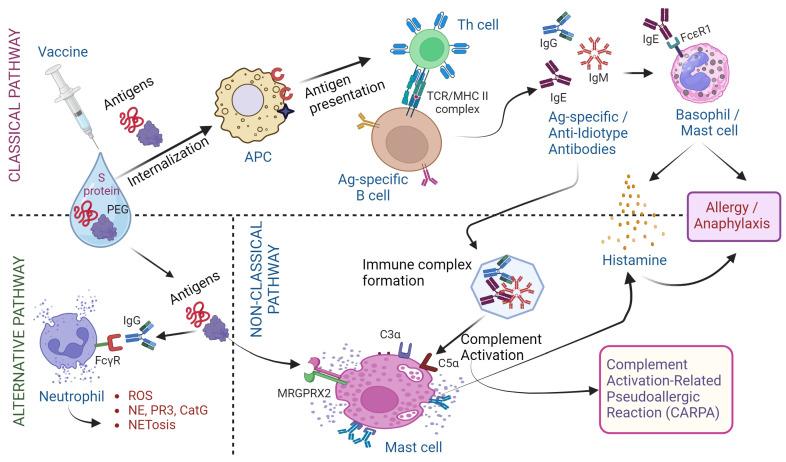
The Coronavirus disease 2019 (COVID-19) pandemic, caused by severe acute respiratory syndrome coronavirus-2 (SARS-CoV-2), has prompted a massive global vaccination campaign, leading to the rapid development and deployment of several vaccines. Various COVID-19 vaccines are under different phases of clinical trials and include the whole virus or its parts like DNA, mRNA, or protein subunits administered directly or through vectors. Beginning in 2020, a few mRNA (Pfizer-BioNTech BNT162b2 and Moderna mRNA-1273) and adenovirus-based (AstraZeneca ChAdOx1-S and the Janssen Ad26.COV2.S) vaccines were recommended by WHO for emergency use before the completion of the phase 3 and 4 trials. These vaccines were mostly administered in two or three doses at a defined frequency between the two doses. While these vaccines, mainly based on viral nucleic acids or protein conferred protection against the progression of SARS-CoV-2 infection into severe COVID-19, and prevented death due to the disease, their use has also been accompanied by a plethora of side effects. Common side effects include localized reactions such as pain at the injection site, as well as systemic reactions like fever, fatigue, and headache. These symptoms are generally mild to moderate and resolve within a few days. However, rare but more serious side effects have been reported, including allergic reactions such as anaphylaxis and, in some cases, myocarditis or pericarditis, particularly in younger males. Ongoing surveillance and research efforts continue to refine the understanding of these adverse effects, providing critical insights into the risk-benefit profile of COVID-19 vaccines. Nonetheless, the overall safety profile supports the continued use of these vaccines in combating the pandemic, with regulatory agencies and health organizations emphasizing the importance of vaccination in preventing COVID-19's severe outcomes. In this review, we describe different types of COVID-19 vaccines and summarize various adverse effects due to autoimmune and inflammatory response(s) manifesting predominantly as cardiac, hematological, neurological, and psychological dysfunctions. The incidence, clinical presentation, risk factors, diagnosis, and management of different adverse effects and possible mechanisms contributing to these effects are discussed. The review highlights the potential ambivalence of human response post-COVID-19 vaccination and necessitates the need to mitigate the adverse side effects.
新型冠状病毒病 2019(COVID-19)大流行是由严重急性呼吸系统综合征冠状病毒 2 型(SARS-CoV-2)引起的,促使了大规模的全球疫苗接种运动,导致了几种疫苗的快速开发和部署。各种 COVID-19 疫苗处于临床试验的不同阶段,包括直接或通过载体施用的整个病毒或其部分,如 DNA、mRNA 或蛋白质亚基。自 2020 年以来,在第三和第四阶段试验完成之前,世界卫生组织推荐了几种 mRNA(辉瑞-BioNTech BNT162b2 和 Moderna mRNA-1273)和腺病毒疫苗(阿斯利康 ChAdOx1-S 和强生 Ad26.COV2.S)用于紧急使用。这些疫苗主要在两剂之间的定义频率下以两剂或三剂的方式给药。虽然这些疫苗主要基于病毒核酸或蛋白质,可预防 SARS-CoV-2 感染进展为严重 COVID-19 并预防因该疾病导致的死亡,但它们的使用也伴随着大量的副作用。常见的副作用包括局部反应,如注射部位疼痛,以及全身反应,如发热、疲劳和头痛。这些症状通常为轻度至中度,在几天内消退。然而,也有报道罕见但更严重的副作用,包括过敏反应,如过敏反应,在某些情况下,特别是在年轻男性中,还会出现心肌炎或心包炎。正在进行的监测和研究工作继续完善对这些不良反应的理解,为 COVID-19 疫苗的风险效益概况提供了关键见解。尽管如此,总体安全性支持继续使用这些疫苗来对抗大流行,监管机构和卫生组织强调疫苗接种在预防 COVID-19 的严重后果方面的重要性。在这篇综述中,我们描述了不同类型的 COVID-19 疫苗,并总结了由于自身免疫和炎症反应(主要表现为心脏、血液、神经和心理功能障碍)引起的各种不良反应。讨论了不同不良反应的发生率、临床表现、危险因素、诊断和管理以及导致这些不良反应的可能机制。该综述强调了人类对 COVID-19 疫苗接种后的潜在矛盾反应,因此需要减轻不良反应。


 Zotero 插件