
高染色体不稳定性与激素受体阳性、人表皮生长因子受体 2 阴性乳腺癌患者 10 年复发风险升高相关:来自大规模、多地点、回顾性研究的临床证据。
High chromosomal instability is associated with higher 10-year risks of recurrence for hormone receptor-positive, human epidermal growth factor receptor 2-negative breast cancer patients: clinical evidence from a large-scale, multiple-site, retrospective study.
机构信息
Department of Breast Medical Oncology, Zhejiang Cancer Hospital, Hangzhou, PR China.
Postgraduate Training Base Alliance of Wenzhou Medical University, Zhejiang Cancer Hospital, Hangzhou, PR China.
出版信息
J Pathol Clin Res. 2024 Nov;10(6):e70011. doi: 10.1002/2056-4538.70011.
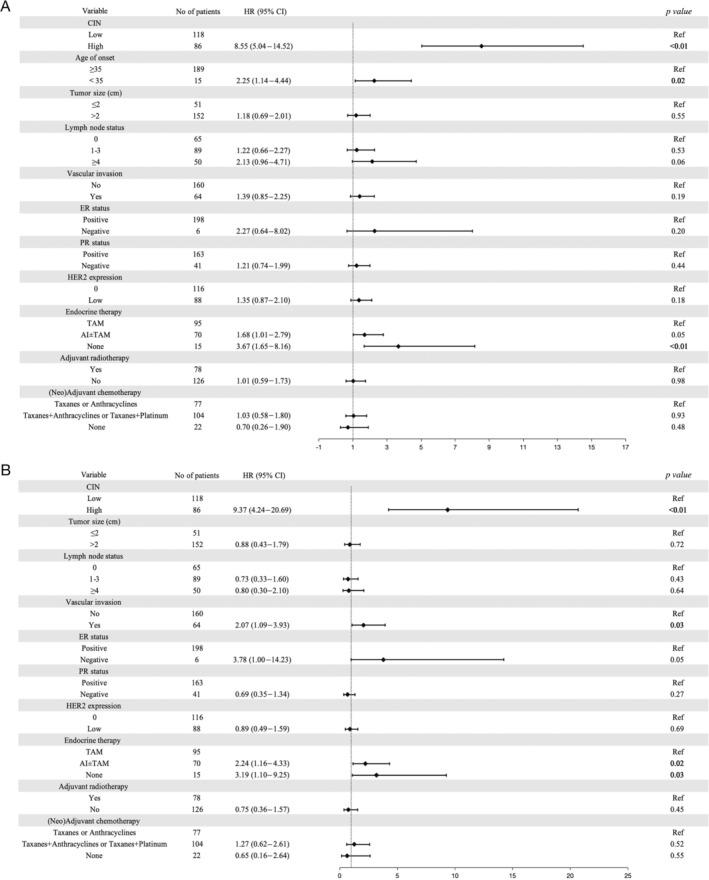
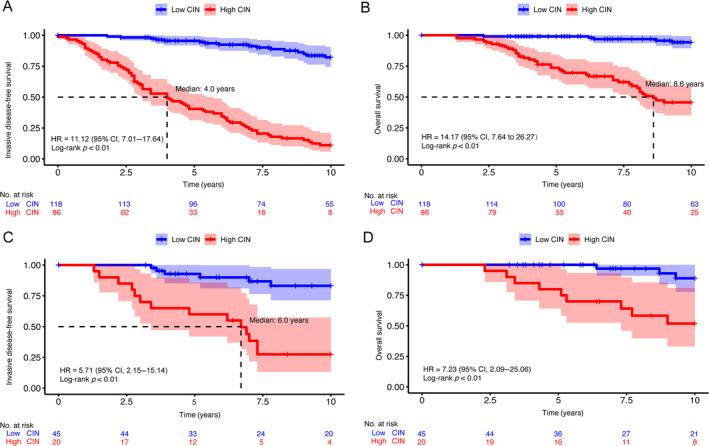
Long-term survival varies among hormone receptor-positive (HR+) and human epidermal growth factor receptor 2-negative (HER2-) breast cancer patients and is seriously impaired by metastasis. Chromosomal instability (CIN) was one of the key drivers of breast cancer metastasis. Here we evaluate CIN and 10-year invasive disease-free survival (iDFS) and overall survival (OS) in HR+/HER2-- breast cancer. In this large-scale, multiple-site, retrospective study, 354 HR+/HER2- breast cancer patients were recruited. Of these, 204 patients were used for internal training, 70 for external validation, and 80 for cross-validation. All medical records were carefully reviewed to obtain the disease recurrence information. Formalin-fixed paraffin-embedded tissue samples were collected, followed by low-pass whole-genome sequencing with a median genome coverage of 1.86X using minimal 1 ng DNA input. CIN was then assessed using a customized bioinformatics workflow. Three or more instances of CIN per sample was defined as high CIN and the frequency was 42.2% (86/204) in the internal cohort. High CIN correlated significantly with increased lymph node metastasis, vascular invasion, progesterone receptor negative status, HER2 low, worse pathological type, and performed as an independent prognostic factor for HR+/- breast cancer. Patients with high CIN had shorter iDFS and OS than those with low CIN [10-year iDFS 11.1% versus 82.2%, hazard ratio (HR) = 11.12, p < 0.01; 10-year OS 45.7% versus 94.3%, HR = 14.17, p < 0.01]. These findings were validated in two external cohorts with 70 breast cancer patients. Moreover, high CIN could predict the prognosis more accurately than Adjuvant! Online score (10-year iDFS 11.1% versus 48.6%, HR = 2.71, p < 0.01). Cross-validation analysis found that high consistency (83.8%) was observed between CIN and MammaPrint score, while only 45% between CIN and Adjuvant! Online score. In conclusion, high CIN is an independent prognostic indicator for HR+/HER2- breast cancer with shorter iDFS and OS and holds promise for predicting recurrence and metastasis.
长期生存因转移而严重受损,在激素受体阳性(HR+)和人表皮生长因子受体 2 阴性(HER2-)乳腺癌患者中存在差异。染色体不稳定性(CIN)是乳腺癌转移的关键驱动因素之一。本研究评估了 HR+/HER2-乳腺癌的 CIN 以及 10 年无侵袭性疾病生存(iDFS)和总生存(OS)。在这项大规模、多地点、回顾性研究中,招募了 354 名 HR+/HER2-乳腺癌患者。其中 204 名患者用于内部培训,70 名用于外部验证,80 名用于交叉验证。仔细审查了所有病历以获取疾病复发信息。收集福尔马林固定石蜡包埋组织样本,然后使用最小 1ng DNA 输入,使用低通全基因组测序进行中位基因组覆盖度为 1.86X 的测序。然后使用定制的生物信息学工作流程评估 CIN。每个样本中出现 3 次或更多次 CIN 定义为高 CIN,内部队列中为 42.2%(86/204)。高 CIN 与淋巴结转移、血管浸润、孕激素受体阴性状态、HER2 低表达、较差的病理类型显著相关,并且是 HR+/-乳腺癌的独立预后因素。高 CIN 患者的 iDFS 和 OS 短于低 CIN 患者[10 年 iDFS 为 11.1%比 82.2%,风险比(HR)=11.12,p<0.01;10 年 OS 为 45.7%比 94.3%,HR=14.17,p<0.01]。这些发现通过对 70 名乳腺癌患者的两个外部队列进行验证。此外,高 CIN 可以比 Adjuvant! Online 评分更准确地预测预后(10 年 iDFS 为 11.1%比 48.6%,HR=2.71,p<0.01)。交叉验证分析发现,CIN 与 MammaPrint 评分之间存在高度一致性(83.8%),而 CIN 与 Adjuvant! Online 评分之间仅有 45%的一致性。总之,高 CIN 是 HR+/HER2-乳腺癌的独立预后指标,其 iDFS 和 OS 较短,有望预测复发和转移。

 Zotero 插件