
肿瘤细胞迁移和转移中的巨噬细胞。
Macrophages in tumor cell migration and metastasis.
机构信息
Integrated Imaging Program for Cancer Research, Albert Einstein College of Medicine/Montefiore Medical Center, Bronx, NY, United States.
Department of Pathology, Albert Einstein College of Medicine/Montefiore Medical Center, Bronx, NY, United States.
出版信息
Front Immunol. 2024 Nov 1;15:1494462. doi: 10.3389/fimmu.2024.1494462. eCollection 2024.
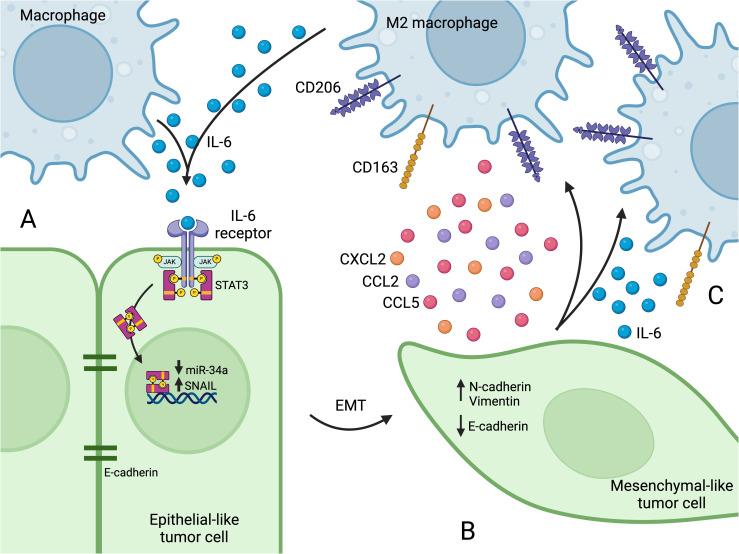
Tumor-associated macrophages (TAMs) are a phenotypically diverse, highly plastic population of cells in the tumor microenvironment (TME) that have long been known to promote cancer progression. In this review, we summarize TAM ontogeny and polarization, and then explore how TAMs enhance tumor cell migration through the TME, thus facilitating metastasis. We also discuss how chemotherapy and host factors including diet, obesity, and race, impact TAM phenotype and cancer progression. In brief, TAMs induce epithelial-mesenchymal transition (EMT) in tumor cells, giving them a migratory phenotype. They promote extracellular matrix (ECM) remodeling, allowing tumor cells to migrate more easily. TAMs also provide chemotactic signals that promote tumor cell directional migration towards blood vessels, and then participate in the signaling cascade at the blood vessel that allows tumor cells to intravasate and disseminate throughout the body. Furthermore, while chemotherapy can repolarize TAMs to induce an anti-tumor response, these cytotoxic drugs can also lead to macrophage-mediated tumor relapse and metastasis. Patient response to chemotherapy may be dependent on patient-specific factors such as diet, obesity, and race, as these factors have been shown to alter macrophage phenotype and affect cancer-related outcomes. More research on how chemotherapy and patient-specific factors impact TAMs and cancer progression is needed to refine treatment strategies for cancer patients.
肿瘤相关巨噬细胞(TAMs)是肿瘤微环境(TME)中表型多样、高度可塑性的细胞群,长期以来一直被认为促进癌症进展。在这篇综述中,我们总结了 TAM 的发生和极化,然后探讨了 TAMs 如何通过 TME 增强肿瘤细胞迁移,从而促进转移。我们还讨论了化疗以及包括饮食、肥胖和种族在内的宿主因素如何影响 TAM 表型和癌症进展。简而言之,TAMs 诱导肿瘤细胞发生上皮-间充质转化(EMT),赋予其迁移表型。它们促进细胞外基质(ECM)重塑,使肿瘤细胞更容易迁移。TAMs 还提供趋化信号,促进肿瘤细胞向血管的定向迁移,然后参与血管中的信号级联反应,使肿瘤细胞能够进入血管并在全身扩散。此外,虽然化疗可以使 TAMs 重新极化以诱导抗肿瘤反应,但这些细胞毒性药物也会导致巨噬细胞介导的肿瘤复发和转移。患者对化疗的反应可能取决于患者的具体因素,如饮食、肥胖和种族,因为这些因素已被证明会改变巨噬细胞的表型并影响癌症相关结局。需要更多关于化疗和患者特定因素如何影响 TAMs 和癌症进展的研究,以完善癌症患者的治疗策略。


 Zotero 插件