
全血细胞毒性的发展:预测B细胞急性淋巴细胞白血病中CAR T细胞治疗后的血液毒性
Development of ALL-Hematotox: predicting post-CAR T-cell hematotoxicity in B-cell acute lymphoblastic leukemia.
作者信息
Nair Monica S, Silbert Sara K, Rejeski Kai, Wilson Karilynn A, Lamble Adam J, Valtis Yannis, Yates Bonnie, Morales Arana Alexa, Shouval Roni, Curran Kevin, Gardner Rebecca A, Shalabi Haneen, Annesley Colleen, Park Jae H, Subklewe Marion, Shah Nirali N
机构信息
Pediatric Oncology Branch, Center for Cancer Research, National Cancer Institute, National Institutes of Health, Bethesda, MD.
Cleveland Clinic Lerner College of Medicine, Cleveland Clinic, Cleveland, OH.
出版信息
Blood. 2025 Mar 13;145(11):1136-1148. doi: 10.1182/blood.2024025910.
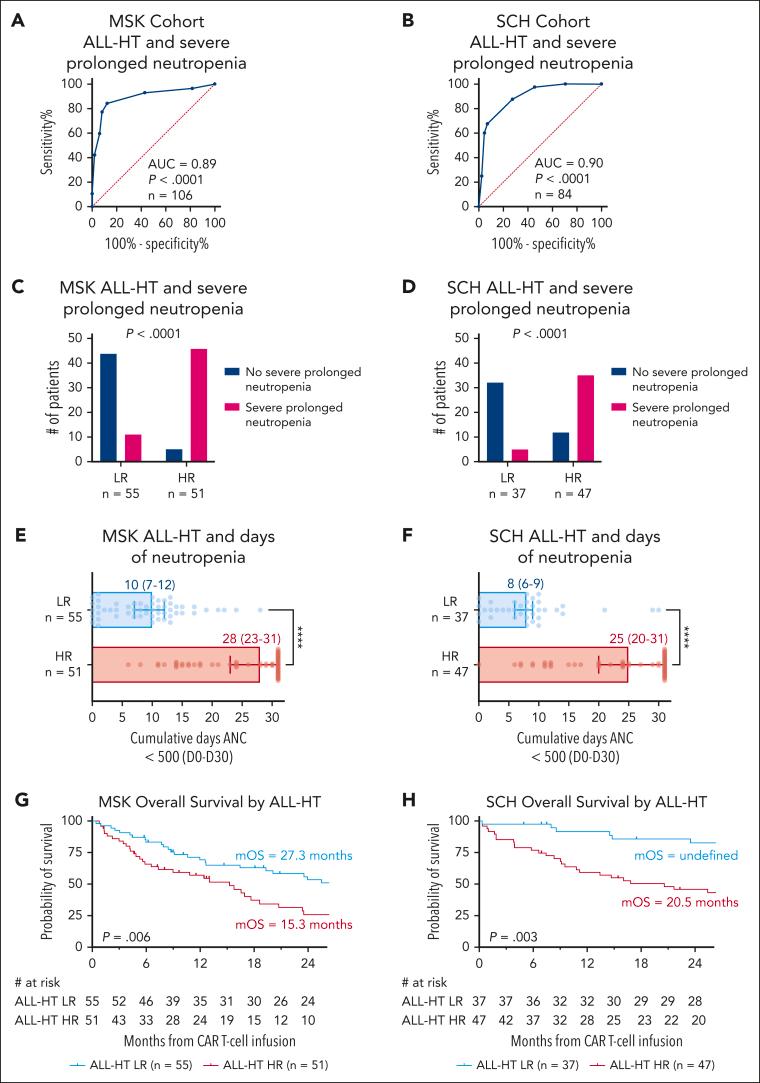
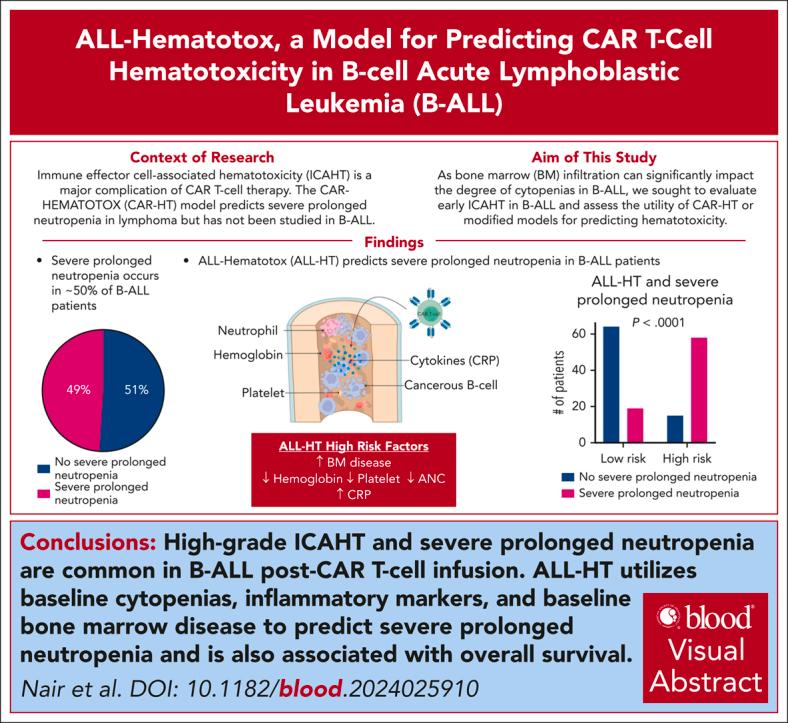
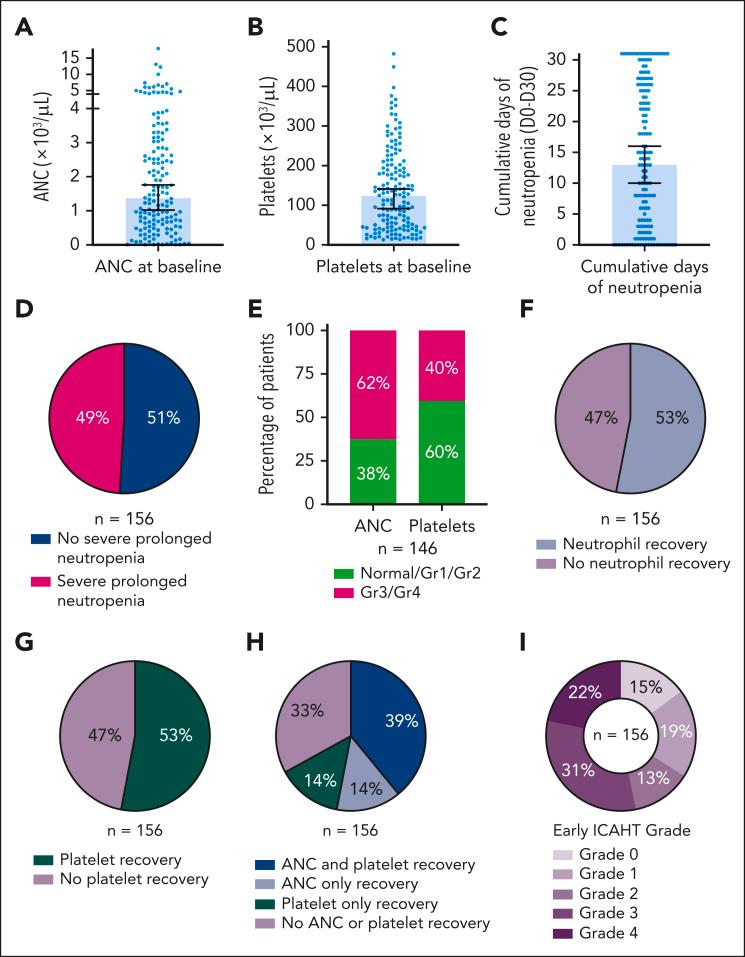
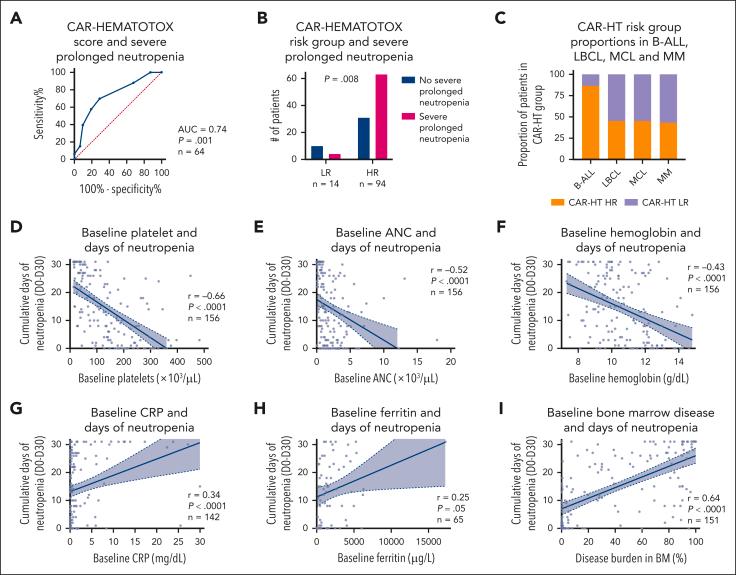
Immune effector cell-associated hematotoxicity (ICAHT) is a major B-cell targeted chimeric antigen receptor (CAR) T-cell related toxicity. Although ICAHT incidence and severity is documented in large B-cell lymphoma (LBCL), mantle cell lymphoma (MCL), and multiple myeloma (MM), ICAHT has not been described in B-cell acute lymphoblastic leukemia (B-ALL). Similarly, the CAR-HEMATOTOX (CAR-HT) model, designed to predict severe prolonged neutropenia (≥14 days of absolute neutrophil count [ANC] <500/μL), has been validated in LBCL, MCL, and MM, but not in B-ALL. As B-ALL bone marrow (BM) infiltration can impact cytopenias, we sought to describe ICAHT and assess CAR-HT for predicting hematotoxicity in B-ALL. In a cohort of 156 children and young adults with relapsed/refractory B-ALL, the median duration of severe neutropenia (ANC <500/μL) was 13 days (95% confidence interval, 10-16 days), with 83 (53%) experiencing grade ≥3 ICAHT. Applying CAR-HT, nearly 90% were classified as high risk, demonstrating limited discriminative power and prompting further development. Using the association identified between BM disease burden and postinfusion neutropenia (r = 0.64, P < .0001), we developed the ALL-Hematotox (ALL-HT) score, which substitutes BM disease burden for ferritin in CAR-HT. The ALL-HT score associated with severe prolonged neutropenia (area under the curve = 0.84, P < .0001), and appropriately discriminated high-risk patients (47%) who had more cumulative days of neutropenia (26 vs 4 days; P < .0001), fewer rates of complete response (88% vs 98%; P = .03), and shorter median overall survival (9.8 vs 24 months; log-rank P = .0002). ALL-HT was also validated in 2 independent cohorts. The ALL-HT score refines a widely accepted predictive model of postinfusion hematotoxicity, which is applicable in B-ALL.
免疫效应细胞相关血液毒性(ICAHT)是一种主要的靶向B细胞的嵌合抗原受体(CAR)T细胞相关毒性。尽管在大B细胞淋巴瘤(LBCL)、套细胞淋巴瘤(MCL)和多发性骨髓瘤(MM)中记录了ICAHT的发生率和严重程度,但在B细胞急性淋巴细胞白血病(B-ALL)中尚未描述ICAHT。同样,旨在预测严重长期中性粒细胞减少(绝对中性粒细胞计数[ANC]<500/μL持续≥14天)的CAR-HEMATOTOX(CAR-HT)模型已在LBCL、MCL和MM中得到验证,但在B-ALL中未得到验证。由于B-ALL骨髓(BM)浸润可影响血细胞减少,我们试图描述ICAHT并评估CAR-HT在预测B-ALL血液毒性方面的作用。在156例复发/难治性B-ALL儿童和年轻成人队列中,严重中性粒细胞减少(ANC<500/μL)的中位持续时间为13天(95%置信区间,10-16天),83例(53%)发生≥3级ICAHT。应用CAR-HT,近90%被分类为高风险,显示出有限的判别能力并促使进一步改进。利用确定的BM疾病负担与输注后中性粒细胞减少之间的关联(r = 0.64,P <.0001),我们开发了ALL-Hematotox(ALL-HT)评分,该评分在CAR-HT中用BM疾病负担替代铁蛋白。ALL-HT评分与严重长期中性粒细胞减少相关(曲线下面积 = 0.84,P <.0001),并能适当区分高风险患者(47%),这些患者有更多的中性粒细胞减少累积天数(26天对4天;P <.0001)、更低的完全缓解率(88%对98%;P = 0.03)和更短的中位总生存期(9.8个月对24个月;对数秩P = 0.0002)。ALL-HT也在2个独立队列中得到验证。ALL-HT评分改进了一个广泛接受的输注后血液毒性预测模型,该模型适用于B-ALL。


 Zotero 插件