
在发育中的大脑中标记Notch信号通路。
Barcoding Notch signaling in the developing brain.
作者信息
Siniscalco Abigail M, Perera Roshan Priyarangana, Greenslade Jessie E, Veeravenkatasubramanian Hemagowri, Masters Aiden, Doll Hannah M, Raj Bushra
机构信息
Department of Cell and Developmental Biology, University of Pennsylvania Perelman School of Medicine, Philadelphia, PA 19104, USA.
Institute for Regenerative Medicine, University of Pennsylvania Perelman School of Medicine, Philadelphia, PA 19104, USA.
出版信息
Development. 2024 Dec 15;151(24). doi: 10.1242/dev.203102. Epub 2024 Dec 20.
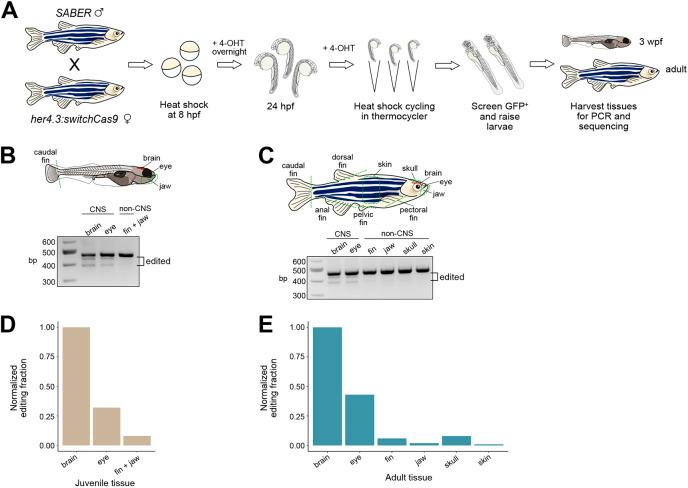
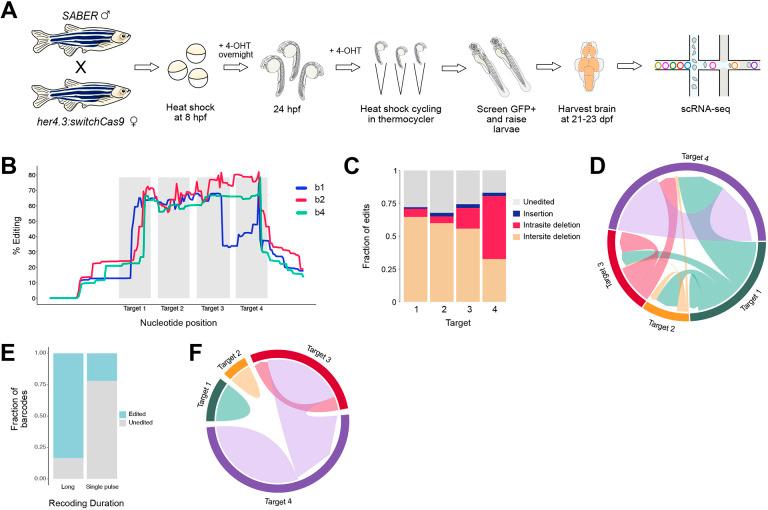
Developmental signaling inputs are fundamental for shaping cell fates and behavior. However, traditional fluorescent-based signaling reporters have limitations in scalability and molecular resolution of cell types. We present SABER-seq, a CRISPR-Cas molecular recorder that stores transient developmental signaling cues as permanent mutations in cellular genomes for deconstruction at later stages via single-cell transcriptomics. We applied SABER-seq to record Notch signaling in developing zebrafish brains. SABER-seq has two components: a signaling sensor and a barcode recorder. The sensor activates Cas9 in a Notch-dependent manner with inducible control, while the recorder obtains mutations in ancestral cells where Notch is active. We combine SABER-seq with an expanded juvenile brain atlas to identify cell types derived from Notch-active founders. Our data reveal rare examples where differential Notch activities in ancestral progenitors are detected in terminally differentiated neuronal subtypes. SABER-seq is a novel platform for rapid, scalable and high-resolution mapping of signaling activity during development.
发育信号输入对于塑造细胞命运和行为至关重要。然而,传统的基于荧光的信号报告系统在细胞类型的可扩展性和分子分辨率方面存在局限性。我们提出了SABER-seq,一种CRISPR-Cas分子记录器,它将短暂的发育信号线索存储为细胞基因组中的永久突变,以便在后期通过单细胞转录组学进行解构。我们应用SABER-seq记录斑马鱼发育大脑中的Notch信号。SABER-seq有两个组件:一个信号传感器和一个条形码记录器。传感器通过诱导控制以Notch依赖的方式激活Cas9,而记录器在Notch活跃的祖细胞中获得突变。我们将SABER-seq与扩展的幼体脑图谱相结合,以识别源自Notch活跃祖细胞的细胞类型。我们的数据揭示了在终末分化的神经元亚型中检测到祖细胞中Notch活性差异的罕见例子。SABER-seq是一个用于在发育过程中快速、可扩展和高分辨率绘制信号活性的新型平台。



 Zotero 插件