
益生菌通过调节肠-肝轴的糖脂代谢来提高生长性能和营养价值。
Probiotics Enhance Growth Performance and Nutritional Value by Regulating Glucolipid Metabolism via the Gut-Liver Axis.
机构信息
Wuxi Fisheries College, Nanjing Agricultural University, Wuxi 214081, China.
Key Laboratory of Freshwater Fisheries and Germplasm Resources Utilization, Ministry of Agriculture, Freshwater Fisheries Research Center, Chinese Academy of Fishery Sciences, Wuxi 214081, China.
出版信息
Int J Mol Sci. 2024 Nov 13;25(22):12196. doi: 10.3390/ijms252212196.
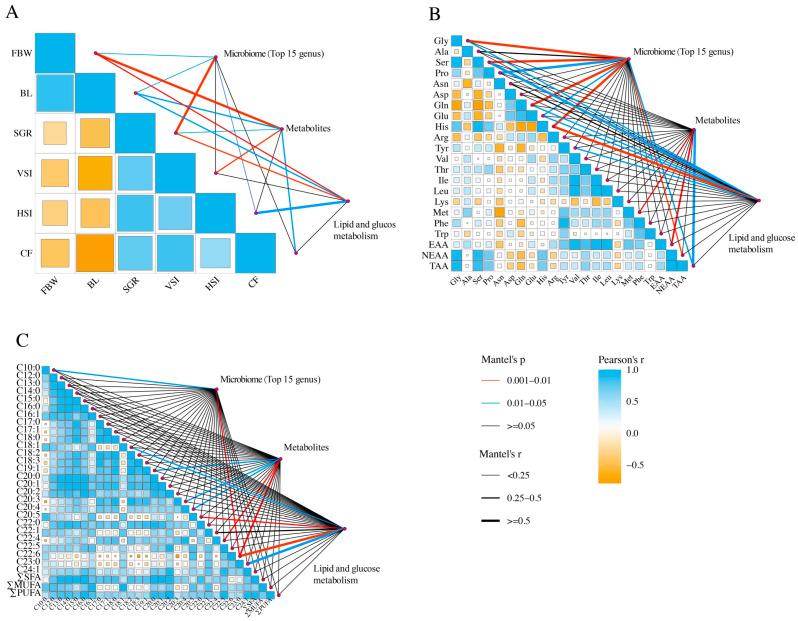
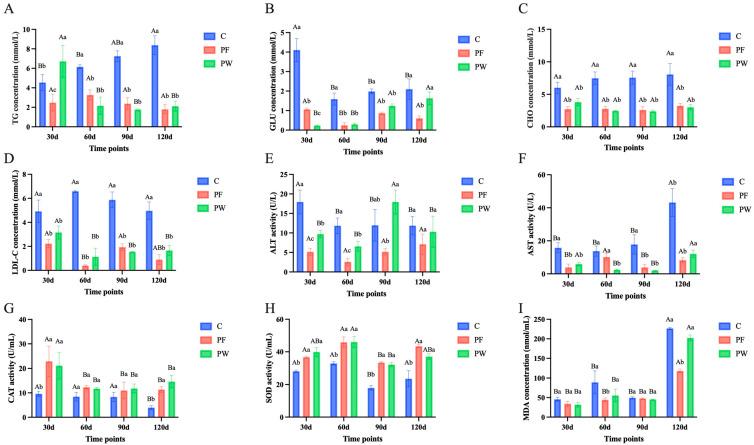
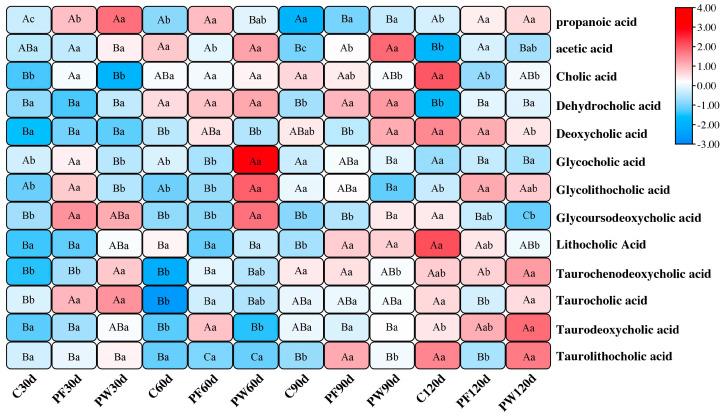
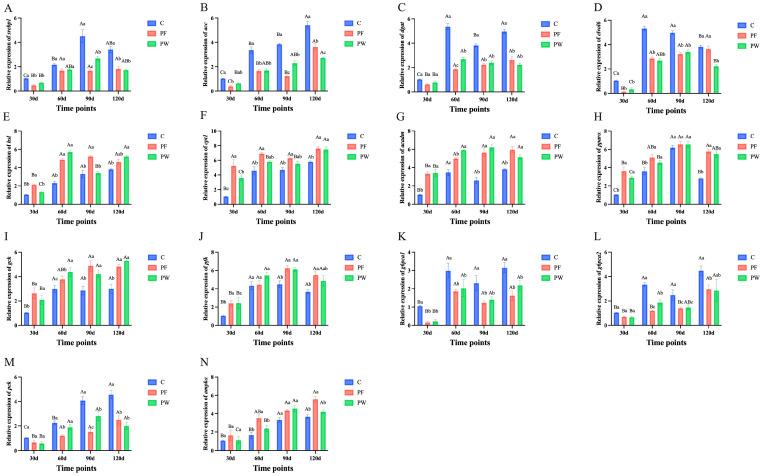
Large-scale intensive feeding triggered reduced growth performance and nutritional value. Exogenous probiotics can promote the growth performance and nutritional value of fish through improving the intestinal microbiota. However, detailed research on the correlation between the intestinal microbiota, growth performance, and nutritional value remains to be elucidated. Therefore, we performed metagenomic and metabolomic analysis to investigate the effects of probiotic addition to basal diet (1.0 × 10 CFU/g) (PF) and water (1.0 × 10 CFU/g) (PW) on the growth performance, muscle nutritional value, intestinal microbiota and their metabolites, and glucolipid metabolism in . The results showed that FBW, BL, and SGR were enhanced in PF and PW groups. The concentrations of EAAs, TAAs, SFAs, MUFAs, and PUFAs were increased in PF and PW groups. Metagenomic and metabolic analyses revealed that bacterial community structure and metabolism were changed in the PF and PW groups. Moreover, adding probiotics to diet and water increased SCFAs and bile acids in the intestine. The gene expression associated with lipolysis and oxidation (, , , and ) and glycolysis ( and ) was upregulated, while the gene expression associated with lipid synthesis (, , , and ) and gluconeogenesis (, , and ) was downregulated in the liver. Correlation analysis displayed that hepatic glucolipid metabolism was regulated through the microbiota-gut-liver axis. Mantel test analysis showed that growth performance and muscle nutritional value were improved by the gut-liver axis. Our findings offered novel insights into the mechanisms that underlie the enhancement of growth performance and nutritional value in and other fish by adding probiotics.
大规模集约化养殖会降低生长性能和营养价值。外源性益生菌可通过改善肠道微生物群来促进鱼类的生长性能和营养价值。然而,肠道微生物群、生长性能和营养价值之间的相关性的详细研究仍有待阐明。因此,我们进行了宏基因组和代谢组学分析,以研究在基础日粮(1.0×10 CFU/g)(PF)和水中添加益生菌(1.0×10 CFU/g)(PW)对生长性能、肌肉营养价值、肠道微生物群及其代谢物和糖脂代谢的影响。结果表明,PF 和 PW 组的 FBW、BL 和 SGR 均提高。PF 和 PW 组的必需氨基酸(EAA)、总氨基酸(TAA)、饱和脂肪酸(SFA)、单不饱和脂肪酸(MUFA)和多不饱和脂肪酸(PUFA)浓度增加。宏基因组和代谢组学分析显示,PF 和 PW 组的细菌群落结构和代谢发生了变化。此外,在日粮和水中添加益生菌会增加肠道中的短链脂肪酸和胆汁酸。与脂肪分解和氧化(、、、和)和糖酵解(和)相关的基因表达上调,而与脂质合成(、、、和)和糖异生(、、和)相关的基因表达下调在肝脏中。相关性分析显示,肝糖脂代谢通过肠道-肝脏轴进行调节。Mantel 检验分析表明,通过肠道-肝脏轴改善了生长性能和肌肉营养价值。我们的研究结果为通过添加益生菌提高生长性能和营养价值提供了新的见解,并为其他鱼类提供了新的见解。


 Zotero 插件