
人小肠上皮细胞中RNA和蛋白质的细胞内极化
Intracellular polarization of RNAs and proteins in the human small intestinal epithelium.
作者信息
Novoselsky Roy, Harnik Yotam, Yakubovsky Oran, Katina Corine, Levin Yishai, Bahar Halpern Keren, Pencovich Niv, Nachmany Ido, Itzkovitz Shalev
机构信息
Department of Molecular Cell Biology, Weizmann Institute of Science, Rehovot, Israel.
Department of General Surgery and Transplantation, Sheba Medical Center, Ramat Gan, Israel.
出版信息
PLoS Biol. 2024 Dec 2;22(12):e3002942. doi: 10.1371/journal.pbio.3002942. eCollection 2024 Dec.
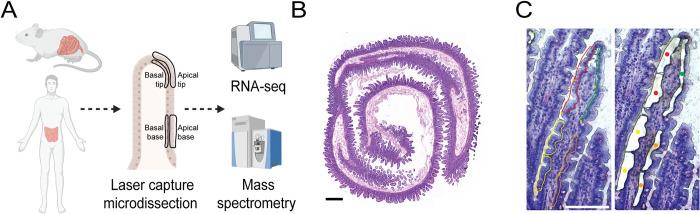
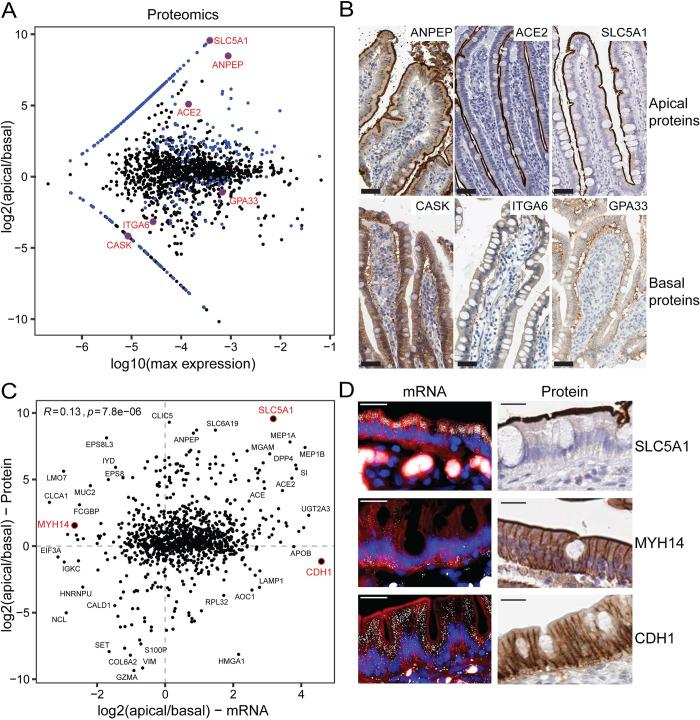
The intestinal epithelium is a polarized monolayer of cells, with an apical side facing the lumen and a basal side facing the blood stream. In mice, both proteins and mRNAs have been shown to exhibit global basal-apical polarization; however, polarization in the human intestine has not been systematically explored. Here, we employed laser-capture microdissection to isolate apical and basal epithelial segments from intestinal tissues of 8 individuals and performed RNA sequencing and mass-spectrometry proteomics. We find a substantial polarization of mRNA molecules that largely overlaps polarization patterns observed in mice. This mRNA polarization remains consistent across different zones of the intestinal villi and is generally correlated with the polarization of proteins. Our protein analysis exposes streamlined intracellular nutrient transport and processing and reveals that mitochondria and ribosomes are less polarized in humans compared to mice. Our study provides a resource for understanding human intestinal epithelial biology.
肠上皮是一层极化的单层细胞,其顶端面向肠腔,基底侧面向血流。在小鼠中,蛋白质和mRNA均已显示出整体的基底-顶端极化;然而,人类肠道中的极化尚未得到系统研究。在这里,我们采用激光捕获显微切割技术从8名个体的肠道组织中分离出顶端和基底上皮片段,并进行了RNA测序和质谱蛋白质组学分析。我们发现mRNA分子存在显著的极化现象,这在很大程度上与在小鼠中观察到的极化模式重叠。这种mRNA极化在肠绒毛的不同区域保持一致,并且通常与蛋白质的极化相关。我们的蛋白质分析揭示了简化的细胞内营养物质运输和加工过程,并表明与小鼠相比,人类的线粒体和核糖体极化程度较低。我们的研究为理解人类肠上皮生物学提供了资源。


 Zotero 插件